2013 AP Physics C物理C—Mechanics力學真題系列之簡答題免費下載

歷年AP Physcis物理學系列
真題與答案下載

翰林國際教育全網首發
力爭超快速發布最全資料
助你在升學路上一帆風順
為你的未來保駕護航
2013 AP Physics C Mechanics Free-Response Questions Free Download
2013 AP 物理C力學簡答題部分免費下載
此套題僅 p II含有簡答題,
共計時45分鐘,共3題
占總分50%
每道大題可能含有不同數量的小題
可以使用計算器
部分真題預覽:
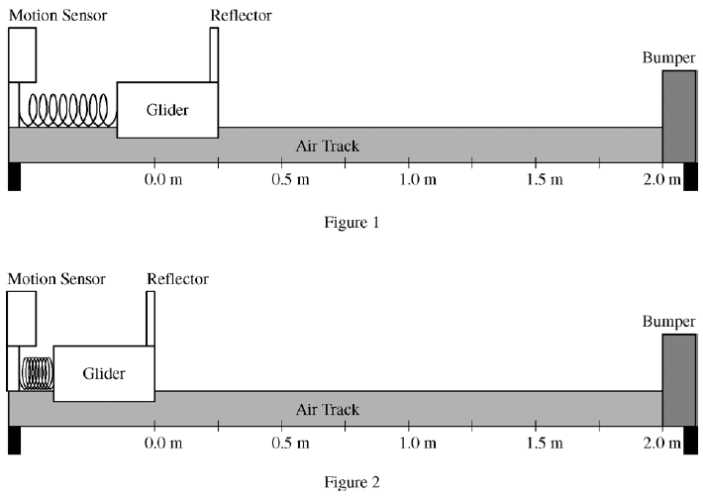 1)A student places a 0.40 kg glider on an air track of negligible friction and holds it so that it touches an uncompressed ideal spring, as shown in Figure 1 above. The student then pushes the glider back to compress the spring by 0.25 m, as shown in Figure 2. At time t = 0, the student releases the glider, and a motion sensor begins recording the velocity of the reflector at the front of the glider as a function of time. The data points are shown in the table below. At time t = 0.79 s, the glider loses contact with the spring.
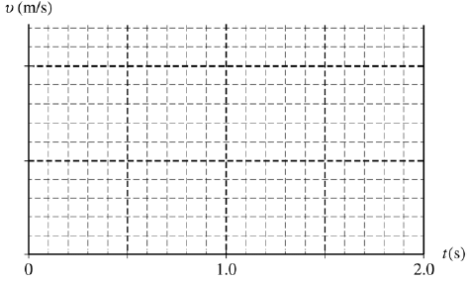
- On the axes below, plot the data points for velocity u as a function of time t for the glider, and draw a smooth curve that best fits the data. Be sure to label an appropriate scale on the vertical axis.
- The student wishes to use the data to plot position x as a function of time t for the glider.
- Describe a method the student could use to do this.
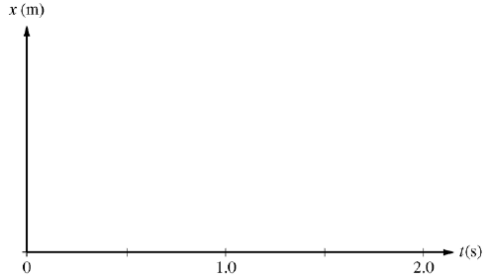
- On the axes below, sketch the position x as a function of time t for the glider. Explicitly label any intercepts, asymptotes, maxima, or minima with numerical values or algebraic expressions, as appropriate.
- Calculate the time at which the glider makes contact with the bumper at the far right.
- Calculate the force constant of the spring.
- The experiment is run again, but this time the glider is attached to the spring rather than simply being pushed against it.
- Determine the amplitude of the resulting periodic motion.
- Calculate the period of oscillation of the resulting periodic motion.
以上就是關于【2013 AP Physics C物理C—Mechanics力學真題系列之簡答題免費下載】的解答,如需了解學校/賽事/課程動態,可至翰林教育官網獲取更多信息。
往期文章閱讀推薦:
新賽季AP如何“彎道超車”?拒絕無效內卷!AP科學選課指南來了!
CB官宣重磅新規!2027年AP考試開考時間新規解讀+大考日程發布!大陸報名搶位開啟行動,翰林3大考點幫你提前鎖位!


翰林AMC8視頻課重磅上線!

國際競賽真題資源免費領取






