2021HIMCM全球高中生數模賽A題

2021HiMCM全球高中生數模賽A題全文如下
Problem A:Storing the Sun
Your team is helping to plan the use of solar power to provide electricity to a 1600 square-foot home being built in a remote area. You need to plan for enough energy to support the energy requirements of the home at night and on a cloudy day. You have done some research and found that you can either pull energy from the grid (i.e. a power company) when your solar panels aren’t producing enough, or use an energy storage system. As the house is in a remote area, the cost of connecting to the grid is very expensive, so you decide to go off-the-grid and invest in
energy storage.
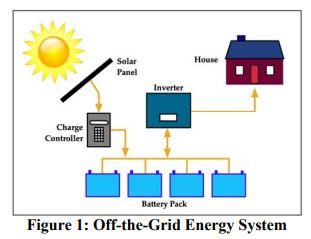
Background. An energy storage system allows you to capture electricity, store it as another form of energy (battery, thermal, mechanical) and then have it available to use when needed. The purpose of these storage units is to store energy produced during sunny daylight hours for use when the solar panels do not produce enough energy for the demand (night or cloud covered), or for storage and transfer of excess energy. Of the solar-powered homes that use an energy storage system, most use some sort of battery. Some homeowners have only one large battery, while others may use a “bank of batteries” (two or more batteries connected). Energy storage can be expensive and so homeowners should choose a system that is appropriate for their situation. Figure 1 shows the general concept of off-the-grid energy.
In choosing an energy storage system there are many criteria to consider. Here are a few of the
most common decision criteria, as well as which battery specifications matter most for each
criterion.
? To power more of your home at once, you will want a battery with a high continuous
power rating.
? To power a more energy-intensive appliance (requiring more power in short bursts), your
battery should have a high instantaneous power rating.
? To run your home for a longer amount of time, look for a battery with a higher usable
capacity.
? If you want to get the most out of every kilowatt-hour of electricity you put into your
battery, look for a battery with a higher round-trip efficiency.
Additional considerations apply for the type of battery.
? Lead-acid (flooded or sealed) and lithium-ion batteries are ideal for a full-time, off-grid
supply of different levels of use.
? Lead-acid batteries have been around for a long time and are known for their low prices
and reliability.
? Lithium-ion batteries are more expensive, but require no maintenance. Other options are
nickel cadmium and flow batteries.
? Look for lithium iron phosphate (LFP) batteries (a type of lithium-ion battery) to get the
longest lifetime that you can cycle the most times.
? For the absolute highest safety rating possible (although they are all safe), look to LFP
batteries.
Requirements
1. Consider the 1600 square-foot off-the-grid home you are planning.
a. Analyze your solar-power storage requirements by first making a list of questions to determine your energy needs. Discuss the range of possible answers to your questions. To get you started, here are a few questions:
? How many people will be using energy in this home?
? What items in the home will need energy and how much energy will they need?
? When will people in the home use energy?
b. Use your analysis from part 1.a., along with the criteria and considerations from the problem background and any other factors you consider important, to develop a mathematical model or algorithm for choosing the “best” battery storage system for your offthe-grid home.
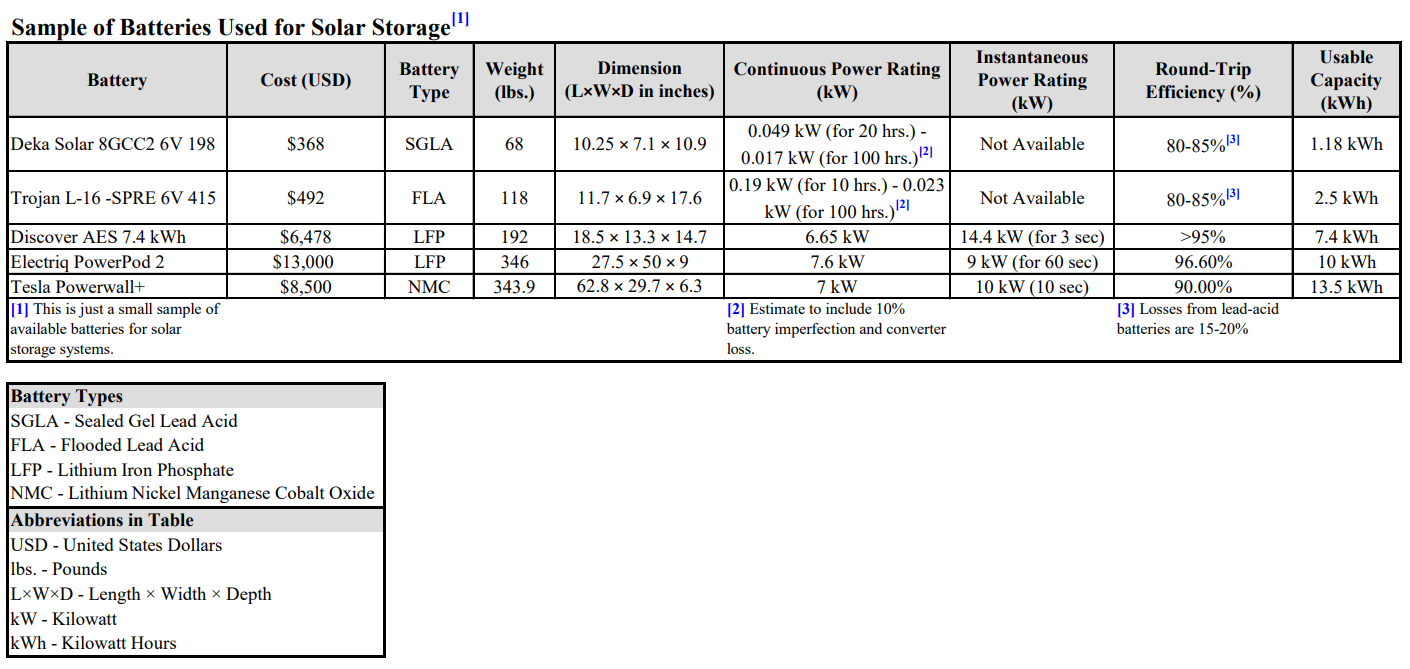
c. Consider available battery storage options and use your model to choose the best option for your off-the-grid home. The chart at the end of the problem statement provides several, but not all, battery options. Discuss your choice.
2. Adjust and generalize your model from Requirement 1 so that it is adaptable to individual needs and preferences to choose the best battery storage for any home. Discuss the changes you make to your model. Evaluate your model.
3. Recently, researchers in Sweden discovered that cement could be used to store energy[1]. Concrete, which is made with cement, is used to build buildings, sidewalks, bridges, and countless other structures.
a. Identify some of the advantages and disadvantages of using cement batteries to store solar power. Describe how might you incorporate cement as a battery for your off-the-grid home or for any home?
b. Determine and discuss the additional information you would need in order for you to model and compare the use of cement batteries to currently available batteries for solarpower storage. Note: You are NOT required to create the model.
4. Write a one-page non-technical news article describing your solar power battery storage decision model. Include in your article any recommendations for the future possibilities of a cement battery.
Your PDF solution of no more than 25 total pages should include:
? One-page Summary Sheet.
? Table of Contents.
? Your complete solution.
? One-page Article.
? References list.
Note: The HiMCM Contest now has a 25-page limit. All aspects of your submission count toward the 25-page limit (Summary Sheet, Table of Contents, Reference List and any Appendices).
Glossary
Continuous Power Rating: the kilowatts (kW) or Amps (A) of power that the battery can provide continuously (until the battery runs out of power).
Energy Storage System: a system that captures electricity, stores it in another form, and then retrieves it for use at a later time.
Instantaneous Power Rating: the kilowatts (kW) or Amps (A) of power that the battery can provide in short bursts (but not sustain over a long period).
Lifetime (of battery): the length of time your battery will continue working which is measured by expected years of operation, expected throughput (kWh of use), and expected number of cycles (charging and discharging).
Off-The-Grid: not using or depending upon public supply of electricity (or other utilities).
Round-Trip Efficiency: the number of units of electricity you’ll get out of a battery for every unit you put into it measured in a percentage.
Usable Capacity: the amount of electricity, in kilowatt-hours (kWh) or Amp-hours (Ah) that a battery is able to store and supply to your home.
Reference
[1] Zhang, Emma Q., and Luping Tang. 2021. "Rechargeable Concrete Battery" Buildings 11, no. 3: 103. https://doi.org/10.3390/buildings11030103
以上就是關于【2021HIMCM全球高中生數模賽A題】的解答,如需了解學校/賽事/課程動態(tài),可至翰林教育官網獲取更多信息。
往期文章閱讀推薦:
2026年HiMCM數模比賽時間如何安排?立即了解HiMCM報名節(jié)點!


翰林AMC8視頻課重磅上線!

國際競賽真題資源免費領取






