AQA A Level Biology復(fù)習(xí)筆記2.4.6 Osmosis in Plant Cells

Osmosis: Plant Cells
- Osmosis is the?net movement of water molecules?from a region of?higher water potential?(dilute solution) to a region of?lower water potential?(concentrated solution), through a partially permeable membrane
- If a plant cell is placed in?pure water?or a?dilute solution, water will?enter?the plant cell through its partially permeable cell surface membrane by?osmosis, as the pure water or dilute solution has a?higher water potential?than the plant cell
- As water enters the?vacuole?of the plant cell, the?volume?of the plant cell?increases
- The expanding?protoplast?(living part of the cell inside the cell wall) pushes against the cell wall and?pressure builds up?inside the cell – the inelastic cell wall prevents the cell from bursting
- The pressure created by the cell wall also stops too much water entering and this also helps to prevent the cell from bursting
- When a plant cell is fully inflated with water and has become rigid and firm, it is described as fully?turgid
- This turgidity is important for plants as the effect of all the cells in a plant being firm is to provide?support?and?strength?for the plant – making the plant stand upright with its leaves held out to catch sunlight
- If plants do not receive enough water the cells cannot remain rigid and firm (turgid) and the plant?wilts
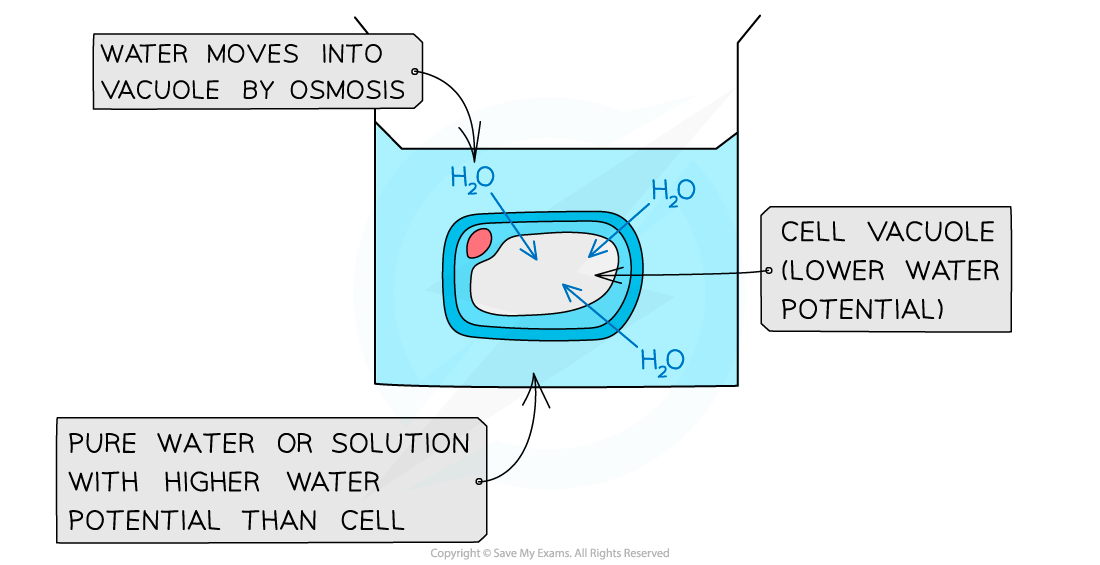
Osmosis of water into a plant cell
- If a plant cell is placed in a solution with a?lower water potential?than the plant cell (such as a concentrated sucrose solution), water will?leave?the plant cell through its partially permeable cell surface membrane by?osmosis
- As water leaves the?vacuole?of the plant cell, the volume of the plant cell?decreases
- The protoplast gradually shrinks and no longer exerts pressure on the cell wall
- As the protoplast continues to shrink, it begins to pull away from the cell wall
- This process is known as?plasmolysis?– the plant cell is?plasmolysed
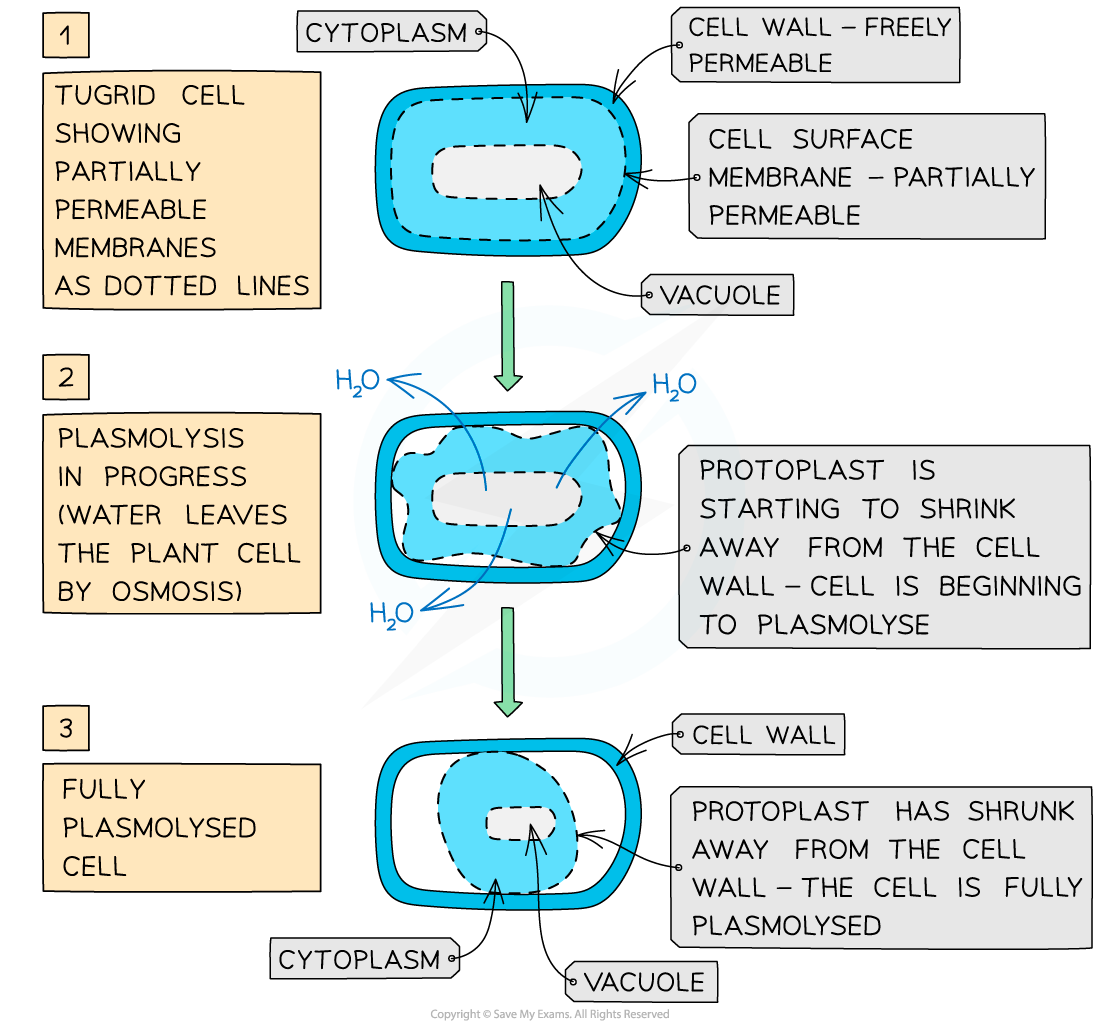
Plasmolysis of a plant cell that has been placed in a solution with a lower water potential than the cell itself
Exam Tip
Remember – plant cell membranes are composed of a phospholipid bilayer and are partially permeable (only certain molecules can cross), whereas plant cell walls are made of cellulose and are freely permeable. Thus, in a plasmolysed cell, the external solution will be exerting pressure on the protoplast, that is, there is not an empty space between the cell wall and protoplast.Pure water has a water potential of 0 kPa, so all other solutions will have negative water potentials.
轉(zhuǎn)載自savemyexams
以上就是關(guān)于【AQA A Level Biology復(fù)習(xí)筆記2.4.6 Osmosis in Plant Cells】的解答,如需了解學(xué)校/賽事/課程動(dòng)態(tài),可至翰林教育官網(wǎng)獲取更多信息。
往期文章閱讀推薦:
斯坦福大學(xué)官方推薦書(shū)單!名校學(xué)霸們暑假都在讀什么?
MIT官方發(fā)布【2026年夏季推薦閱讀書(shū)單】!橫跨科學(xué)/人文/經(jīng)濟(jì)...


翰林AMC8視頻課重磅上線!

國(guó)際競(jìng)賽真題資源免費(fèi)領(lǐng)取






