AQA A Level Biology復(fù)習(xí)筆記2.5.8 Antibodies

Antibodies: Structure
Structure
- Antibodies are?globular glycoproteins?called?immunoglobulins
- Antibodies have a?quaternary?structure (which is represented as?Y-shaped), with?two ‘heavy’?(long) polypeptide chains bonded by?disulfide bonds?to?two ‘light’?(short) polypeptide chains
- Each polypeptide chain has a?constant region?and?variable region
- The?constant regions?do not vary?within a class (isotype) of antibodies but do vary between the classes. The constant region determines the mechanism used to destroy the antigens
- There are 5 classes of mammalian antibodies each with different roles
- The amino acid sequence in the?variable regions?of the antibodies (the tips of the "Y") are different for each antibody. The variable region is where the antibody attaches to the antigen to form an?antigen-antibody complex
- At the end of the variable region is a site called the?antigen-binding site. Each antigen-binding site is generally composed of 110 to 130 amino acids and includes both the ends of the light and heavy chains
- The antigen-binding sites?vary?greatly giving the antibody its?specificity?for binding to?antigens. The sites are specific to the epitope (the part of the antigen that binds to the antibody)
- A pathogen or virus may therefore present multiple antigens different antibodies need to be produced
- The ‘hinge’ region (where the disulfide bonds join the heavy chains) gives flexibility to the antibody molecule which allows the antigen-binding site to be placed at different angles when binding to antigens
- This region is not present in all classes of antibodies
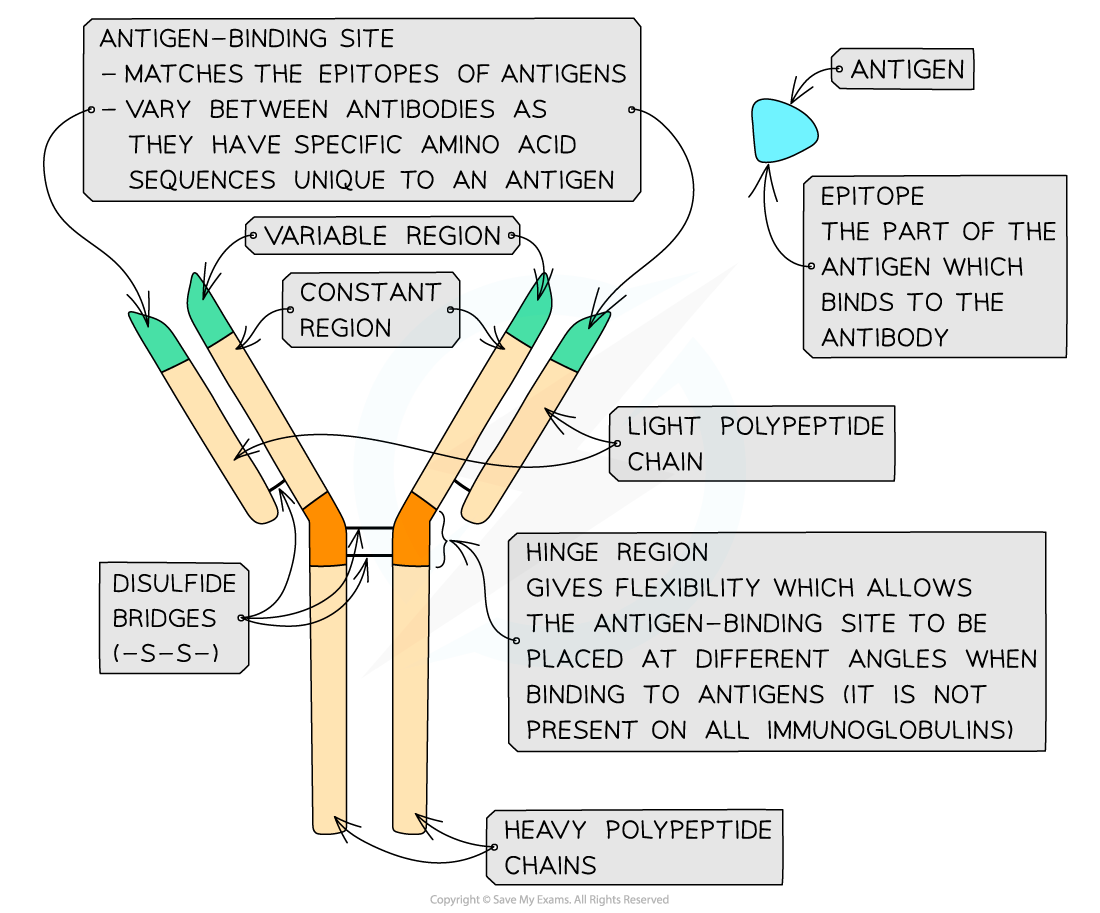
A model of the generalised structure of an antibody molecule
Exam Tip
You must know that each antibody will have a different variable region with an antigen-binding site that matches one antigen or toxin produced by a pathogen. The antigen-binding site (and therefore the antibody) is?specific?to?one?antigen.
轉(zhuǎn)載自savemyexams
以上就是關(guān)于【AQA A Level Biology復(fù)習(xí)筆記2.5.8 Antibodies】的解答,如需了解學(xué)校/賽事/課程動(dòng)態(tài),可至翰林教育官網(wǎng)獲取更多信息。
往期文章閱讀推薦:
斯坦福大學(xué)官方推薦書單!名校學(xué)霸們暑假都在讀什么?
MIT官方發(fā)布【2026年夏季推薦閱讀書單】!橫跨科學(xué)/人文/經(jīng)濟(jì)...


翰林AMC8視頻課重磅上線!

國(guó)際競(jìng)賽真題資源免費(fèi)領(lǐng)取






