Edexcel IGCSE Maths 復習筆記 6.1.1 Mean, Median & Mode

Edexcel IGCSE Maths 復習筆記 6.1.1 Mean, Median & Mode
Why do we have different types of average?
- You’ll hear the phrase “on average” used a lot, from politicians talking about the economy to sports analysts to shops talking about their “average customer”
- However not all data is numerical (eg the party people voted for in the last election) and even when it is numerical, some of the data may lead to misleading results
- This is why we have?3 types of average
What do I need to know?
1. Mean
- This is what is usually meant by “average” – it’s like an ideal world where everybody has the same, everything is shared out equally
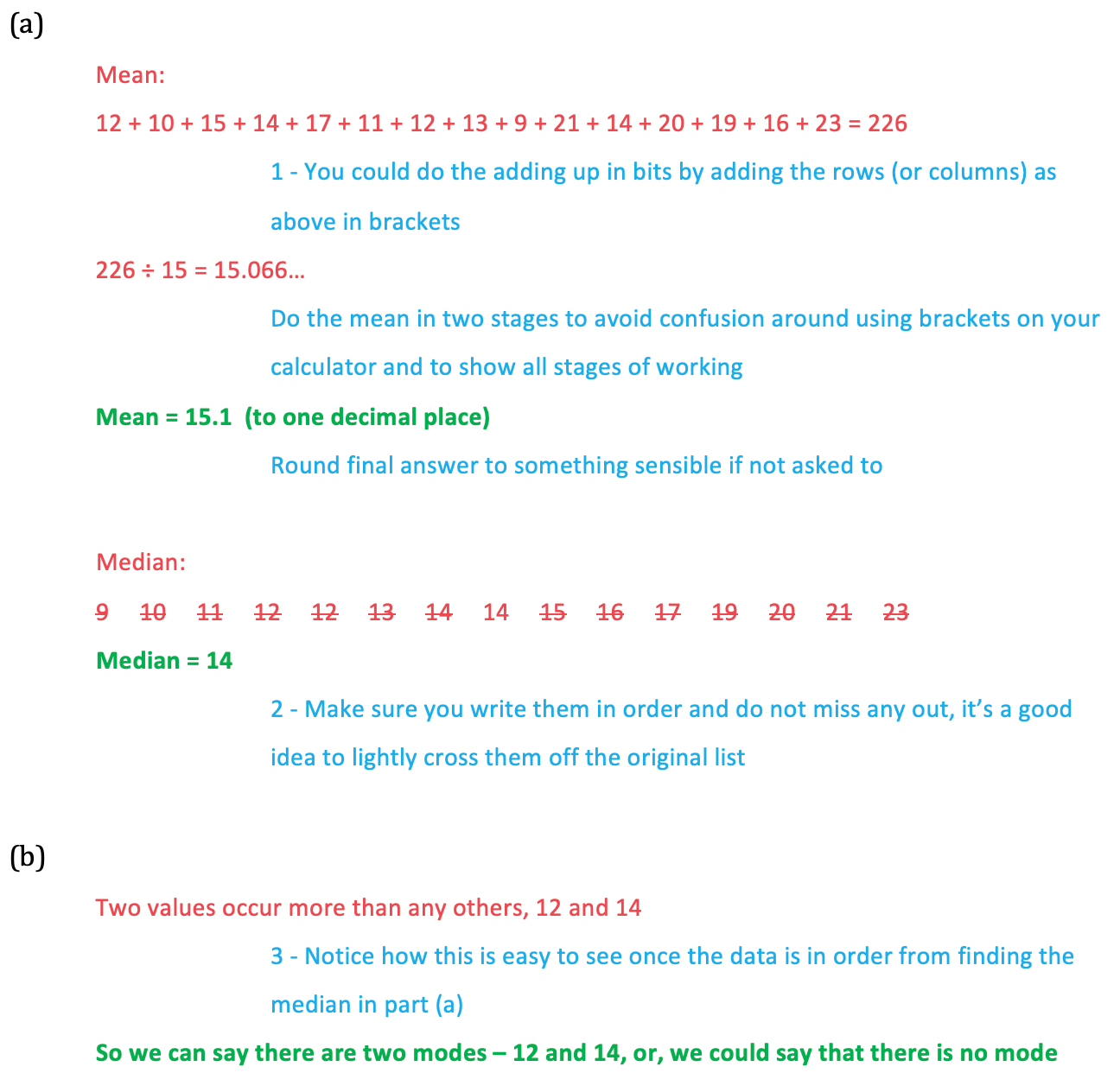
- It is the?TOTAL?of all the values?DIVIDED?by the?NUMBER OF VALUESFind the mean of 4, 6, 7, 9
4 + 6 + 7 + 9 = 26
26 ÷ 4 = 6.5
Mean = 6.5
- Problems with the mean occur when there are one or two unusually high (or low) values in the data (outliers) which can make the mean too high (or too low) to reflect any patterns in the data
2. Median
- This is similar to the word medium, which can mean in the middle
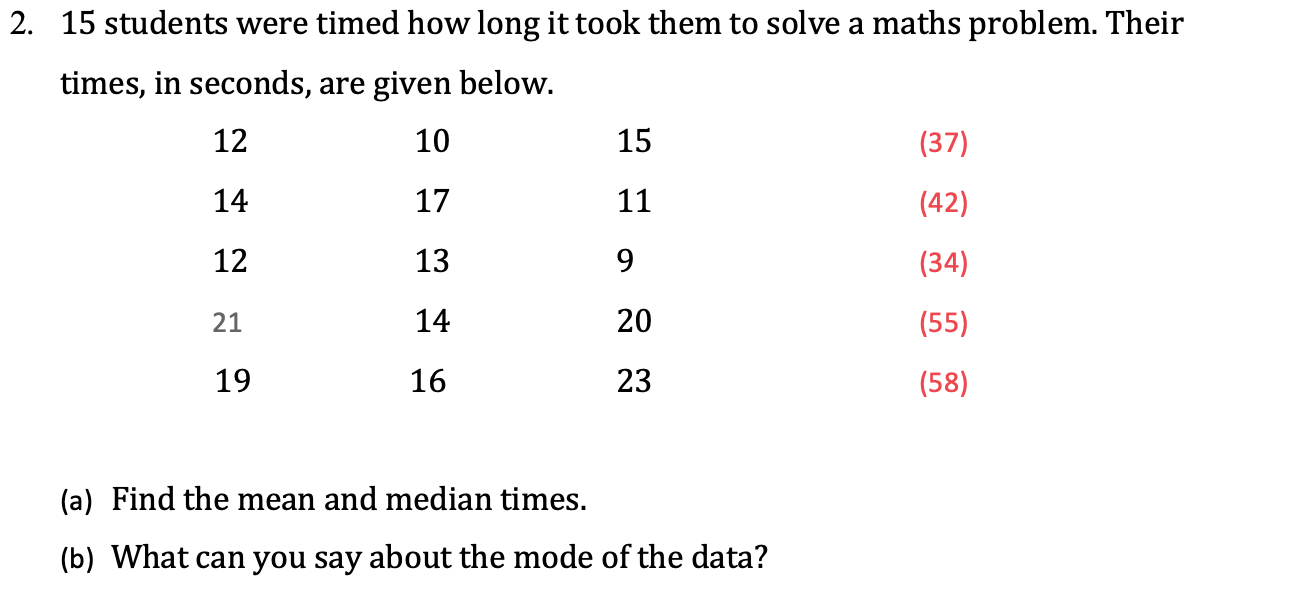
- So the median is the middle value – but beware, the data has to be arranged into numerical order firstFind the median of 20, 43, 56, 78, 92, 56, 48
In order: 20, 43, 48, 56, 56, 78, 92
To find the median cross out numbers from either end until you meet in the middle (cross them out lightly so you can still read them)
This may not be necessary with small lists but is more important when working with lots of data
20, 43, 48, 56, 56, 78,?92
20,?43, 48, 56, 56,?78,?92
20,?43,?48, 56,?56,?78,?92
Median = 56
- We would use the median instead of the mean if we did not want extreme values (outliers) affecting our data
- If we have an even number of values we would get two values in the middle
- In these cases we take the half-way point between these two values. This is usually obvious but, if not, we?add the two middle values and divide by 2?(this is the same as finding the mean of the middle two values)20, 43, 46, 48, 56, 56, 78, 92 (as above with an extra 46 in there!)
When crossed out we get
20,?43,?46, 48, 56,?56,?78,?92
So the two middle values are 48 and 56.
Halfway is 52 but if you can’t spot that you can work it out …
48 + 56 = 104
104 ÷ 2 =52
Median = 52
3. Mode
- Not all data is numerical and that is where we use mode
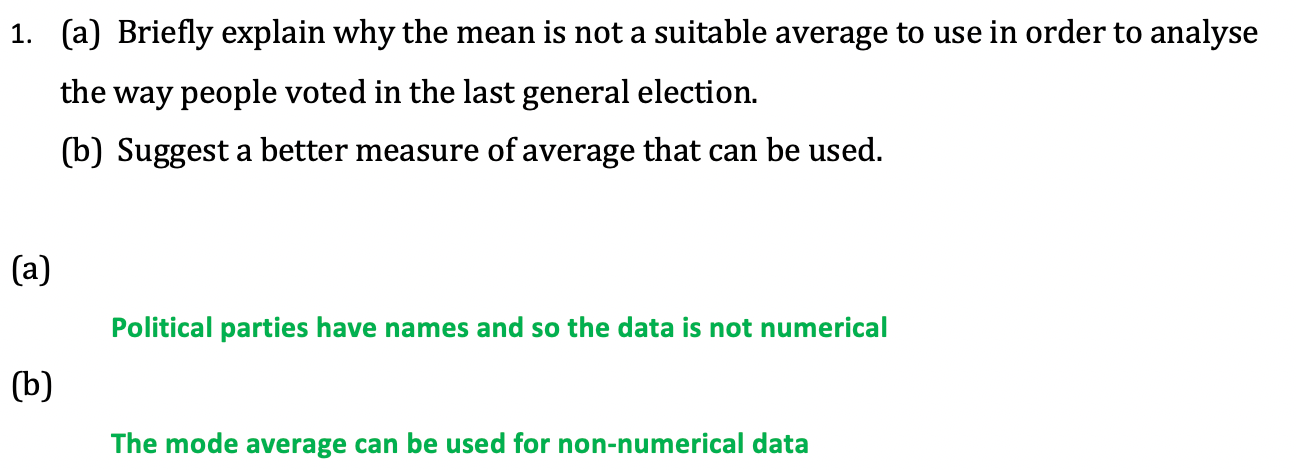
- MOde means the?Most?Often
- So it is often used for things like “favourite …” or “… sold the most” or “… were the most popular”
- Mode is sometimes referred to as?modal?– so you may see phrases like “modal value” – but they still mean the mode12 people were asked about their favourite crisp flavour. The responses are below:
Salt and vinegar, Prawn cocktail, Ready salted,
Ready salted, Salt and vinegar, Salt and vinegar,
Smokey bacon, Ready salted, Salt and vinegar
Salt and vinegar, Cheese and onion, Ready salted
With only a few pieces of data it is quite quick and easy to see here that Salt and vinegar is chosen the most
With more data it may be wise to create a tally chart or similar to help count the number of each flavour
Mode is Salt and vinegar
- Be aware that the mode can apply to numerical data as well (from the data used in the example for the median the mode would have been 56)
- Sometimes if no value/data occurs more often than others we say there is no mode
- If two values occur the most we may say there are two modes (bi-modal) – whether it is appropriate to do this will depend on what the data is about
Worked Example
Worked Example
Worked Example
轉載自savemyexam
以上就是關于【Edexcel IGCSE Maths 復習筆記 6.1.1 Mean, Median & Mode】的解答,如需了解學校/賽事/課程動態,可至翰林教育官網獲取更多信息。
往期文章閱讀推薦:
MIT官方發布【2026年夏季推薦閱讀書單】!橫跨科學/人文/經濟...


翰林AMC8視頻課重磅上線!

國際競賽真題資源免費領取






