IB DP Maths: AA SL復(fù)習(xí)筆記4.3.3 Sample Space Diagrams

Venn Diagrams
What is a Venn diagram?
- A Venn diagram is a way to illustrate?events?from an?experiment?and are particularly useful when there is an overlap between possible?outcomes
- A Venn diagram consists of
- a?rectangle?representing the?sample?space (U)
- The rectangle is labelled?U?
- Some mathematicians instead use?S?or?ξ?
- a?circle?for each?event
- Circles may or may not overlap depending on which?outcomes?are shared between?events
- a?rectangle?representing the?sample?space (U)
- The numbers in the circles represent either the?frequency?of that event or the?probability?of that event
- If the?frequencies?are used then they should?add up to the total frequency
- If the?probabilities?are used then they should?add up to 1
What do the different regions mean on a Venn diagram?
 Venn diagrams show ‘AND’?and ‘OR’?statements easily
- Venn diagrams also instantly show?mutually?exclusive?events as these circles will?not overlap
- Independent?events can not be instantly seen
- You need to use probabilities to deduce if two events are independent
How do I solve probability problems involving Venn diagrams?
- Draw, or add to a given Venn diagram, filling in as many values as possible from the information provided in the question
- It is usually helpful to work from the centre outwards
- Fill in?intersections?(overlaps) first
 Add together the frequencies/probabilities in the?B?circle
- This is your denominator
- Out of those frequencies/probabilities add together the ones that are also in the?A?circle
- This is your numerator
- Evaluate the fraction
Exam Tip
- If you struggle to fill in a Venn diagram in an exam:
- Label the missing parts using algebra
- Form equations using known facts such as:
- the sum of the probabilities should be 1
- P(A∩B)=P(A)P(B) if A and B are independent events
Worked Example
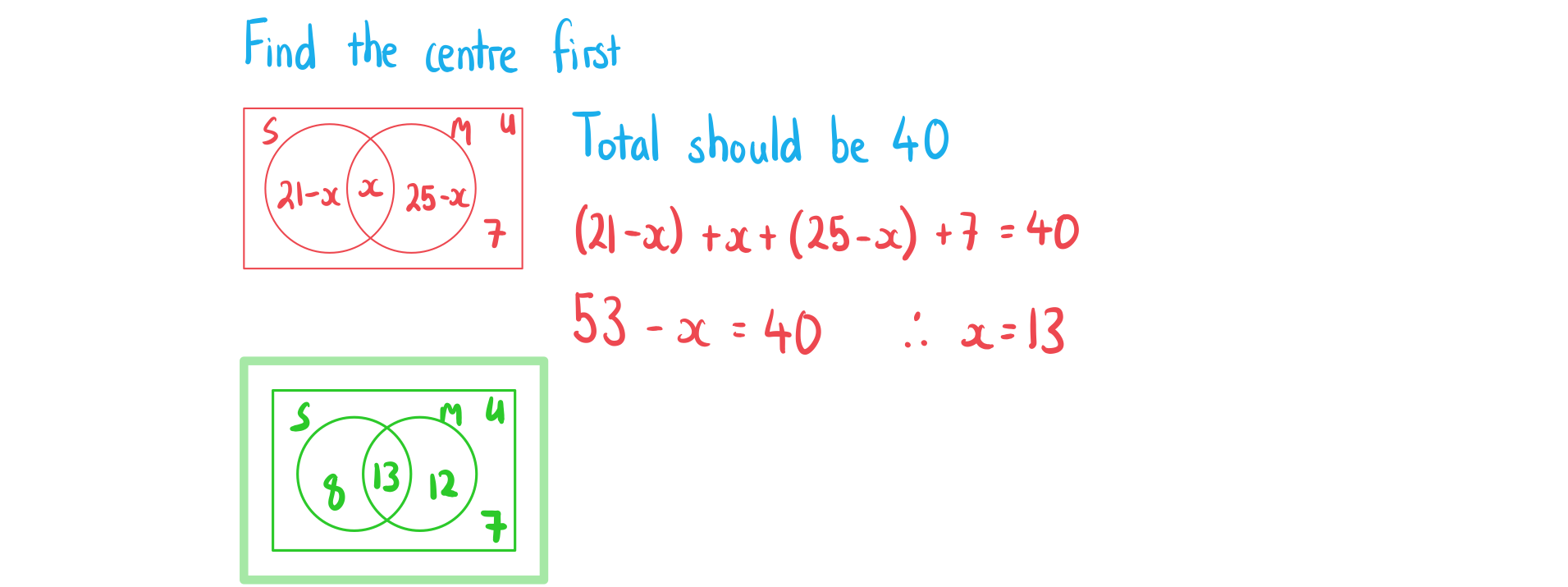
40 people are asked if they have sugar and/or milk in their coffee. 21 people have sugar, 25 people have milk and 7 people have neither.
a)? ? ? ? ? Draw a Venn diagram to represent the information.
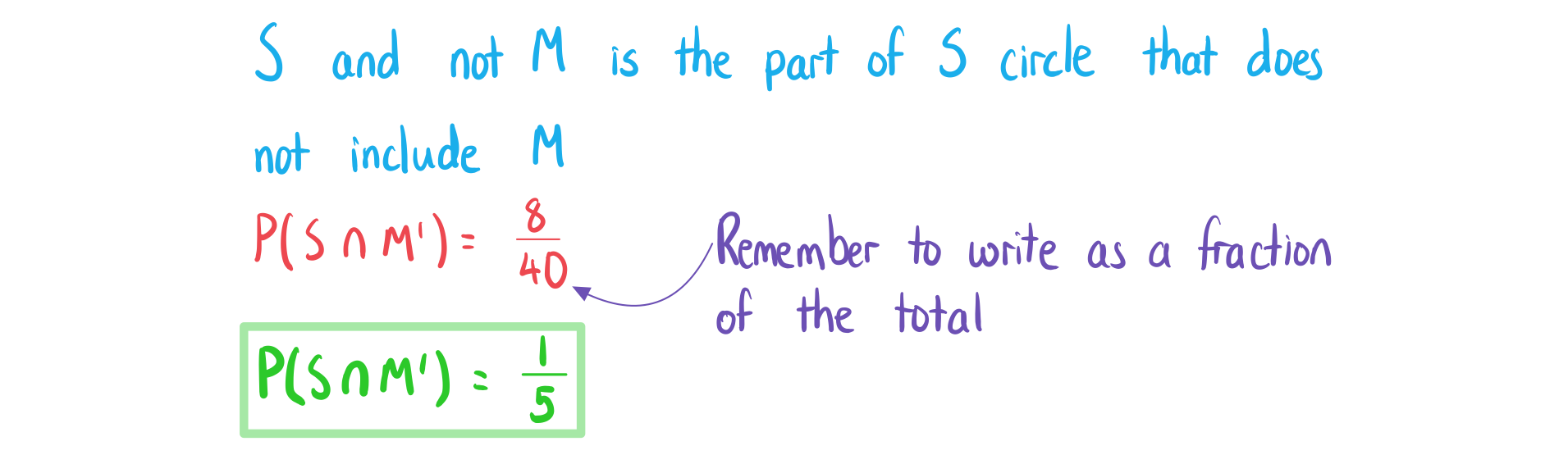
b)? ? ? ? ?One of the 40 people are randomly selected, find the probability that they have sugar but not milk with their coffee.
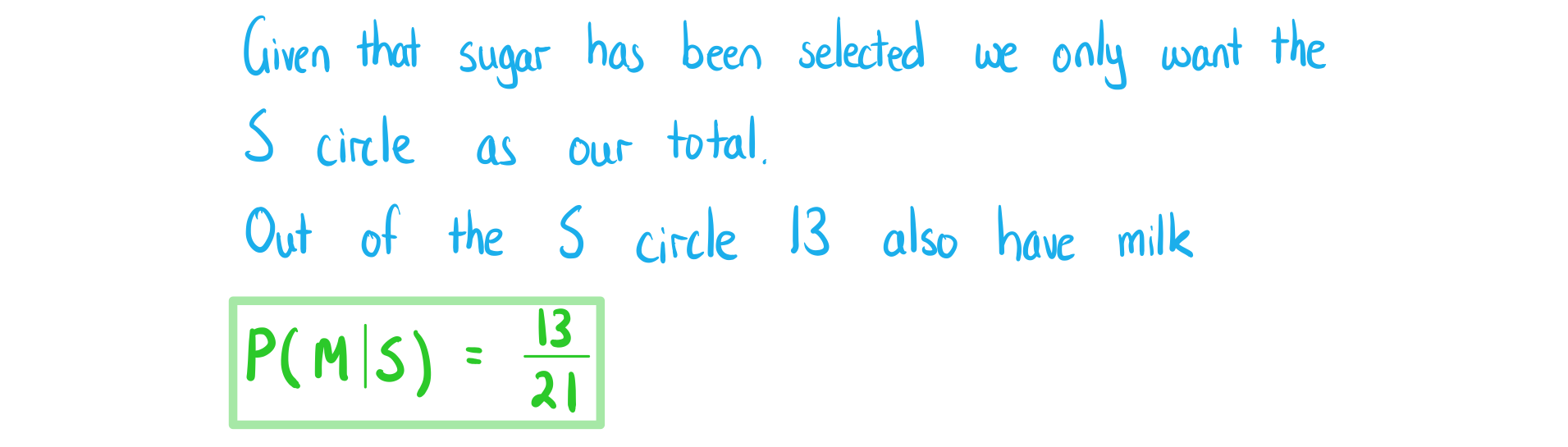
c)? ? ? ? ?Given that a person who has sugar is selected at random, find the probability that they have milk with their coffee.
Tree Diagrams
What is a tree diagram?
- A?tree?diagram?is another way to show the outcomes of combined events
- They are very useful for intersections of events
- The events on the branches must be?mutually exclusive
- Usually they are an event and its complement
- The probabilities on the second sets of branches?can depend?on the outcome of the first event
- These are?conditional probabilities
- When selecting the items from a bag:
- The second set of branches will be the?same?as the first if the items?are replaced
- The second set of branches will be the?different?to the first if the items?are not replaced
How are probabilities calculated using a tree diagram?
- To find the probability that two events happen together you?multiply?the corresponding probabilities on their branches
- It is helpful to find the probability of all combined outcomes once you have drawn the tree
- To find the probability of an event you can:
- add together?the probabilities of the?combined outcomes?that are part of that event
 Do I have to use a tree diagram?
- add together?the probabilities of the?combined outcomes?that are part of that event
- If there are?multiple events?or trials then a tree diagram can get big
- You can break down the problem by using the words?AND/OR/NOT?to help you find probabilities without a tree
- You can speed up the process by only drawing parts of the tree that you are interested in
Which events do I put on the first branch?
- If the events?A?and?B?are?independent?then the?order does not matter
- If the events?A?and?B?are?not independent?then the?order does matter
- If you have the probability of?A?given?B?then put?B?on the first set?of branches
- If you have the probability of?B?given?A?then put?A?on the first set?of branches
Exam Tip
- In an exam do not waste time drawing a full tree diagram for scenarios with lots of events unless the question asks you to
- Only draw the parts that you are interested in
Worked Example
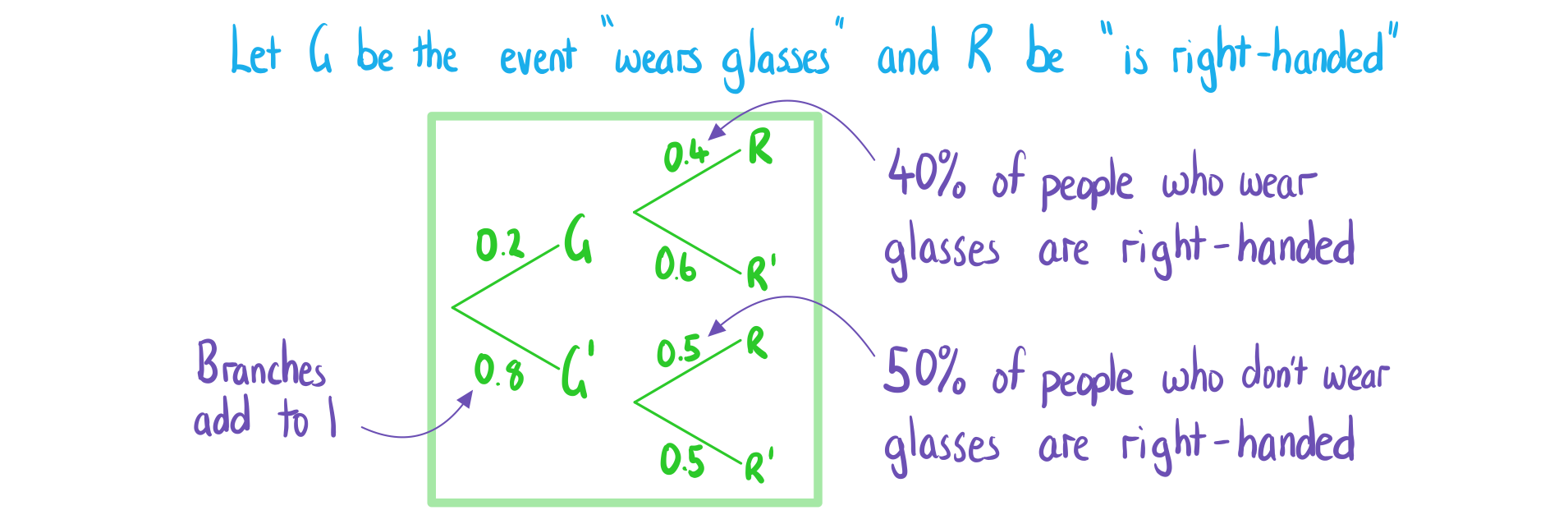
20% of people in a company wear glasses. 40% of people in the company who wear glasses are right-handed. 50% of people in the company who don’t wear glasses are right-handed.
a)? ? ? ? ? ? ?Draw a tree diagram to represent the information.
b)? ? ? ? ? ? ?One of the people in the company are randomly selected, find the probability that they are right-handed.
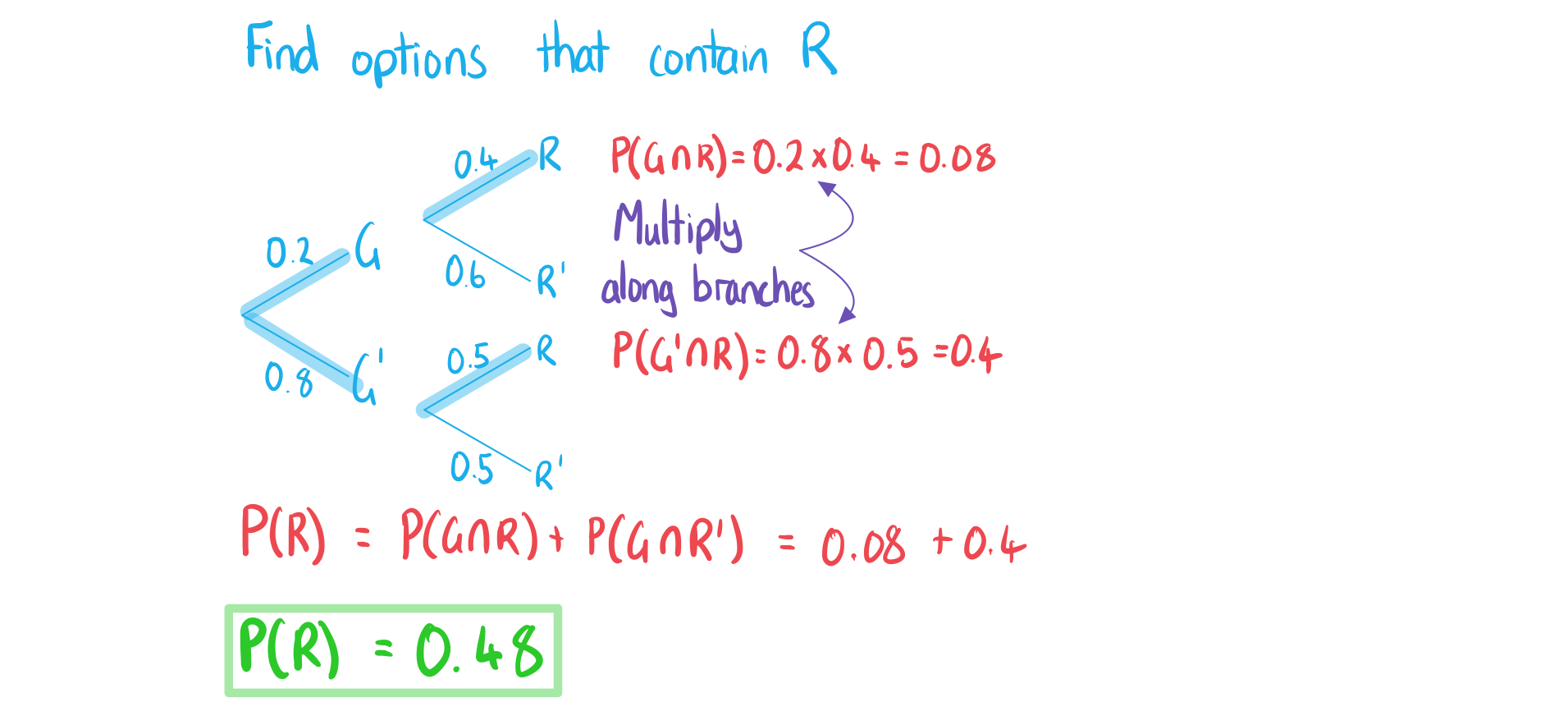
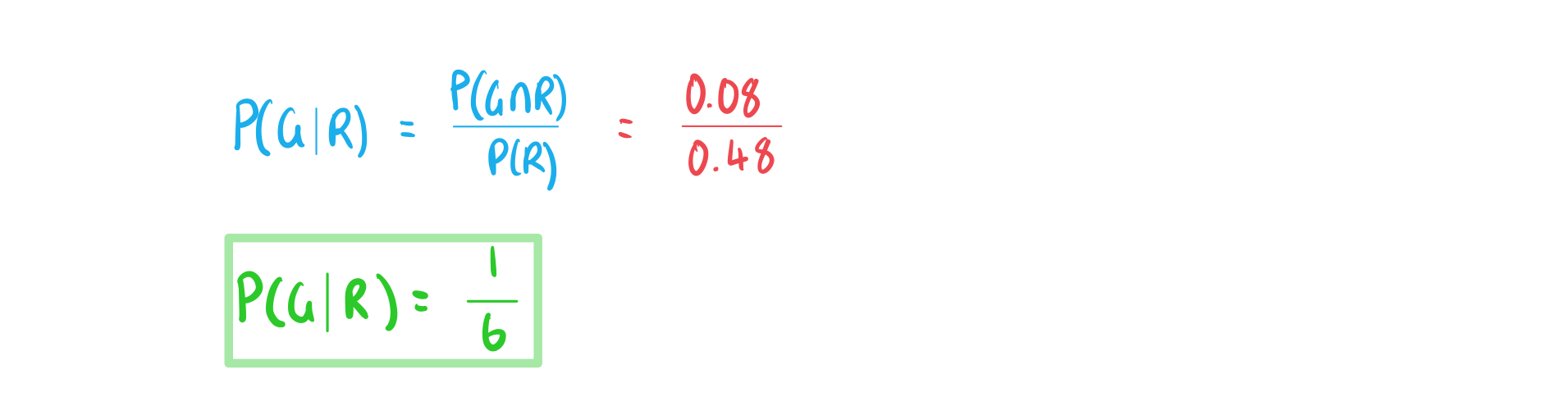
c)? ? ? ? ? ? ? ?Given that a person who is right-handed is selected at random, find the probability that they wear glasses.
轉(zhuǎn)載自savemyexams
以上就是關(guān)于【IB DP Maths: AA SL復(fù)習(xí)筆記4.3.3 Sample Space Diagrams】的解答,如需了解學(xué)校/賽事/課程動(dòng)態(tài),可至翰林教育官網(wǎng)獲取更多信息。
往期文章閱讀推薦:
斯坦福大學(xué)官方推薦書單!名校學(xué)霸們暑假都在讀什么?
MIT官方發(fā)布【2026年夏季推薦閱讀書單】!橫跨科學(xué)/人文/經(jīng)濟(jì)...


翰林AMC8視頻課重磅上線!

國際競賽真題資源免費(fèi)領(lǐng)取






