Edexcel IGCSE Physics 復習筆記 1.2.7 Terminal Velocity

Edexcel IGCSE Physics 復習筆記 1.2.7 Terminal Velocity
Terminal Velocity
- Falling objects experience?two forces:
- Weight?(due to gravity)
- Air resistance?(due to friction)
- The force of air resistance increases with speed. This is illustrated in the image below:
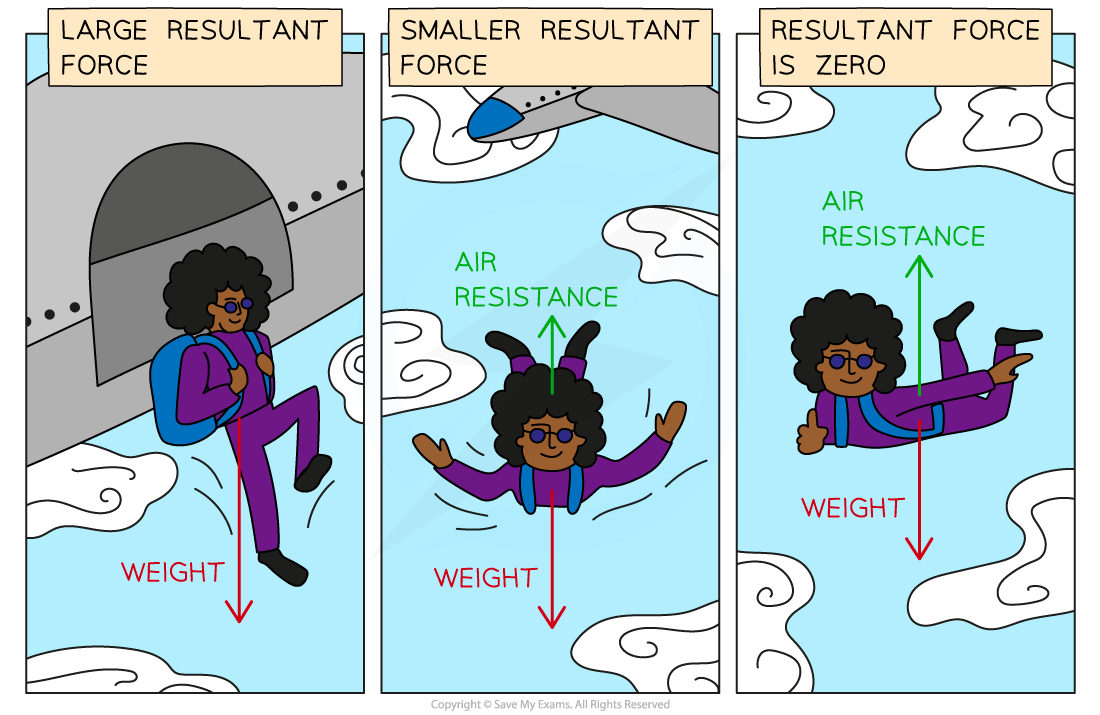
Debbie initially accelerates downwards due to her weight. The upwards air resistance increases as she falls until it eventually grows big enough to balance the weight force
- Initially, the upwards air resistance is?very small?because the skydiver isn't falling very quickly
- Therefore, there are?unbalanced?forces on the skydiver initially
- As the skydiver speeds up, air resistance?increases,?eventually growing large enough to?balance the downwards weight force
- Once?air resistance equals weight,?the forces are?balanced
- This means there is no longer any?resultant force
- Therefore, the skydiver's acceleration is?zero?- they now travel at a?constant?speed
- This speed is called their?terminal velocity
Worked Example
A small object falls out of an aircraft.Choose words from the list to complete the sentences below:
Friction? ? ? ?Gravity? ? ? ?Air pressure
Accelerates? ? ? ?Falls at a steady speed? ? ? ?Slows down
(a) The weight of an object is the force of __________ which acts on it.
(b) When something falls, initially it ____________.
(c) The faster it falls, the larger the force of ______________ which acts on it.
(d) Eventually it ______________ when the force of friction equals the force of gravity acting on it.
Part (a)
The weight of an object is the force of?gravity?which acts on it.
-
- The weight force is due to the Earth's gravitational pull on the object, so weight is due to gravity
Part (b)
When something falls, initially it?accelerates.
-
- The?resultant force?on the object is?very large?initially, so it accelerates
- This is because there is a?large unbalanced force?downwards (its weight) - the upward force of air resistance is very small to begin with
Part (c)
The faster it falls, the larger the force of?friction?which acts on it.
-
- The force of?air resistance?is due to?friction?between the object's motion and?collisions with air particles
- Air particles try to slow the object down, so air itself produces a?frictional force, called air resistance (sometimes called?drag)
Part (d)
Eventually it?falls at a steady speed?when the force of friction equals the force of gravity acting on it.
-
- When the upwards?air resistance?grows enough to?balance?the downwards?weight?force, the resultant force on the object is?zero
- This means the object isn't accelerating - rather, it is moving at a?steady?(terminal)?speed
Exam Tip
The force of gravity on an object is called its?weight. If you are asked to name this force, use this word: don't call it 'gravity', as this term could also mean gravitational field strength, and so might be marked wrong.Additionally, remember to identify?air resistance?as the upwards force on a falling object. This force?gets larger?as the object speeds up, but the weight of the object stays constant. Don't confuse 'air resistance' with 'air pressure' - these are two different concepts!
轉載自savemyexam
以上就是關于【Edexcel IGCSE Physics 復習筆記 1.2.7 Terminal Velocity】的解答,如需了解學校/賽事/課程動態,可至翰林教育官網獲取更多信息。
往期文章閱讀推薦:
MIT官方發布【2026年夏季推薦閱讀書單】!橫跨科學/人文/經濟...


翰林AMC8視頻課重磅上線!

國際競賽真題資源免費領取






