Edexcel IGCSE Physics 復習筆記 1.2.8 Core Practical: Investigating Force & Extension

Edexcel IGCSE Physics 復習筆記 1.2.8 Core Practical: Investigating Force & Extension
Core Practical 2: Investigating Force & Extension
Equipment List
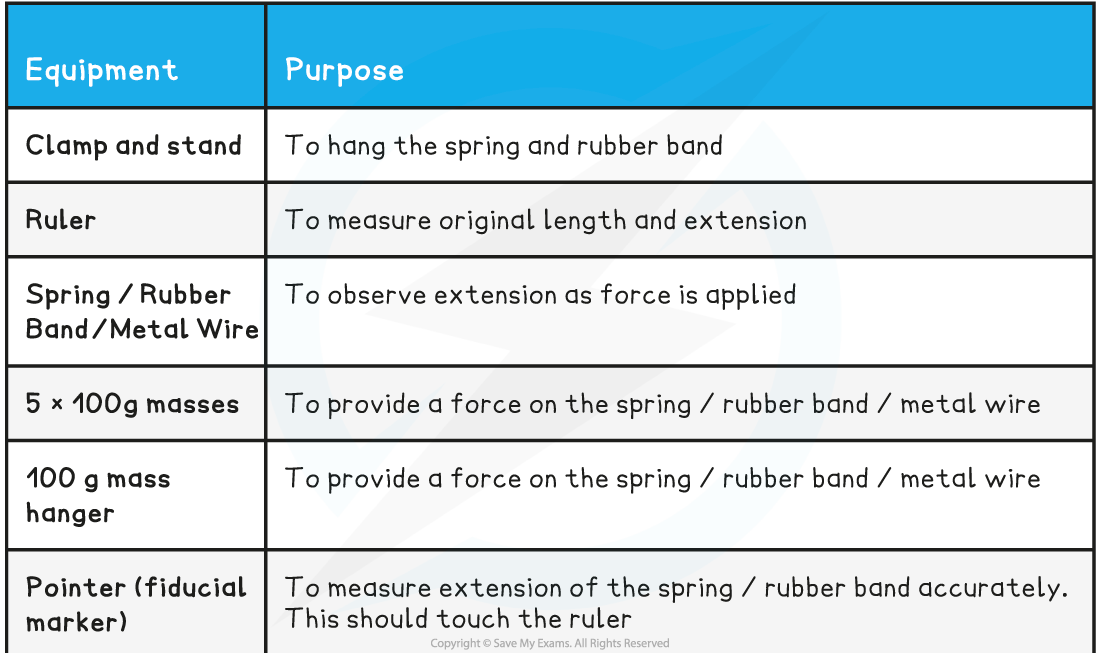
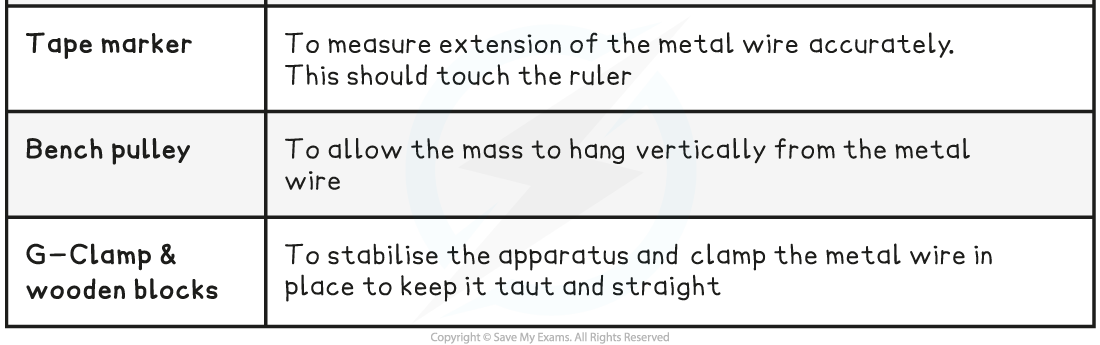
- Resolution?of measuring equipment:
- Ruler = 1 mm
Experiment 1: Investigating Springs & Rubber Bands
- The aim of this experiment is to investigate the relationship between?force?and?extension?for a spring and a rubber band:
Variables:
- Independent variable?= Force,?F
- Dependent variable?= Extension,?e
Method
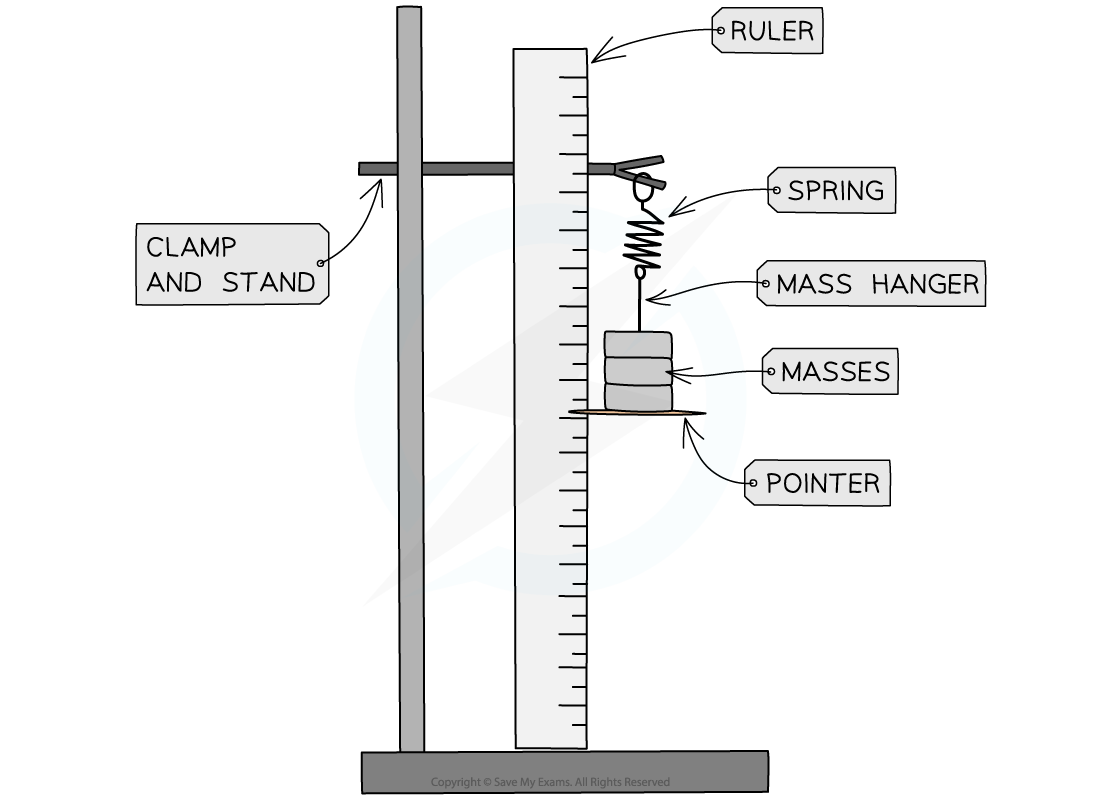
Investigating force-extension apparatus for a spring (and rubber band)
- Set up the apparatus as shown in the diagram, initially without any masses hanging from the spring / rubber band
- Align the marker to a value on the ruler, record this initial length of the spring / rubber band
- Add the 100 g mass hanger onto the spring / rubber band
- Record the mass (in kg) and position (in cm) from the ruler now that the spring / rubber band has extended
- Add another 100 g to the mass hanger
- Record the new mass and position from the ruler now that the spring / rubber band has extended further
- Repeat this process until all masses have been added
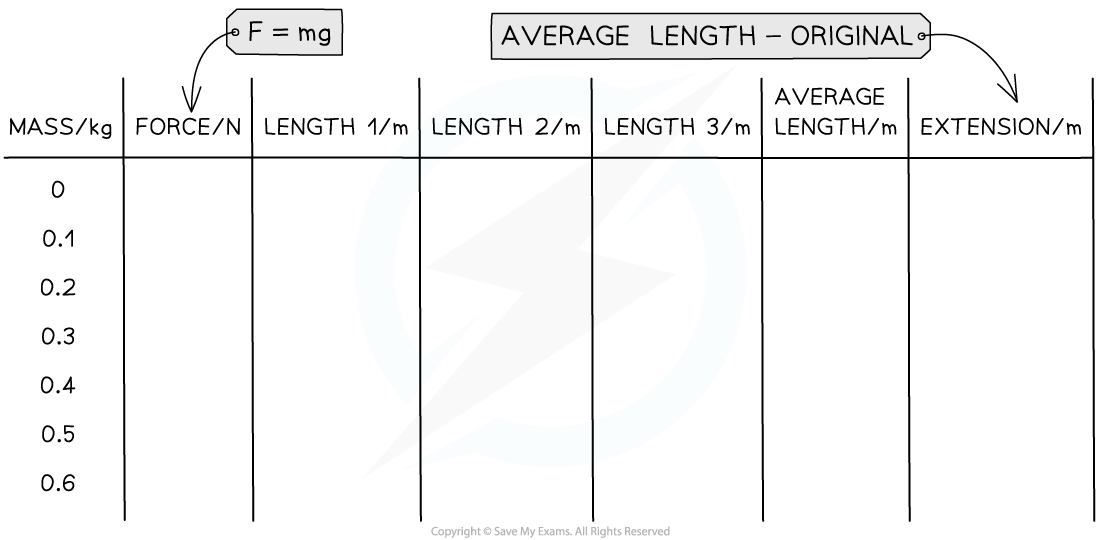
- Remove the masses and repeat the entire process again, until it has been carried out a total of three times, and an average length (for each mass attached) is calculated
- An example table of results might look like this:
Experiment 2: Investigating Metal Wires
- The aim of this experiment is to investigate the relationship between force and extension for a metal wire
Variables:
- Independent variable?= Force,?F
- Dependent variable?= Extension,?e
Method
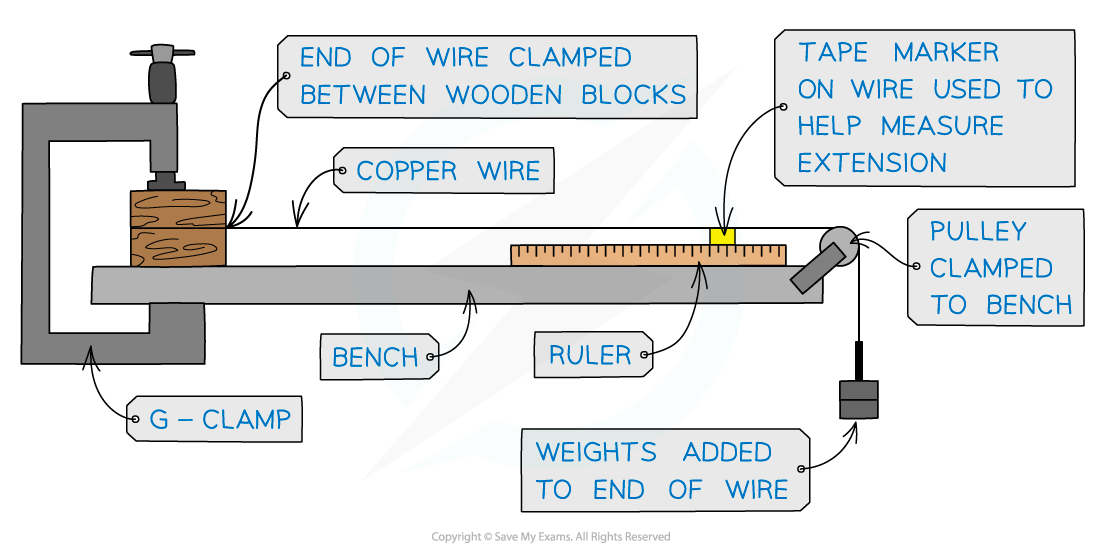
Investigating force-extension apparatus for a metal (e.g. copper) wire
- Set up the apparatus so the wire is taut. No masses should be attached just yet
- Measure the original length of the wire using a metre ruler and mark a reference point with tape preferably near the beginning of the scale eg. at 1 cm
- Record the initial reading on the ruler of the reference point
- Add a 100 g mass onto the mass hanger
- Read and record the new reading of the tape marker from the meter ruler now that the metal wire has extended
- Repeat this process until all masses have been added
- Remove the masses and repeat the entire process again, until it has been carried out a total of three times, and an average length (for each mass attached) is calculated
- An example table of results might look like this:
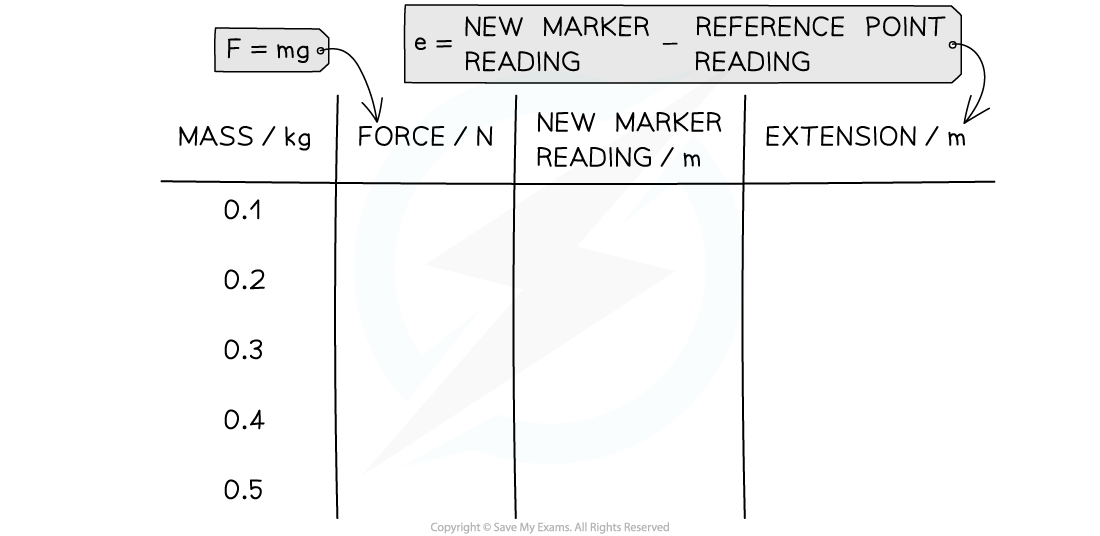
Analysis of Results
- The force,?F?added to the spring / rubber band / metal wire is the?weight?of the mass
- The weight is calculated using the equation:
W?=?m × g
- Where:
- W?= weight in newtons (N)
- m?= mass in kilograms (kg)
- g?= gravitational field strength on Earth in newtons per kg (N/kg)
- Therefore, multiply each mass by gravitational field strength,?g, to calculate the force,?F
- The force can be calculated by multiplying the mass (in kg) by 10 N/kg
- The?extension?e?of the spring / rubber band is calculated using the equation:
e = average length – original length
- The final length is the length of the spring / rubber band recorded from the ruler after the masses were added
- The?extension?e?of the metal wire is calculated using the equation:
e = new marker reading ? reference point reading
- The original length is the length of the spring / rubber band / metal wire when there were?no?masses attached
- Plot a graph of the force against extension for the spring / rubber band / metal wire
- Draw a line or curve of best fit
- If the graph has a?linear?region (is a straight line), then the force is?proportional?to the extension
Evaluating the Experiment
Systematic Errors:
- Make sure the measurements on the ruler are taken at eye level to avoid?parallax error
Random Errors:
- The accuracy of such an experiment is improved with the use of a pointer (a fiducial marker)
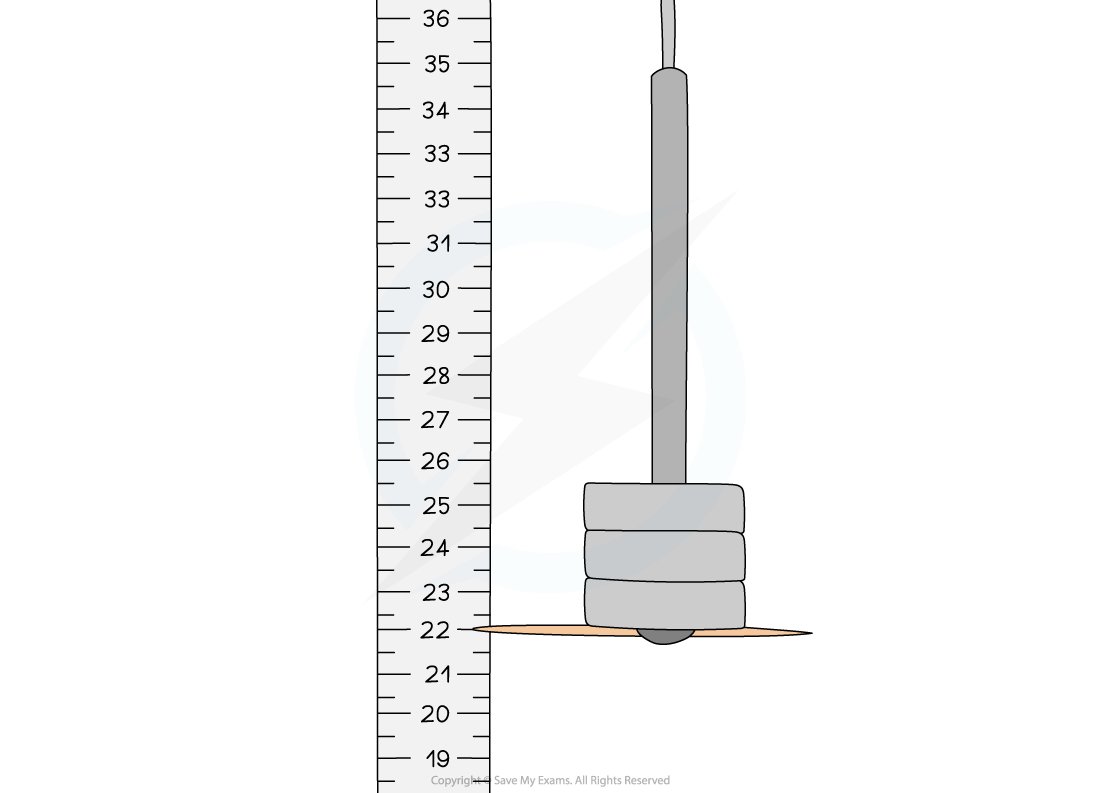
Fiducial marker to measure the extension more accurately
- Wait a few seconds for the spring / rubber band / metal wire to fully extend when a mass is added, before taking the reading for its new length
- Make sure to check whether the spring has not gone past its?limit of proportionality?otherwise, it has been stretched too far
Safety Considerations
- Wear goggles during this experiment in case the spring snaps
- Stand up while carrying out the experiment making sure no feet are directly under the masses
- Place a mat or a soft material below the masses to prevent any damage in case they fall
- Use a G clamp to secure the clamp stand to the desk so that the clamp and masses do not fall over
- As well as this, place each mass carefully on the hanger and do not pull the spring too hard that it breaks or pulls the apparatus over
Exam Tip
Remember - for the spring and rubber band, the extension measures how much the object has stretched by and can be found by?subtracting the original length from each of the subsequent lengths.For the metal wire, each extension is measured by finding the difference between the?new marker point?and the?original reference point.A common mistake is to calculate the increase in length by each time instead of the total extension – if each of your extensions is roughly the same then you might have made this mistake!
轉載自savemyexam

國際競賽真題資源免費領取


美高學分項目重磅來襲!立即了解