Edexcel IGCSE Physics 復習筆記 2.2.4 IV Graphs

Edexcel IGCSE Physics 復習筆記 2.2.4 IV Graphs
IV Graphs
- As the potential difference across a component is increased, the current also increases
- This is because potential difference and current are?proportional
- The precise relationship between voltage and current is different for different components and can be shown on an?IV?graph, including in:
- Fixed resistors & wires
- Filament lamps
- Diodes
Fixed Resistors & Wires
- The?current?through a fixed resistor or a wire?increases?as the?potential difference (or voltage)?across it?increases
- In other words, current is?directly proportional?to the potential difference for a fixed resistor (or a wire)
- This relationship is true because the resistance of the fixed resistor (or wire) stays?constant
- An?IV?graph shows that the line is?straight?and goes through the?origin,?as shown in the image?below:
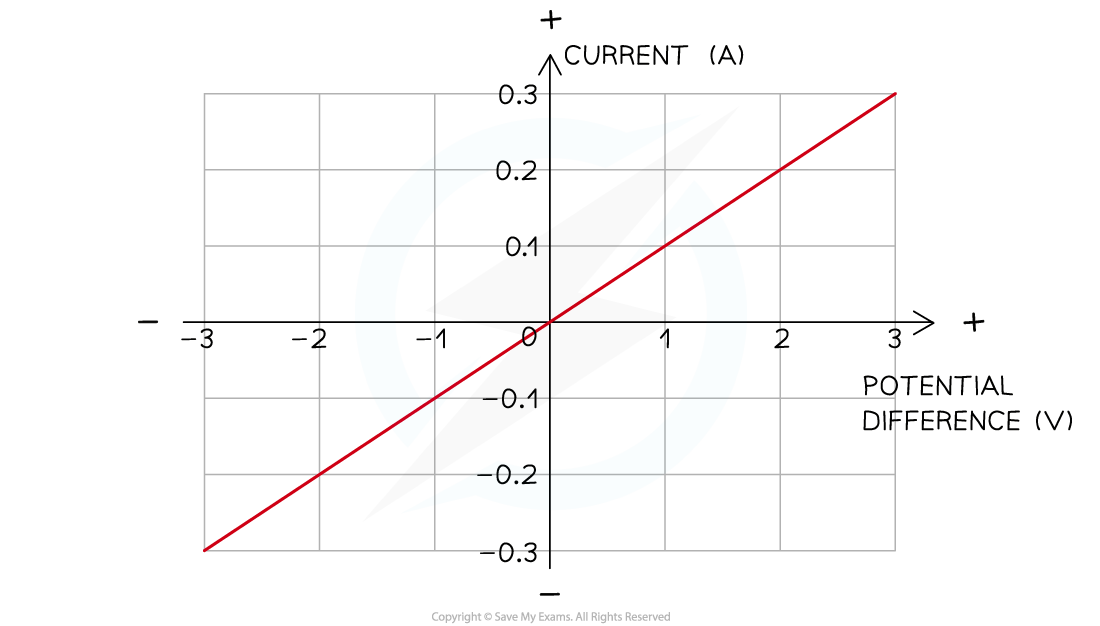
IV graph for a fixed resistor. The current is directly proportional to the potential difference (voltage) as the graph is a straight line through the origin
Filament Lamps
- For a filament lamp, current and voltage are?not?directly proportional
- This is because the resistance of the filament lamp?increases?as the?temperature?of the filament?increases
- The?IV?graph for a filament lamp shows the current increasing at a proportionally slower rate than the potential difference
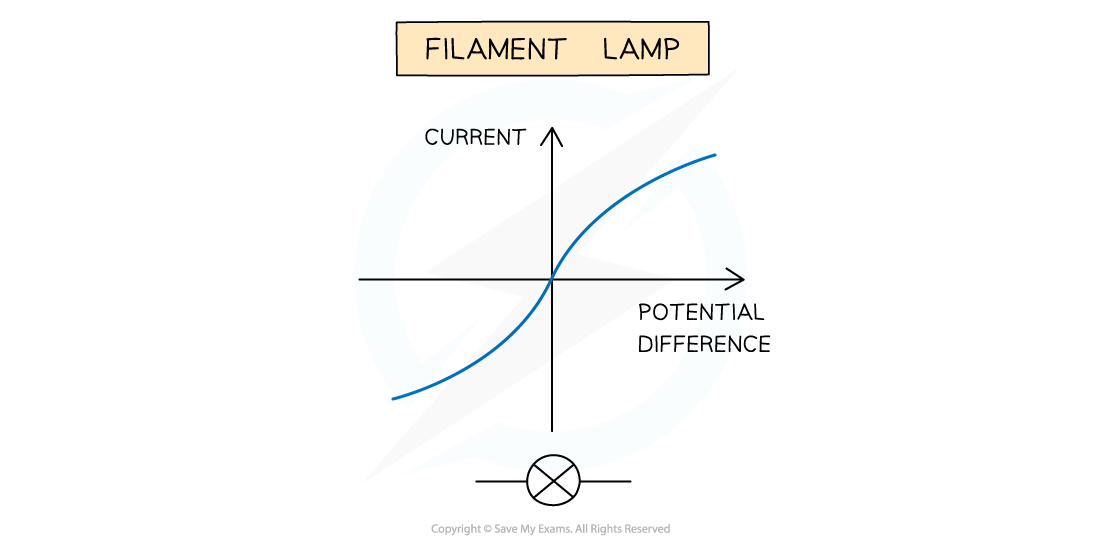
IV graph for a filament lamp
- This is because:
- As the?current?increases, the?temperature?of the filament in the lamp increases
- The higher temperature causes the atoms in the metal lattice of the filament to?vibrate?more
- This causes an increase in resistance as it becomes more difficult for?free?electrons?(the current) to pass through
- Resistance?opposes?the current, causing the current to increase at a?slower?rate
- Where the graph is a straight line, the resistance is?constant
- The resistance?increases?as the graph?curves
- Reversing the potential difference reverses the current and makes no difference to the shape of the curve
Diodes
- A diode?allows current to flow in?one?direction only
- This is called?forward bias
- In the reverse direction, the diode has very high resistance, and therefore?no?current flows
- This is called?reverse bias
- The?IV?graph for a diode is slightly different:
- When the current is in the direction of the arrowhead symbol, this is?forward bias
- This is shown by the sharp increase in potential difference and current on the right side of the graph
- When the diode is switched around, this is?reverse bias
- This is shown by a zero reading of current or potential difference on the left side of the graph
- When the current is in the direction of the arrowhead symbol, this is?forward bias
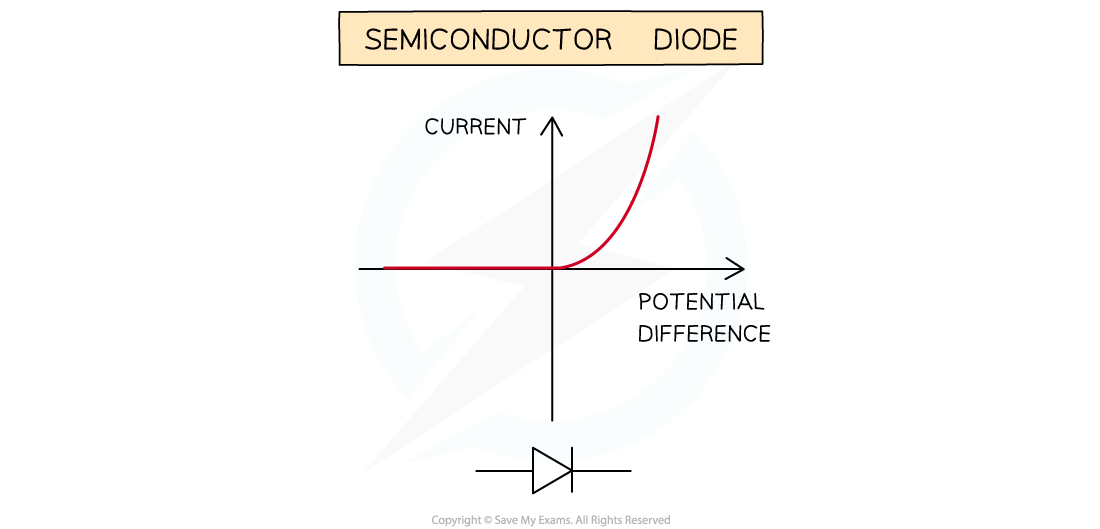
IV graph for a semiconductor diode
Investigating IV Graphs Experimentally
- In order to investigate the relationship between?current?and?voltage?different components, the following equipment is required:
- An?ammeter?- to measure the current through the component
- A?voltmeter?- to measure the voltage across the component
- A?variable resistor?- to vary the current through the circuit
- Power?source?- to provide a source of potential difference (voltage)
- Wires?- to connect the components together in a circuit
- The image below shows the circuits set up to obtain?IV?graphs for a filament lamp and a diode
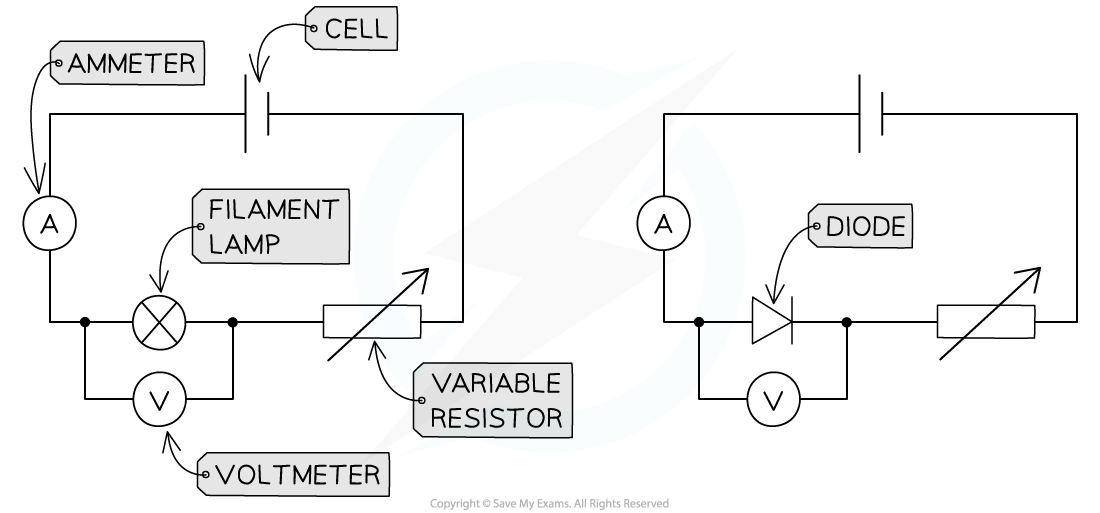
These circuits enable the investigation of current and voltage for a filament lamp or diode to be investigated
- The?current?is the?independent?variable
- The?variable resistor?is used to change the current flowing through the filament lamp / diode
- The?voltage?is the?dependent?variable
- The?voltmeter?is used to measure the voltage across the filament lamp / diode
- Recording measurements of current and voltage as the current increases enables an?IV?graph to be plotted for each component
Resistance
- Resistance is the?opposition?to the flow of?current
- The?higher?the resistance of a circuit the?lower?the current
- Resistors come in two types:
- Fixed?resistors
- Variable?resistors
- Fixed resistors have a resistance that remains?constant
- Variable resistors can?change?the resistance by changing the?length?of wire that makes up the circuit
- A?longer?length of wire has?more?resistance?than a shorter length of wire

Fixed and variable resistor circuit symbols
轉載自savemyexam

國際競賽真題資源免費領取


美高學分項目重磅來襲!立即了解