IB DP Biology: HL復習筆記2.2.3 Lipids

Long Term Storage
Lipids are excellent storage compounds
- Lipid macromolecules, like carbohydrates, contain?carbon, hydrogen?and?oxygen?atoms
- However, unlike carbohydrates, lipids contain?a low proportion of oxygen
- More of the oxygen required for their respiration has to come from?the air
- This allows lipids to be?energy-dense, maximising the energy content per gram versus carbohydrates
- They contain?2× more energy per gram?than most carbohydrates
- Less body mass?is required to store a given amount of energy
Lipids are?insoluble?so do not affect osmosis, so do not risk upsetting the water balance of the organism
- When lipids are respired,?a lot of water is produced?compared to the respiration of carbohydrates
- This is called?metabolic water?and can be used as a?dietary water source?when drinking water is unavailable
- A?camel's hump?is not a water sac, it is a lipid-rich storage organ that yields metabolic water for the camel in its dry desert habitat
- A?bird's egg?also makes use of lipid-rich yolk to provide energy and metabolic water to the growing chick
All these features make lipids ideal for long term energy storage
- This is called?metabolic water?and can be used as a?dietary water source?when drinking water is unavailable
Forms of lipid storage
- In?animals, lipids are stored in various areas
- Subcutaneous?fats are stored below the skin
- Visceral?fats are stored around the major internal organs
There are genetic?and?gender differences?between how individuals store fat
- Fat is stored in?adipose cells, which are specialised to contain large globules of fat
- Adipose cells shrink?when the fat is respired to generate metabolic energy
- In many plants,?seeds?have evolved to store fats to provide energy for a growing seedling plant
- Olives,?sunflowers,?nuts,?coconuts?and?oilseed rape?are good examples of crops whose oils are harvested for edible oil production by humans
Other roles of lipids
- As well as energy storage molecules, lipids have a?number of other roles
- Physical?protection of soft organs?eg. visceral fat around the heart
- Thermal insulation?from subcutaneous fat eg. whale blubber
- Subcutaneous fat as a?buoyancy aid?eg. in seals (fat is less dense than water so assists flotation)
- Waterproofing secretions?eg. birds' preening glands or waxy cuticles on leaf surfaces
- Electrical insulation?eg. the myelin sheath around certain nerve axons
Exam Tip
Ensure that you are familiar with the structure of a triglyceride and that you can recognise whether the fatty acids are saturated or unsaturated.
Lipids: Health Claims
- Lipids have been?associated with poor health?for a long time, even though they perform vital functions in tissues and organs
- High-fat diets tend to supply?more chemical energy?than an individual needs
- Consuming excess fat can cause an individual to become?overweight?or?obese?due to the?storage of fat?in adipose tissue
Body Mass Index?(BMI) is a rough and ready measure of a person's mass in relation to their height
- The calculation of BMI is as follows

-
- A BMI below 18.5 is considered?underweight
- A BMI 18.5-24.9 is considered?normal
- A BMI of 25.0-29.9 is considered?overweight
- A BMI of 30.0-39.9 is considered?obese
- A BMI of 40.0 or more is considered?morbidly obese
BMI is a crude measurement?as it works against individuals who are heavily muscular but who are also extremely lean
- Overweight and obese people have a higher risk of developing?type II diabetes?and?high blood pressure?and?coronary heart disease
- Because many risk factors combine in the prevalence of these conditions,?lipids are by no means the only cause
NOS: Evaluating claims; health claims made about lipids in diets need to be assessed
- Popular literature, TV and social media make?claims about various foods?and their health benefits
- A food product labelled, 'Low Sugar' may in fact contain a lot of trans-fats but?hides that information, or doesn't label it at all!
- Many health claims are based on?pseudoscience, or backed up with only very small trials or small samples sizes
- Only?scientifically controlled studies?are able to prove?causal links?between food choices and health risks
- Techniques such as?randomised clinical trials?provide data to?inform government policy?and consumers about their food choices
- There remain?complex challenges?for consumers, food producers and governments to ensure a food supply that puts people?at least risk of disease?whilst ensuring that enough food is produced
Formation of Lipids
Triglycerides are formed by?esterification
- An?ester bond?forms when the hydroxyl (-OH) group of the glycerol bonds with the carboxyl group (-COOH) of the fatty acid
- The formation of an ester bond is a?condensation reaction
- For each ester bond formed a water molecule is released
Three fatty acids?join to?one glycerol?molecule to form a?triglyceride
- Therefore for one triglyceride to form,?three water molecules are released
- The formation of an ester bond is a?condensation reaction
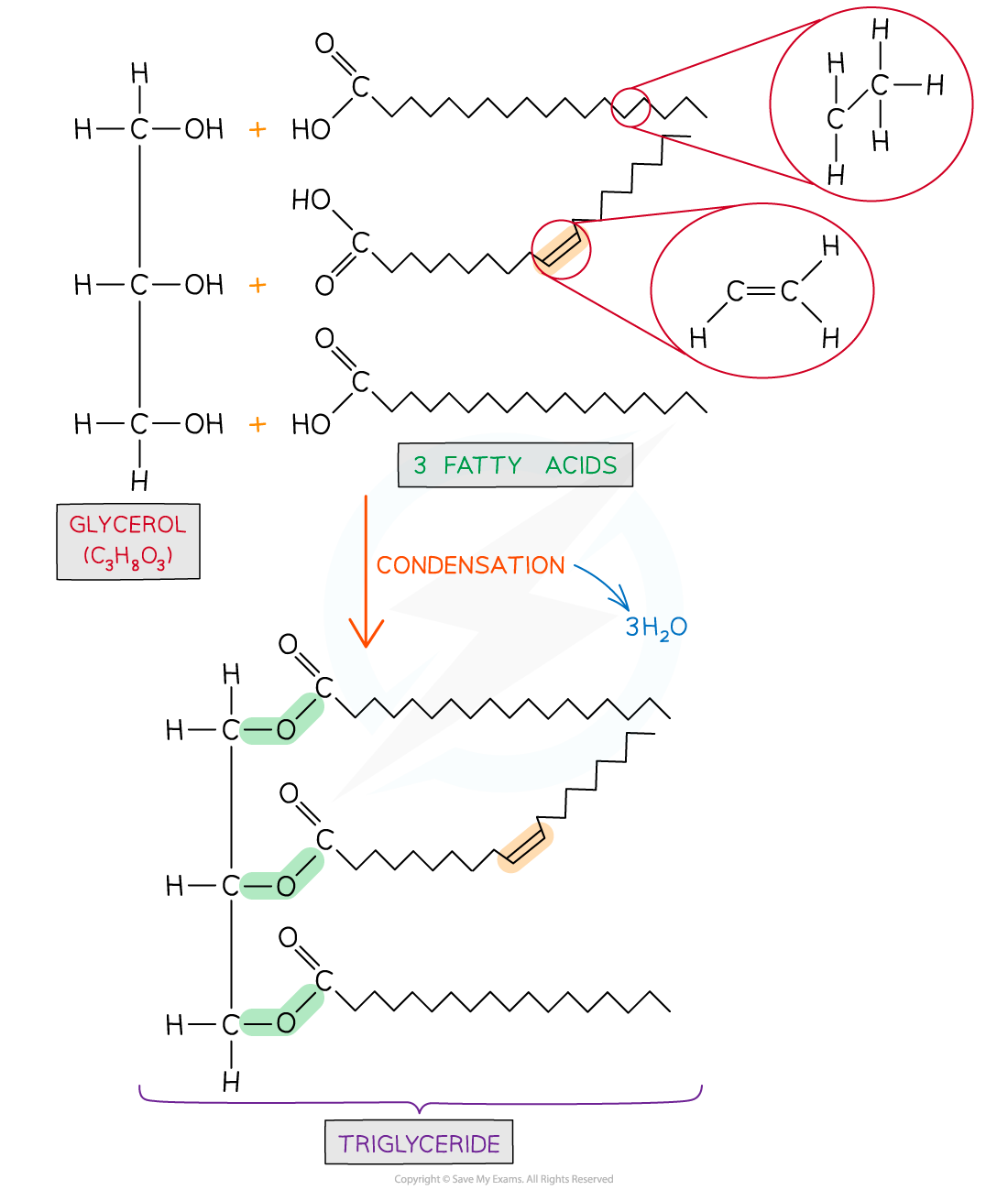
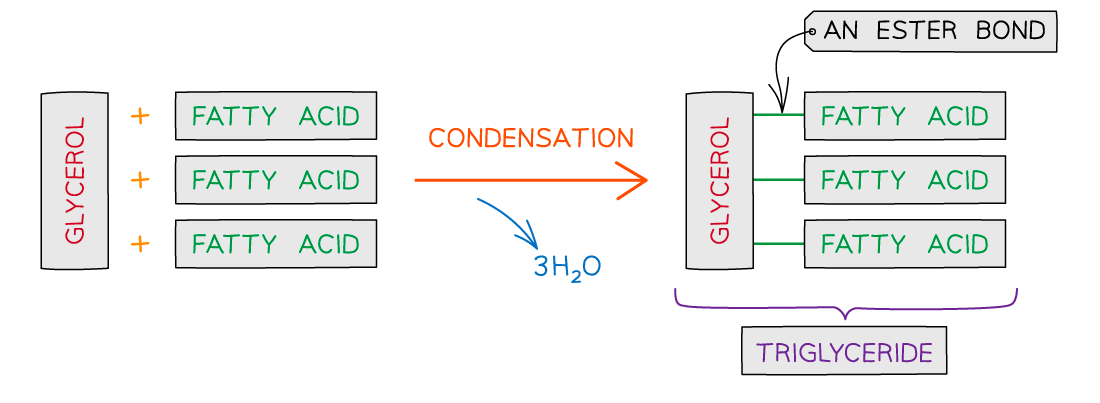
Formation of a triglyceride from a glycerol molecule and three fatty acid molecules by the process of esterification
轉載自savemyexams

國際競賽真題資源免費領取


美高學分項目重磅來襲!立即了解