IB DP Biology: HL復習筆記11.2.1 Requirements for Movement

Bones & Exoskeletons
- The effective movement of the human body requires both?muscle?and an?incompressible skeleton
- Bones and exoskeletons provide?anchorage for muscles?and?act as levers
- Mammals have?internal bones,?called an?endoskeleton,?to support their bodies from the inside with tissues surrounding the bone
- Many organisms have?external skeletons?called?exoskeletons?which are found on the?outside of the organism?to protect the internal tissues
- Organisms that have exoskeletons?include:
- Crustaceans
- Insects
- Arachnids
- Centipedes and millipedes
- Molluscs
- Key features of both exo and endo skeletons is that they?provide?support for the body?of the organism whilst also?facilitating movement
- Exoskeletons also provide?protection?for the body's soft tissues within
- Muscles are anchored to the skeleton either on the inside (as with exoskeletons) or the outside (as with endoskeletons) and the presence of pivot points means that?skeletons act as levers?transferring the size and direction of force
- Levers have a point of?effort, a point of?load?and a?pivot point?called the fulcrum
- These same three features are seen in skeletons
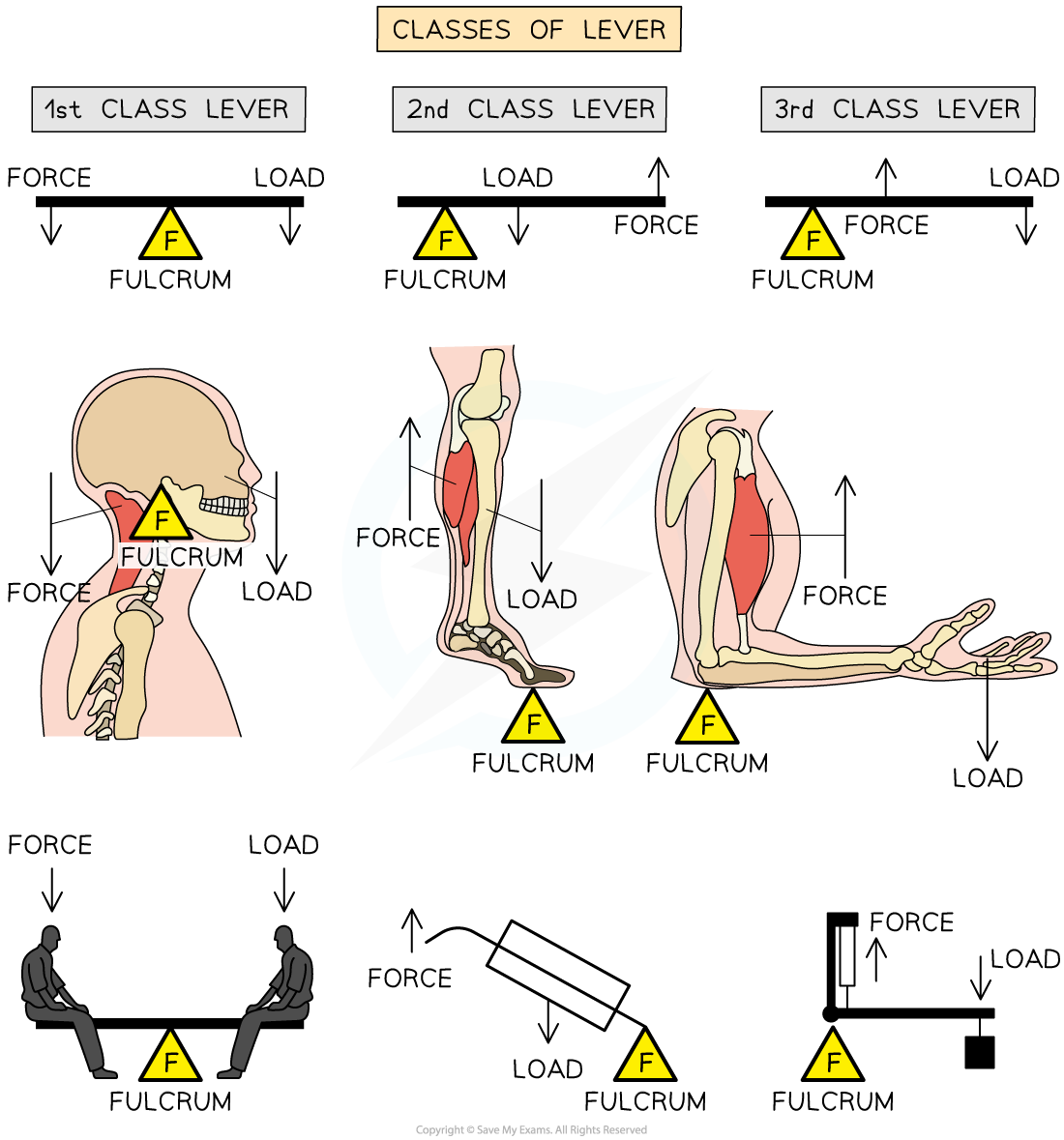
Muscles attach to bones at the joints creating a system of levers
Antagonistic Pairs
- There are over 600 skeletal muscles in the human body
- Muscles are?effectors, stimulated by nerve impulses from?motor neurones?(specialised cells adapted to rapidly carry electrical charges called nerve impulses from sensory neurones to the muscles to bring about movement)
- Lengths of strong connective tissue called?tendons, connect muscles to bones
- They are?flexible but do not stretch?when a muscle is contracting and pulling on a bone
- Muscles are only capable of?contracting?or?pulling, they?cannot push
- As a result of this limitation muscles generally?operate in pairs
- One muscle pulls in one direction at a joint and the other muscle pulls in the opposite direction
- This is described as?antagonistic muscle action
- An example of this can be seen in the?bicep and tricep?of the arm
- To raise the lower arm
- The bicep contracts and the tricep relaxes
- As the bone can't be stretched the arm flexes around the joint
- This brings the tricep into its full length so that it can contract again
- To lower the lower arm
- The tricep contracts and bicep relaxes
- As the bone can't be stretched the arm flexes around the joint
- To raise the lower arm
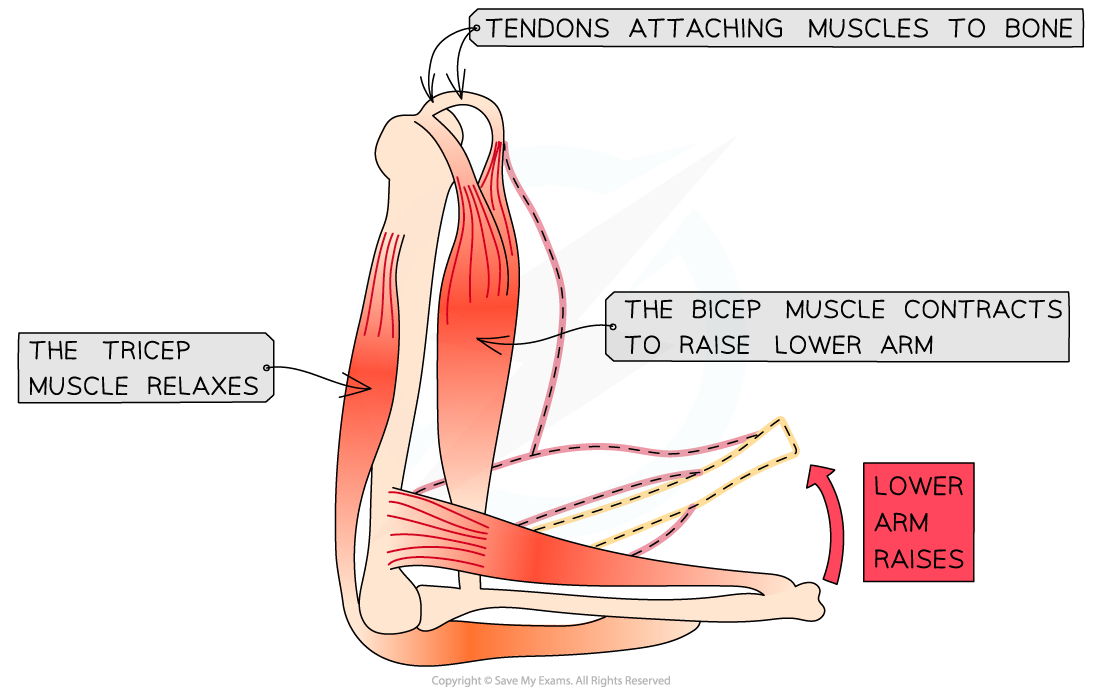
The two muscles work together by pulling in opposite directions
Antagonistic pairs of muscles in an insect leg
- Antagonistic muscles?are also common in the?appendages of insects
- Insects such as the praying mantis and the grasshopper have rear legs that are adapted to allow?jumping
- These rear legs are separated into three sections
- The?tarsus?is the lower leg
- The?tibia?is the middle part below the joint
- The?femur?is the upper leg
- Antagonistic muscles connect the tibia and femur
- An?extensor?muscle
- A?flexor?muscle
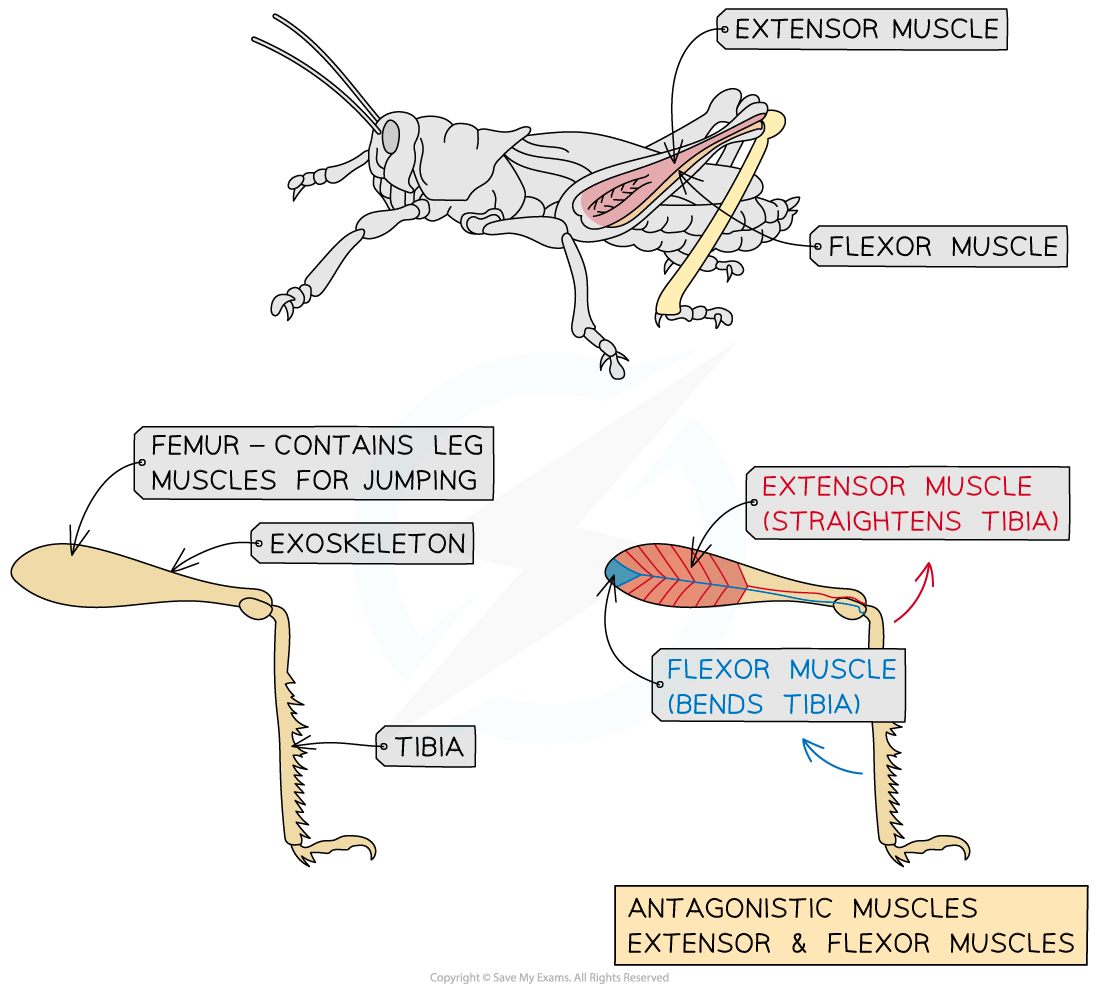
The structure of a grasshopper leg including antagonistic muscles
- When preparing to jump, the?flexor muscles contract?and the?extensor muscles relax
- This is called ‘flexing’
- The shape of the leg is ‘Z’ shaped as the tibia and femur are?brought closer together
- To propel the insect into the air, the?extensor muscle then contract and flexor muscles relax
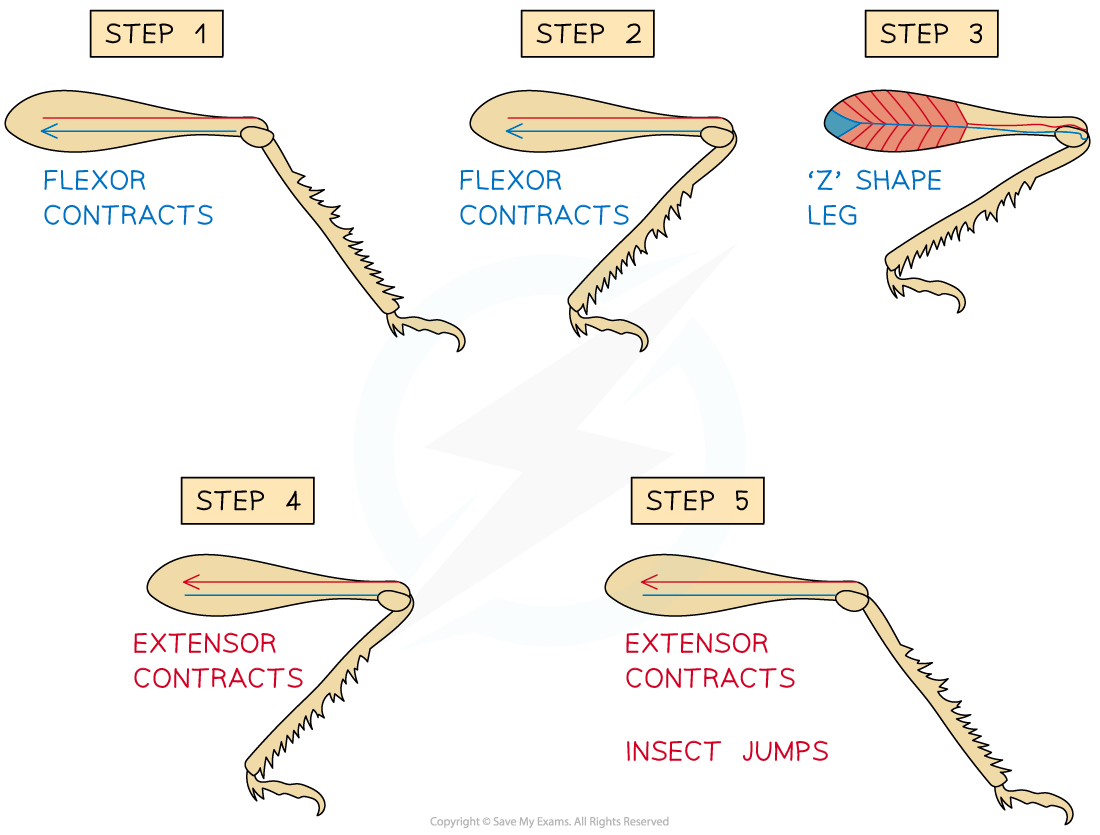
Antagonistic muscles control the jumping movement of a grasshopper
Joints & Range of Movement
- Synovial joints?are the most common type of joint in the human body
- They are characterised by a?joint cavity filled with a lubricating synovial fluid?which?reduces friction
- The fluid is produced by the?synovial membrane, which surrounds the joint
- Synovial joints are?capable of a variety of different movements?which depends on the structure within the joint including the joint type and the ligaments
- The movements possible at the joint are
- Flexion
- Extension
- Rotation
- Abduction (the movement of a limb away from the body)
- Adduction (the movement of a limb towards the body)
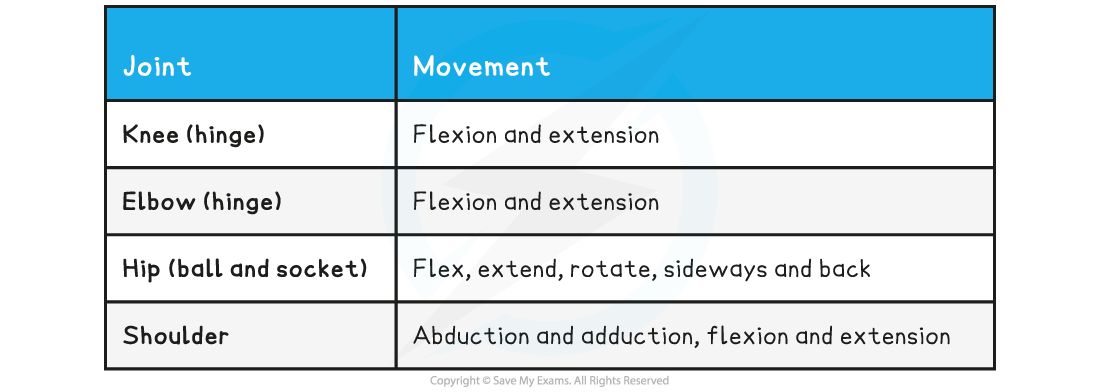
Table to show some examples of different joint types and their associated movements
轉載自savemyexams

國際競賽真題資源免費領取


美高學分項目重磅來襲!立即了解