IB DP Chemistry: HL復(fù)習(xí)筆記14.1.2 More Lewis Structures

Octet Rule Exceptions
Incomplete octets
- We have seen previously that for elements below atomic number 20 the?octet rule?states that the atoms try to achieve 8 electrons in their valence shells, so they have the same electron configuration as a noble gas
- However, there are some elements that are exceptions to the?octet rule, such a H, Li, Be, B and Al
- H can achieve a stable arrangement by gaining an electron to become 1s2, the same structure as the noble gas helium
- Li does the same, but losing an electron and going from 1s22s1?to 1s2?to become a Li+?ion
- Be from group 2, has two valence electrons and forms stable compounds with just four electrons in the?valence shell
- B and Al in group 13 have 3 valence electrons and can form stable compounds with only 6 valence electrons
Table showing examples of incomplete octets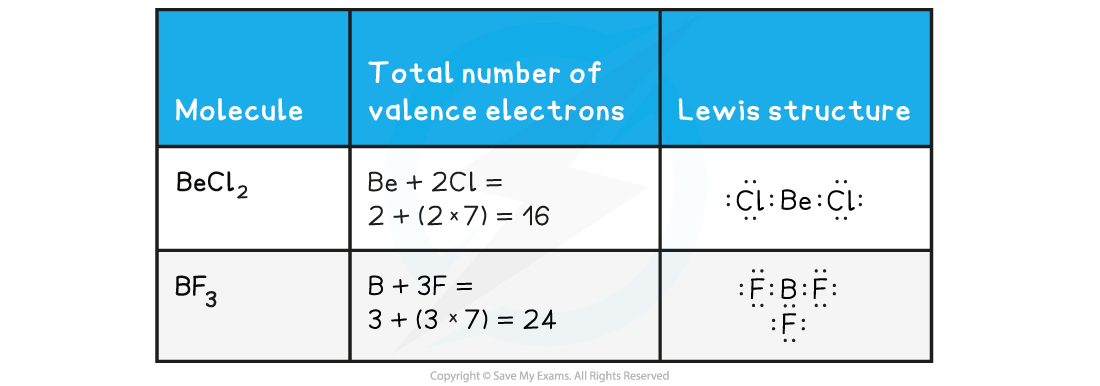
Expansion of the octet
- Elements in period 3 and above have the possibility of having more than eight electrons in their valence shell
- This is because there is a d-subshell present which can accommodate additional pairs of electrons
- This is known as the?expansion of the octet
- The concept explains why structures such as PCl5?and SF6?exist, which have 10 and 12 bonding pairs of electrons respectively, around the central atom
More Lewis Structures
Five electron pairs
Phosphorus pentachloride, PCl5
- An example of a molecule with five bonding electron pairs is phosphorus pentachloride, PCl5
- The total number of valence electrons is = P + 5Cl = 5 + (5 x 7) = 40
- The number of bonding pairs is 5, which accounts for 10 electrons
- The remaining 30 electrons would be 15 lone pairs, so that each Cl has 3 lone pairs
- The completed Lewis diagram looks like this:

Lewis diagram for PCl5
Sulfur tetrafluoride, SF4
- The total number of valence electrons is = S + 4F = 6 + (4 x 7) = 34
- The number of bonding pairs is 4, which accounts for 8 electrons
- The remaining 26 electrons would be 13 lone pairs
- Fluorine cannot expand the octet so each fluorine would accommodate 3 lone pairs, accounting for 24 electrons, leaving one lone pair on the sulfur (sulfur has expanded the octet)
- The completed Lewis diagram looks like this:

Lewis diagram for SF4
Chlorine trifluoride, ClF3
- The total number of valence electrons is = Cl + 3F = 7 + (3 x 7) = 28
- The number of bonding pairs is 3, which accounts for 6 electrons
- The remaining 22 electrons would be 11 lone pairs
- Fluorine cannot expand the octet so each fluorine would accommodate 3 lone pairs, accounting for 18 electrons, leaving two lone pairs on the chlorine
- The completed Lewis diagram looks like this:

Lewis diagram for ClF3
Triiodide?ion, l3-
- The total number of valence electrons is = 3I?+ the negative charge = (3 x 7) + 1 = 22
- The number of bonding pairs is 2, which accounts for 4 electrons
- The remaining 18 electrons would be 9 lone pairs
- Iodine would accommodate 3 lone pairs, accounting for 12 electrons, leaving three lone pairs on the central iodine
- The completed Lewis diagram looks like this:

Lewis diagram for l3-
Six electron pairs
Sulfur hexafluoride, SF6
- An example of a molecule with six bonding electron pairs is sulfur hexafluoride, SF6
- The total number of valence electrons is = S + 6F = 6 + (6 x 7) = 48
- The number of bonding pairs is 6, which accounts for 12 electrons
- The remaining 36 electrons would be 18 lone pairs, so that each F has 3 lone pairs, accounting for all electrons and no lone pairs
- The completed Lewis diagram looks like this:

Lewis diagram for SF6
Bromine pentafluoride, BrF5
- The total number of valence electrons is = Br + 5F = 7 + (5 x 7) = 42
- The number of bonding pairs is 5, which accounts for 10 electrons
- The remaining 32 electrons would be 16 lone pairs
- Fluorine cannot expand the octet so each fluorine would accommodate 3 lone pairs, accounting for 30 electrons, leaving one lone pairs on the bromine
- The completed Lewis diagram looks like this:

Lewis diagram for BrF5
Xenon tetrafluoride, XeF4
- The total number of valence electrons is = Xe + 4F = 8 + (4 x 7) = 36
- The number of bonding pairs is 4, which accounts for 8 electrons
- The remaining 28 electrons would be 14 lone pairs
- Each fluorine would accommodate 3 lone pairs, accounting for 24 electrons, leaving two lone pairs on the xenon
- The completed Lewis diagram looks like this:

Lewis diagram for XeF4
轉(zhuǎn)載自savemyexams

國(guó)際競(jìng)賽真題資源免費(fèi)領(lǐng)取


美高學(xué)分項(xiàng)目重磅來(lái)襲!立即了解