IB DP Physics: HL復習筆記3.1.2 Temperature

Temperature
- Temperature?is a measure of how hot or cold objects are
- Temperature also determines the direction in which thermal energy will flow between two objects (or between an object and its surroundings)
- When thermal energy is exchanged, the objects (or systems) involved are said to have a?thermal interaction
- The thermal energy exchanged during a thermal interaction is referred to as?heat
- During a thermal interaction:
- Thermal energy always flows from the hotter object to the colder object
- The energy transfer continues until the two objects are in?thermal equilibrium?(i.e. they both have the same temperature)
- Thermal energy can be transferred via?conduction,?convection?or?radiation
- Temperature is a?scalar?quantity and it is measured using a?thermometer
- It is measured in?degrees Celsius?(°C) or?kelvin?(K)
- The kelvin is the?SI base unit?for temperature
- The temperature of an object is a?macroscopic?measure of the?average kinetic energy?of the particles (atoms or molecules) that make up the object
Absolute temperature
- Absolute temperature?is temperature measured in kelvin (K)
- Absolute zero?is a temperature of zero kelvin (0 K) and corresponds to the temperature at which the?average?kinetic energy?of the molecules?is at its?minimum
- The conversion between the Kelvin and the Celsius scale is given by:
T(K) = T(°C) + 273.15
- It is important to notice that?differences in absolute temperatures correspond to differences in Celsius temperatures?
ΔT(K) = ΔT(°C)
-
- Where?ΔT?stands for?temperature change
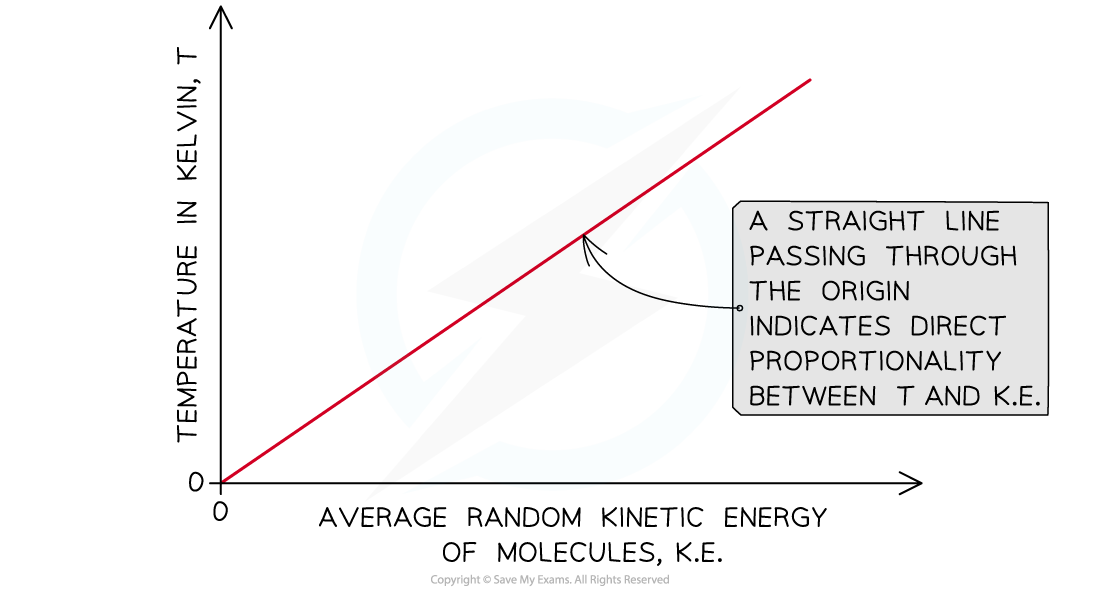
- The?absolute temperature?of a body is?directly proportional to the average kinetic energy of the molecules within the body
The ice point is determined by placing a thermometer in a beaker containing melting ice, while the steam point is determined by placing the thermometer in a beaker with boiling water
Worked Example
Give an estimate of room temperature in kelvin (K).
Step 1: State a reasonable value for room temperature in degree Celsius (°C)
room temperature (°C) ~ 20°C
Step 2: Write down the conversion between Celsius scale and Kelvin scale?
T(K) = T(°C) + 273.15
Step 3: Convert the room temperature value and express it in kelvin (K)
room temperature (K) ~ 293 K
Exam Tip
Remember that the lowest possible temperature on the Kelvin scale is absolute zero (0 K). Therefore, if you are calculating temperature in kelvin and you end up with a negative number, you need to check your work, since negative numbers do not exist on the Kelvin scale.
轉載自savemyexams

國際競賽真題資源免費領取


美高學分項目重磅來襲!立即了解