IB DP Biology: SL復習筆記1.1.3 Surface Area to Volume Ratio

Surface Area to Volume Ratio
- For cells to survive, metabolic reactions must be occurring, these reactions depend on:
- Materials?constantly being?exchanged?across the?plasma membrane
- The?volume/mass?of cytoplasm (as this is where the reactions take place)
- As organisms?increase in size?their?SA:V ratio decreases
- There is?less surface area?for the absorption of nutrients and gases and secretion of waste products
- The?greater volume?results in a?longer diffusion distance?to the cells and tissues of the organism
- Thus the?rate?at which substances (e.g. oxygen and heat) are?exchanged?across the plasma membrane is dependent on the?surface area?(the?larger?the surface area the?more?substances are exchanged)
- The rate at which a cell?metabolises?is dependent on the?mass/volume?of the cytoplasm (the?larger?the mass/volume the?longer?it takes for metabolic reactions to occur)
Limitations to cell size
- Single-celled organisms have a high SA:V ratio which allows for the exchange of substances to occur via simple diffusion
- The large surface area allows for maximum absorption of?nutrients?and?gases?and secretion of?waste products
- The small volume means the diffusion distance to all organelles is?short
- A consequence of the SA:V ratio is that cells cannot grow bigger indefinitely. Once the ratio becomes too small, growth must stop and the cells must divide
- To overcome this, large multicellular animals and plants have?evolved adaptations?to facilitate the exchange of substances between their environment
- They have a large variety of specialised cells, tissues, organs and systems
- Eg. gas exchange system, circulatory system, lymphatic system, urinary system, xylem and phloem
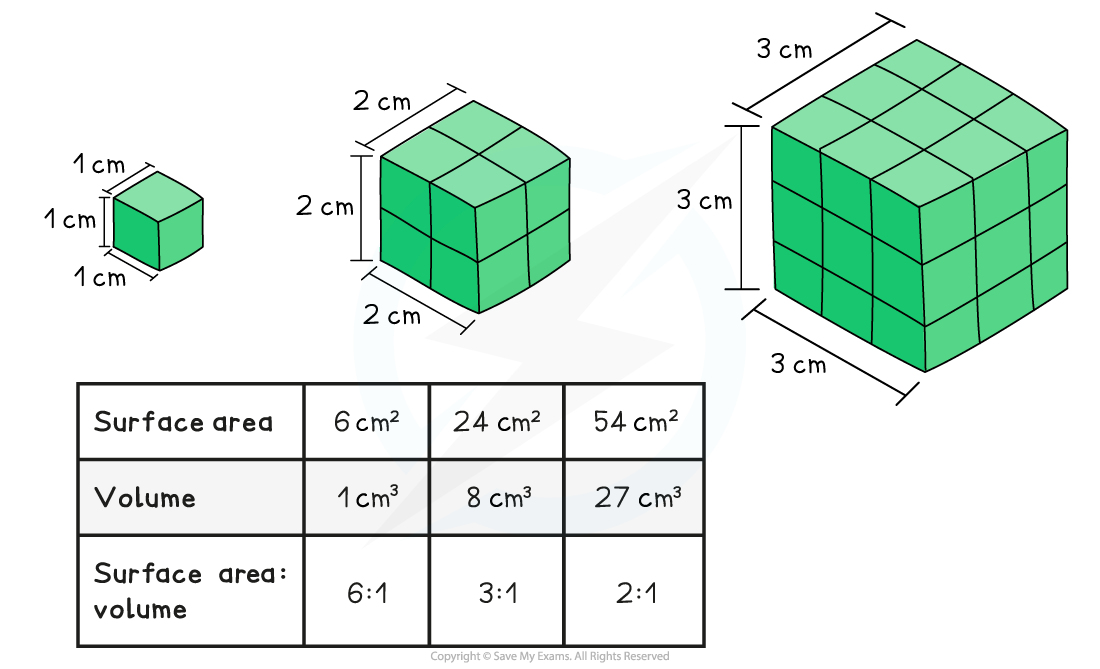
As the size of an organism increases, it’s surface area : volume ratio decreases. Notice for this particular shape the distance between the surface and the centre increases with size.
Exam Tip
Remember the rate of metabolism is dependent on the mass/volume of the cell whereas the rate of exchange is dependent on the surface area.
轉載自savemyexams
以上就是關于【IB DP Biology: SL復習筆記1.1.3 Surface Area to Volume Ratio】的解答,如需了解學校/賽事/課程動態,可至翰林教育官網獲取更多信息。
往期文章閱讀推薦:
IBO官宣!M26 IB放榜全球均分30.88!香港誕生66名狀元,內地均分35.47全球領跑!
2027年IB改革全解析:數學AA/AI考點瘦身、語言B升級及新課綱時間軸詳解!


翰林AMC8視頻課重磅上線!

國際競賽真題資源免費領取






