IB DP Biology: SL復習筆記1.4.2 Phases of Mitosis

Phases of Mitosis
- Mitosis is the process of nuclear division by which?two genetically identical daughter nuclei?are produced that are also genetically identical to the parent cell nucleus (they have the same number of chromosomes as the parent cell)
- Significance of mitosis: mitosis occurs whenever the production of genetically identical nuclei are required in eukaryotic cells
- E.g. during embryonic development, growth, tissue repair and asexual reproduction
Embryonic development and growth of multicellular organisms
- Unicellular zygotes?divide by mitosis in order to?grow in size
- After a certain amount of growth, they then differentiate?into embryos
- Growth?of multicellular organisms occurs as the number of new cells increases due to mitosis
- This growth may occur across the whole body of the organism or be confined to certain regions, such as in the meristems (growing points) of plants
Replacement of cells & repair of tissues
- Damaged tissues can be repaired by mitosis followed by cell division
- As cells are constantly dying they need to be?continually replaced by genetically identical cells
- In humans, for example, cell replacement occurs particularly rapidly in the skin and the lining of the gut
- Some animals can regenerate body parts, for example, zebrafish can regenerate fins and axolotls regenerate legs and their tail amongst other parts
Asexual reproduction
- Asexual reproduction is the production of new individuals of a species by a?single?parent organism – the offspring are genetically identical to the parent
- For unicellular organisms such as?Amoeba, cell division results in the reproduction of a?genetically identical offspring
- For multicellular organisms, new individuals grow from the parent organism (by cell division) and then detach (‘bud off’) from the parent in different ways
- This type of reproduction can be observed in different plant, fungi and animal species
- Some examples of these are budding in?Hydra?and yeast and runners from strawberries
Phases of Mitosis
- Although mitosis is, in reality, one continuous process, it can be divided into?four main stages or phases
- These stages are:
- Prophase
- Metaphase
- Anaphase
- Telophase
- Most organisms contain many chromosomes in the nuclei of their cells (eg. humans have 46) but the diagrams below show mitosis of an animal cell with only four chromosomes, for simplicity
- The different colours of the chromosomes are just to show that half are from the female parent and half from the male parent
Prophase
- Chromosomes?condense?and are now visible when stained
- The chromosomes consist of?two identical chromatids?called?sister chromatids?(each containing one DNA molecule) that are joined together at the?centromere
- The two centrosomes (replicated in the G2?phase just before prophase) move towards?opposite poles?(opposite ends of the nucleus)
- Spindle fibres?(protein?microtubules) begin to emerge from the?centrosomes?(consists of two centrioles in animal cells)
- The?nuclear envelope?(nuclear membrane)?breaks down?into small vesicles
- The nucleolus disappears
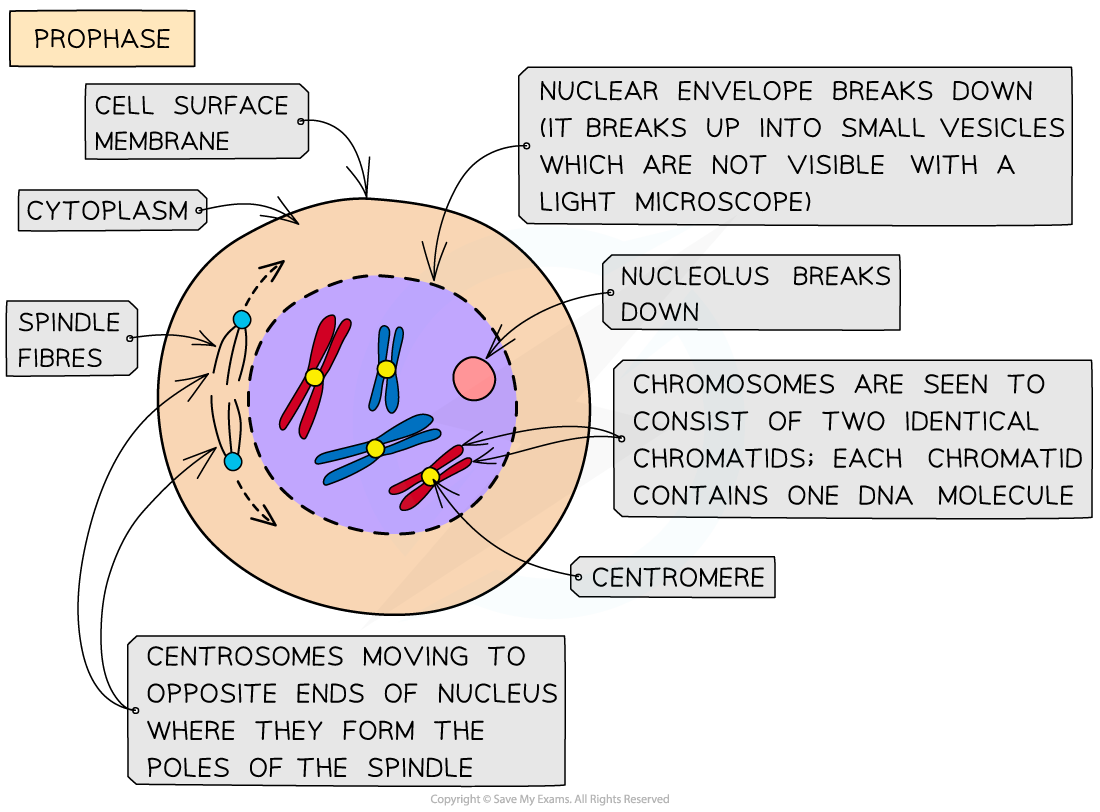
Prophase
Metaphase
- Centrosomes?reach?opposite poles
- Spindle fibres?(protein microtubules) continue to?extend from centrosomes
- Chromosomes?line up at the equator?of the spindle (also known as the metaphase plate) so they are equidistant to the two centrosome poles
- Spindle fibres (protein microtubules) reach the chromosomes and?attach to the centromeres
- This attachment involves specific proteins called?kinetochores
- Each?sister chromatid?is attached to a spindle fibre originating from?opposite poles
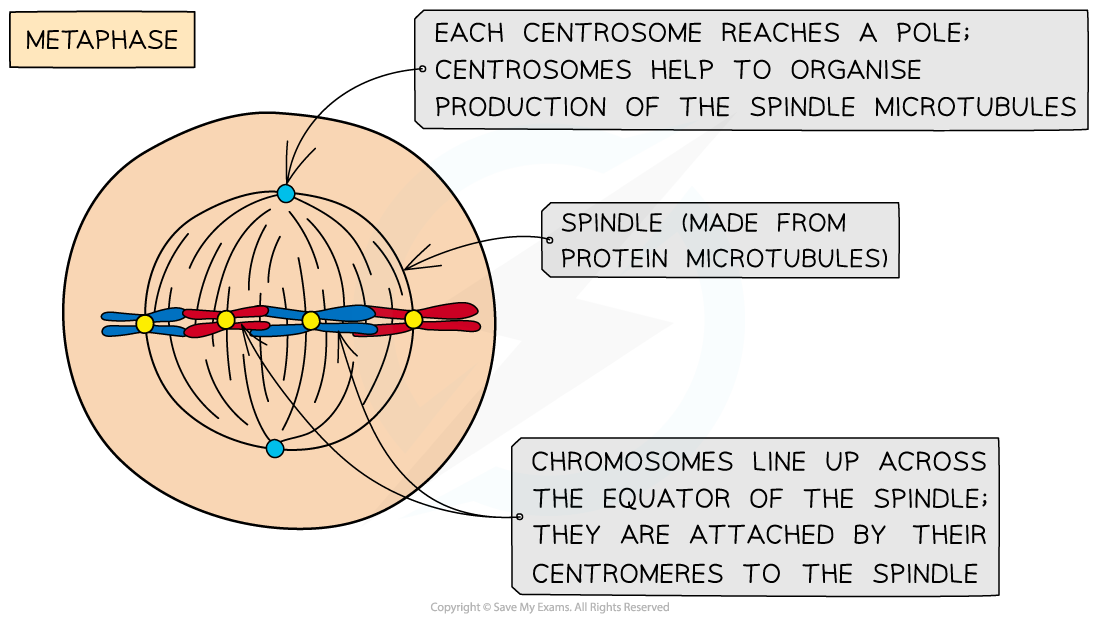
Metaphase
Anaphase
- The sister chromatids?separate at the centromere?(the centromere divides in two)
- Spindle fibres (protein microtubules) begin to?shorten
- The separated sister chromatids (now called chromosomes) are?pulled to opposite poles?by the spindle fibres (protein microtubules)
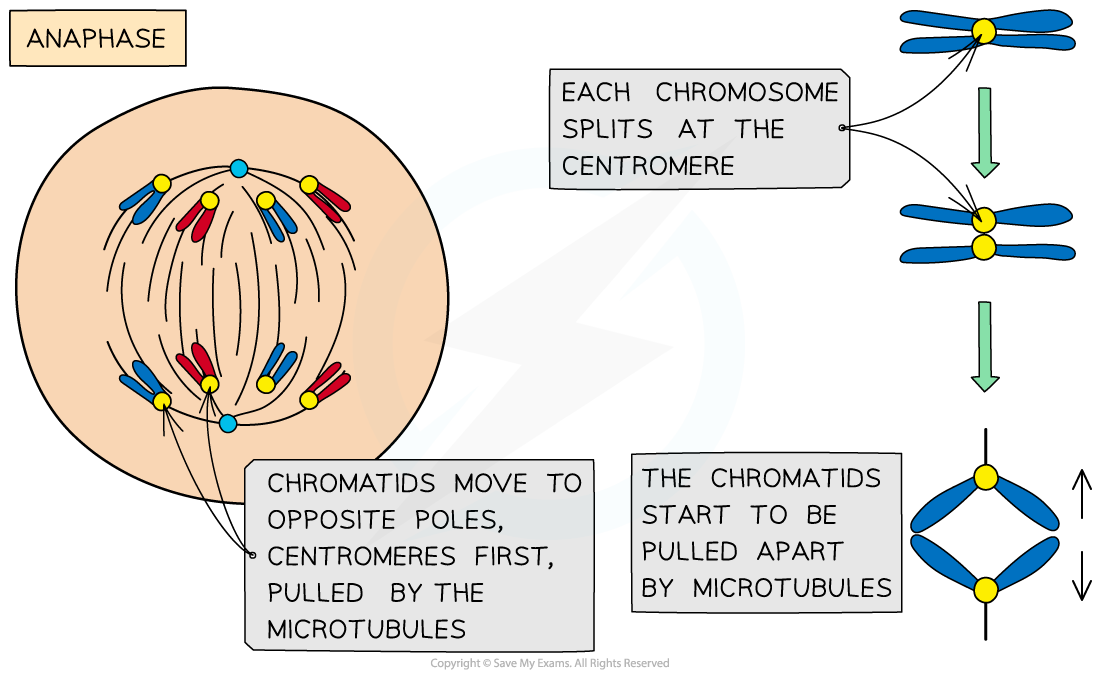
Anaphase
Telophase
- Chromosomes arrive at opposite poles and begin to?decondense
- Nuclear envelopes?(nuclear membranes) begin to?reform?around each set of chromosomes
- The?spindle fibres break down
- New?nucleoli form?within each nucleus
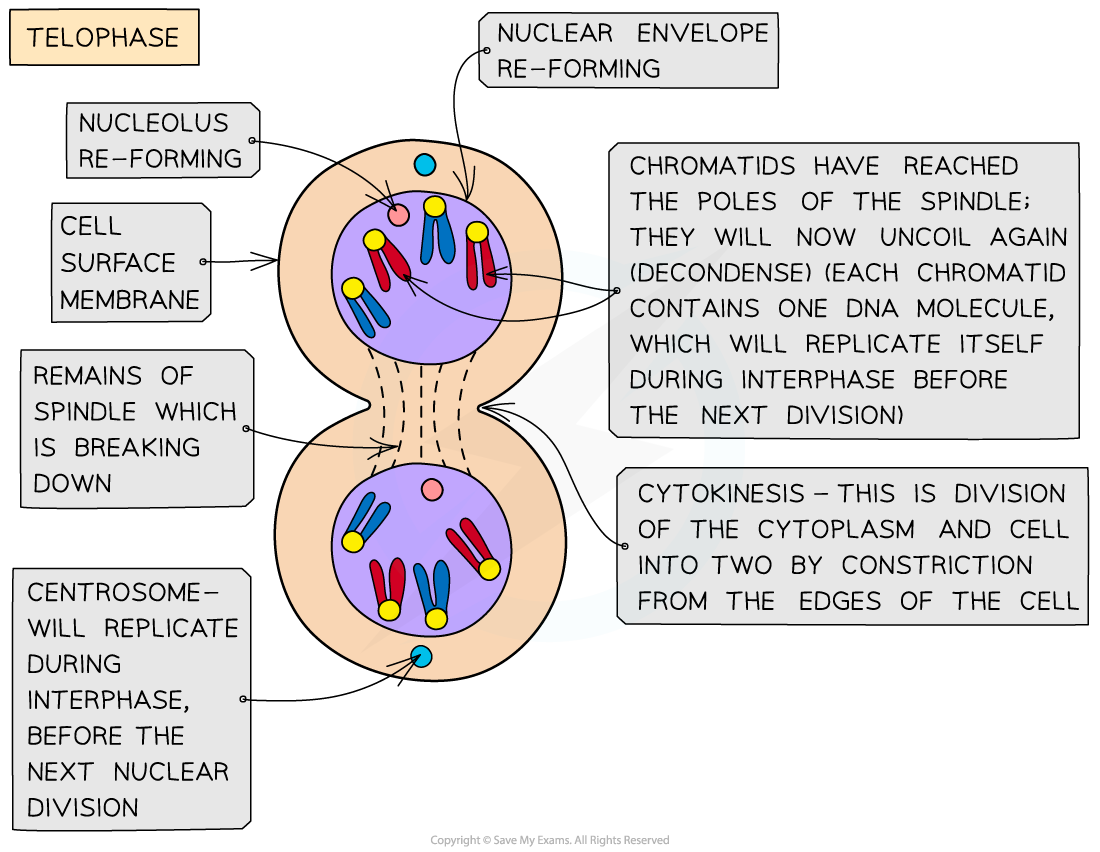
Telophase
Exam Tip
Make sure you learn the four stages of mitosis and what is happening to the DNA molecules (one chromatid contains one DNA molecule) at each stage – learn?‘PMAT’?(prophase, metaphase, anaphase, telophase) to help you remember the order of the stages!After interphase but before the parent cell undergoes mitosis, the human parent cell nucleus actually contains 92 DNA molecules! This is because during interphase (S phase), the 46 DNA molecules in the parent cell have replicated to form sister chromatids. As human cells have a diploid number of 46 this replication results in 92 molecules. This ensures the two daughter cells will be diploid (have 46 chromosomes each) when mitosis occurs.Remember to read the questions carefully as?only?human diploid cells have 46 chromosomes so if the question refers to another organism, its diploid number will be different.
Chromosomes Condense
Condensation of chromosomes
- DNA molecules are?very long molecules?(human DNA can be more than 50,000 μm) that need to fit within much smaller nuclei (human nuclei average less than 5 μm)
- Prior to mitosis, the DNA molecules are loosely coiled (around?histones?in eukaryotic cells) to form a complex called?chromatin
- During?prophase, the chromatin gets?condensed?by?supercoiling?to form?chromosomes
- Condensation occurs by the repeated coiling of the DNA molecule (supercoiling)
- This supercoiling is aided in eukaryotic cells by the presence of histone proteins and enzymes
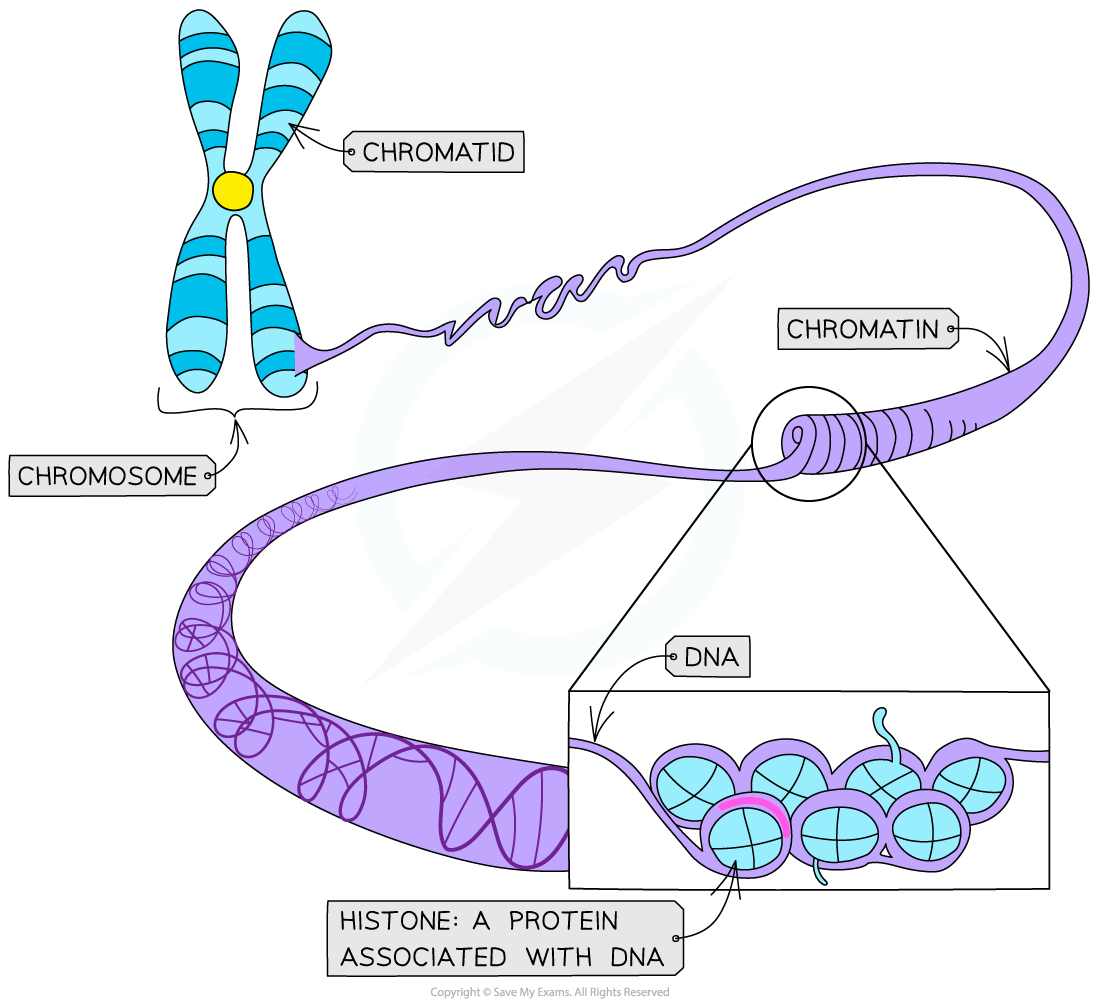
DNA is coiled around histone proteins to make chromatin
轉載自savemyexams
以上就是關于【IB DP Biology: SL復習筆記1.4.2 Phases of Mitosis】的解答,如需了解學校/賽事/課程動態,可至翰林教育官網獲取更多信息。
往期文章閱讀推薦:
MIT官方發布【2026年夏季推薦閱讀書單】!橫跨科學/人文/經濟...


翰林AMC8視頻課重磅上線!

國際競賽真題資源免費領取






