IB DP Biology: SL復習筆記3.1.6 Eukaryotic Chromosomes

Eukaryotic Chromosomes
- Chromosomes in eukaryotic cells are?one,?very long?DNA molecule associated with proteins
- The main proteins present are the large, positively charged globular proteins called?histones, their role is to?organise?and?wrap?the DNA tightly so that it fits into the nucleus
- The other proteins are?enzymes?used in copying and repairing the DNA
- The tightly coiled combination of DNA and proteins is called?chromatin?– this is what chromosomes are made of
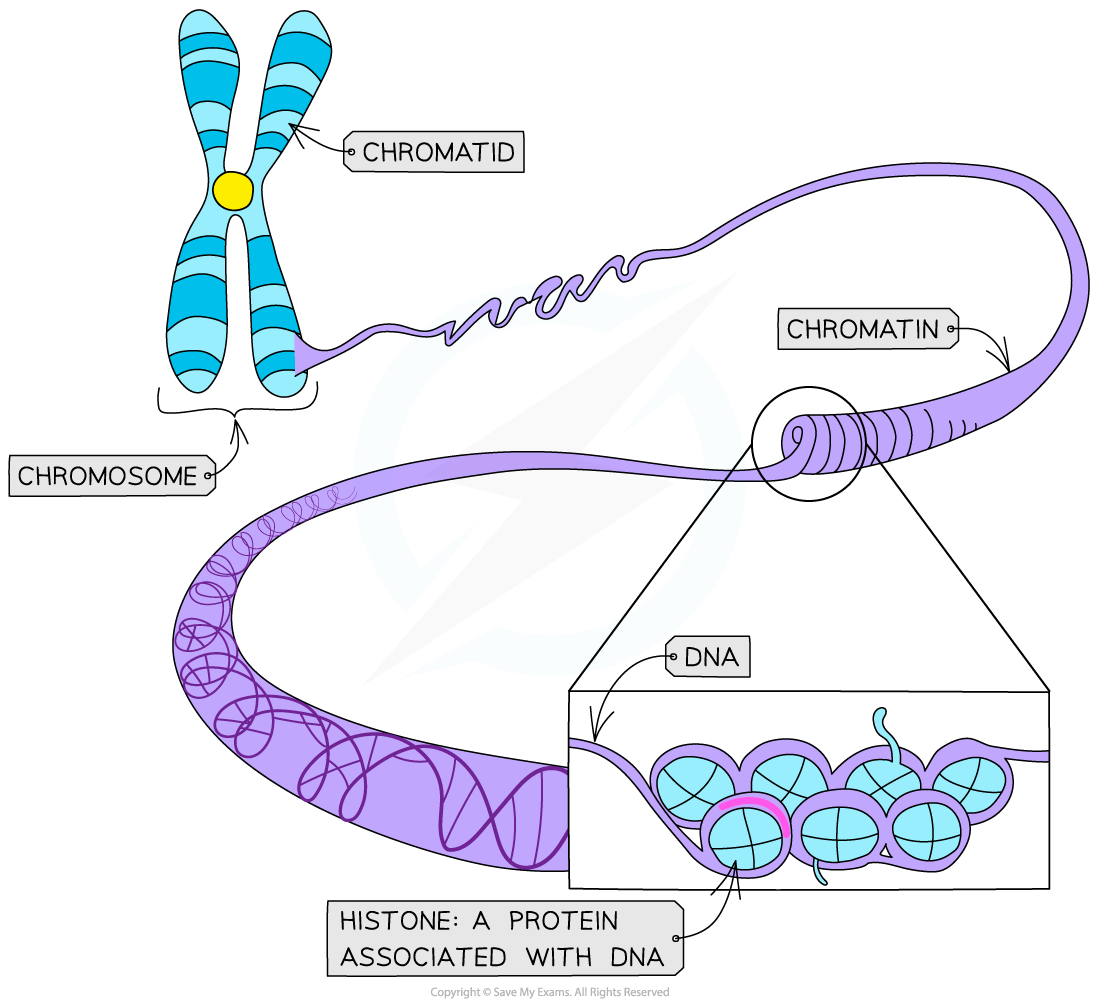 DNA is coiled around histone proteins to form chromatin
The replication of chromosomes
- During?interphase?(the period before mitosis) the DNA replicates to create?two identical strands of DNA called chromatids, joined together by a narrow region called the?centromere
- The two chromatids that make up the double structure of a chromosome are known as?‘sister chromatids’
- It is important that the?sister?chromatids?are?identical?in order to produce?genetically identical?daughter cells via mitosis
- During?anaphase?of?mitosis?one chromatid ends up in one daughter cell while the other chromatid ends up in the other daughter cell
- After the centromere is split apart at the start of anaphase the chromatids are referred to as individual?chromosomes?again
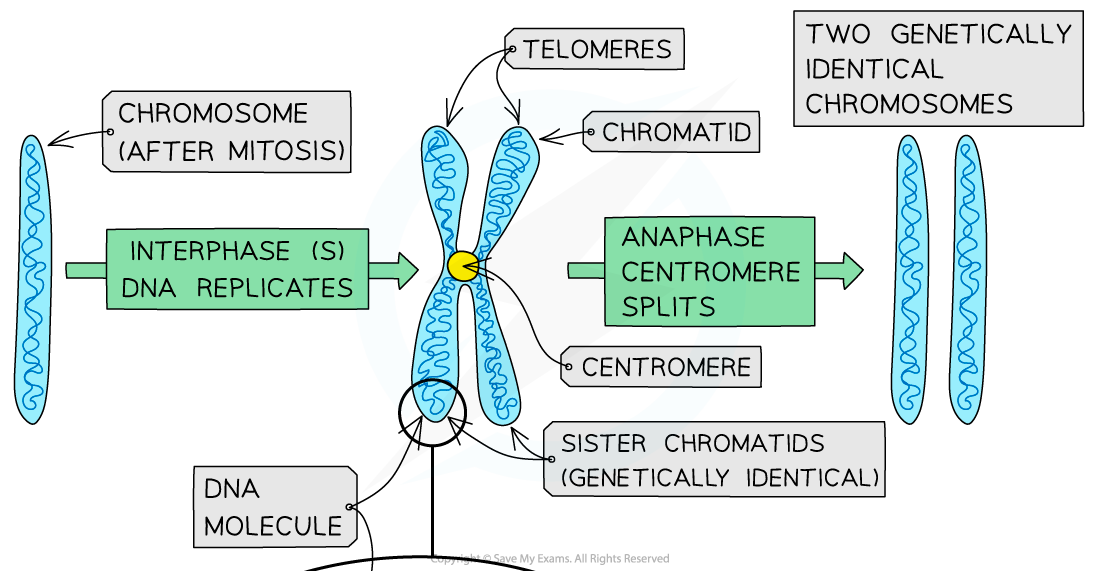
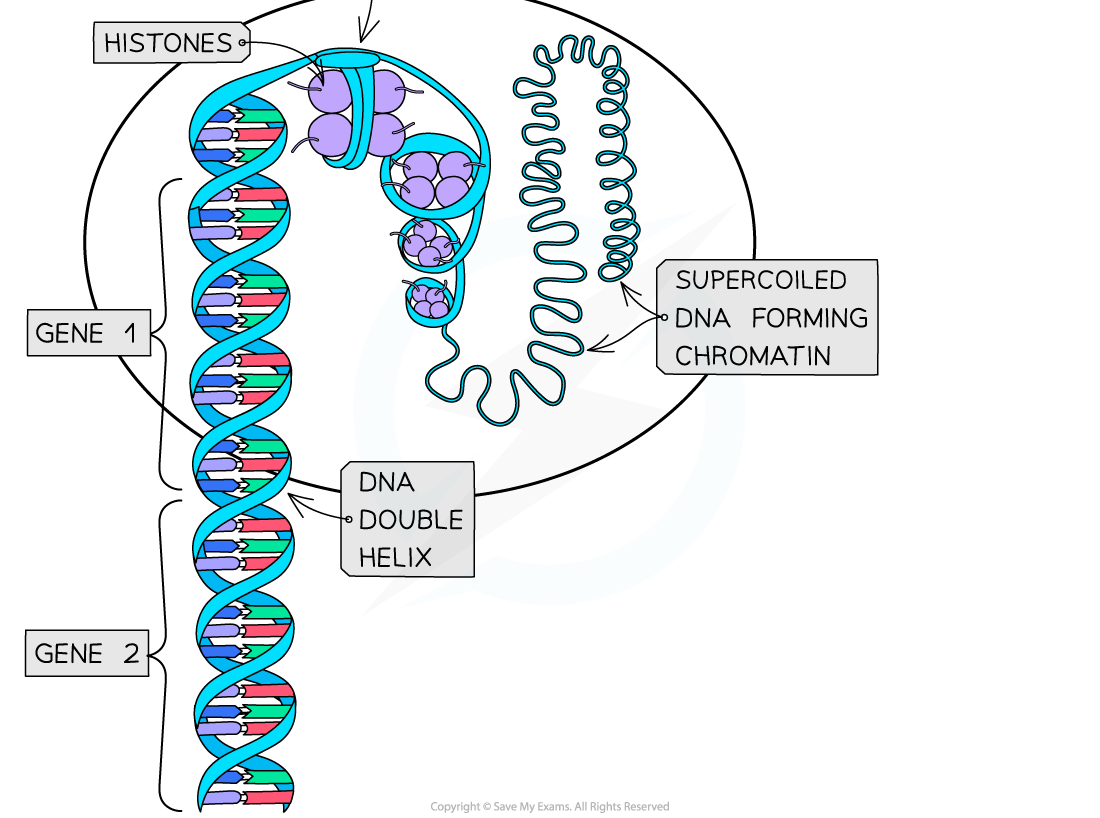
Diagram illustrating the structure of a chromosome at different stages of mitosis
Exam Tip
It is important to distinguish between the terms chromatid, sister chromatids and chromosomes.
Different Types of Chromosomes
- In a eukaryote species, there are different chromosomes that carry different genes
- During mitosis, chromosomes become denser by supercoiling, so?are easier to observe?than when they are in interphase
- Different types of chromosomes can be seen
- They?differ in length?and the?position of the centromere
- Humans have?23 types of chromosomes
- The largest one is numbered 1
- The smallest is numbered 22
- Pair 23 is the pair of sex chromosomes (XX or XY)
- Humans have between?20,000 and 25,000 genes?across all 46 chromosomes
- Specific?genes always appear at the same locus?(position) of a particular chromosome, for example:
- The SRY gene found on the Y chromosome causes the development of male genitalia such as the testes
- The genes that determine eye colour are located on chromosome 15
- The gene with a faulty version that leads to the disease cystic fibrosis is located on chromosome 7
- In other words, each chromosome type contains?specific genes arranged in a standard sequence
- This property allows for the exchange of genetic material between chromosomes during meiosis
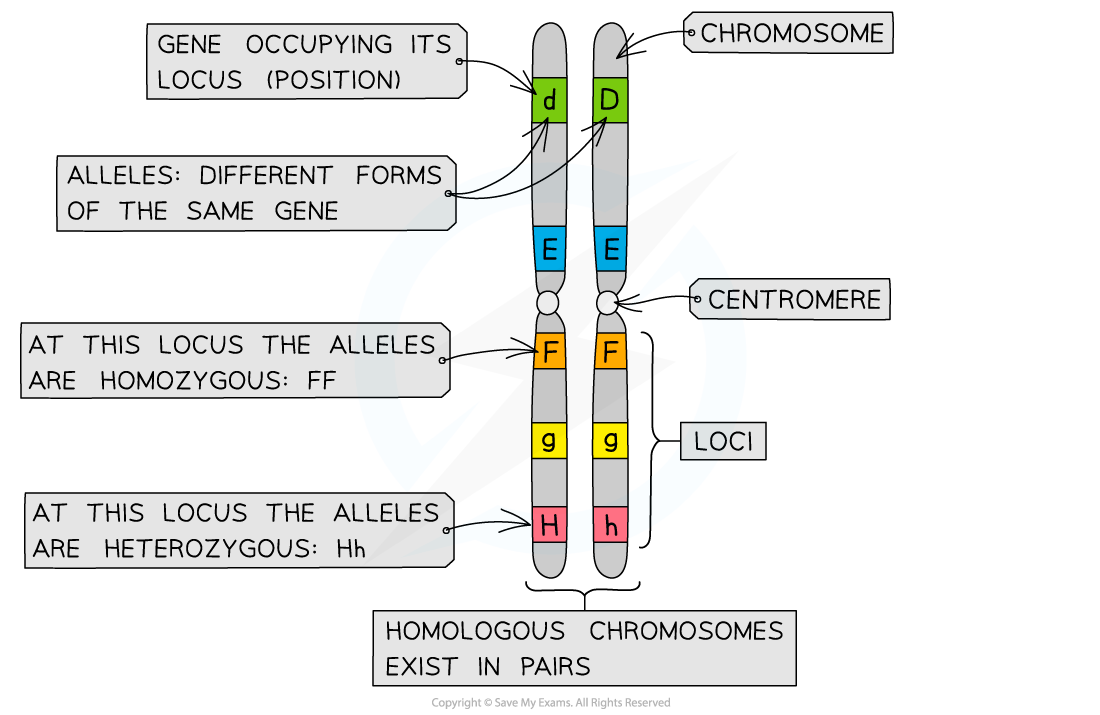
A pair of homologous chromosomes showing the loci of various alleles
Homologous Chromosomes
- In?diploid?cells there are two complete sets of chromosomes in the nucleus
- Homologous?chromosomes
- Carry the?same genes at the same loci
- Are the?same shape
- Are?not usually identical?because they may be carrying?different alleles?to each other
- During fertilization, a diploid?zygote?is formed
- In a zygote, one chromosome of each homologous pair comes from the female gamete and the other comes from the male gamete
- Having the same genes in the same?loci?helps homologous chromosomes line up alongside each other during Metaphase 1 of meiosis
- In photomicrographs, chromosomes are often grouped into their homologous pairs
- These are shown in a picture format as a?karyogram
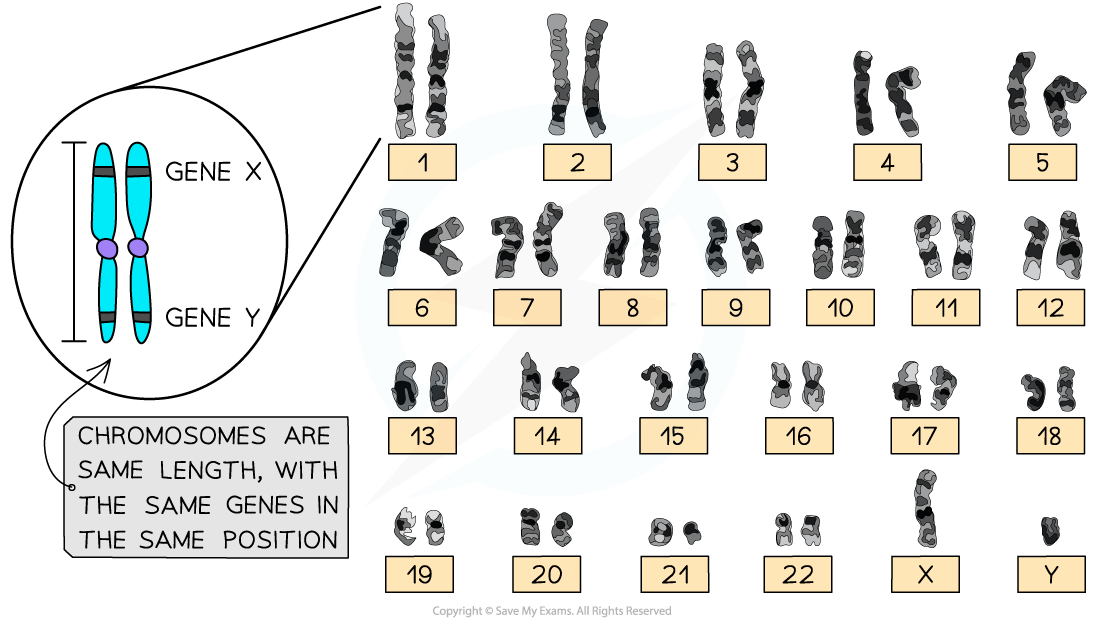
Human karyogram showing homologous chromosomes
Exam Tip
Although homologous pairs of chromosomes contain the same genes in the same order they don’t necessarily carry the same alleles (form) of each gene!
轉載自savemyexms
以上就是關于【IB DP Biology: SL復習筆記3.1.6 Eukaryotic Chromosomes】的解答,如需了解學校/賽事/課程動態,可至翰林教育官網獲取更多信息。
往期文章閱讀推薦:
MIT官方發布【2026年夏季推薦閱讀書單】!橫跨科學/人文/經濟...


翰林AMC8視頻課重磅上線!

國際競賽真題資源免費領取






