IB DP Biology: SL復(fù)習(xí)筆記3.4.3 Genetic Modification

Genetic Modification
Genetic modification is carried out by gene transfer between species
- Genetic?modification?is a term usually used to refer to the transfer of DNA sequences from one species to another
- The key feature of the genetic code that makes this possible is that it is?universal, meaning that almost every organism uses the same four nitrogenous bases – A, T, C & G. There are a few exceptions
- Additionally the?same?codons?code for the same amino acids in all living things?(meaning that genetic information is transferable between species)
- Thus scientists have been able to change an organism's DNA artificially?by combining lengths of nucleotides from?different sources?(typically the nucleotides are from different species)
- If an organism contains nucleotide sequences from a different species it is called a?transgenic?organism
- DNA that has been introduced into the genome of another organism is called?recombinant DNA?(rDNA)
- Any organism that has introduced genetic material is a?genetically modified organism?(GMO)
- The mechanisms of?transcription?and?translation?are also?universal?which means that the transferred DNA can be translated within cells of the genetically modified organism
Recombinant DNA technology
- This form of genetic modification involves?the transfer of fragments of DNA?from?one organism/species?into another?organism/species
- The resulting genetically modified organism will then contain?recombinant DNA?and will be a?Genetically Modified Organism?(GMO)
- Example
- A gene from the bacterium?Bacillus thuringiensis?(Bt?for short) codes for a?toxin?that has?insecticide?properties
- This gene has useful properties in commercial maize plants (Zea mays), so has been transferred into?transgenic maize plants?to make them less susceptible to insect pests,?improving agricultural productivity?as a result
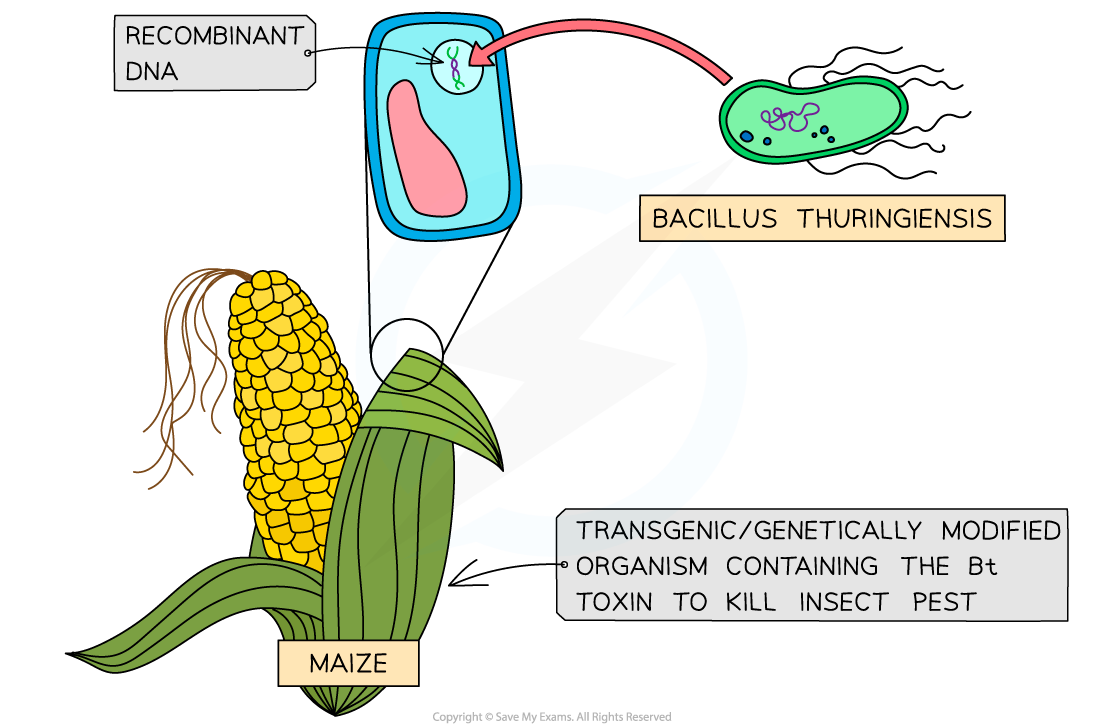
Illustration of a maize plant that has recombinant DNA (DNA from?Bacillus thuringiensis)
Uses of genetic modification
- Because all genes code for proteins,?useful proteins?can be manufactured by the creating of transgenic organisms
- Some of the key uses of genetic modification include the genetic modification of:
- Crops?to increase crop yield through resistance to drought, disease, pesticides and herbicides; or to provide increased nutritional value (e.g. golden rice)
- Livestock?to give disease and pest resistance, increased productivity and new characteristics (eg. goats that produce milk containing spider silk)
- Bacteria?to produce medicines e.g. insulin. Additionally bacterial can be modified to decompose toxic pollutants or carry out large scale chemical production
Analogy: Essay Writing and Recombinant DNA
- Creating?transgenic organisms?is rather like?copying and pasting?some text from one of your previous essays into the one that you are currently writing
- If you believe that the essay that you are currently writing can be strengthened by the use of some text from another essay that you have previously written, it is a common practice to use the computer’s?copy and paste?function to transfer text in one block without having to retype it
- This has similar features to genetic modification in the creation of a transgenic organism
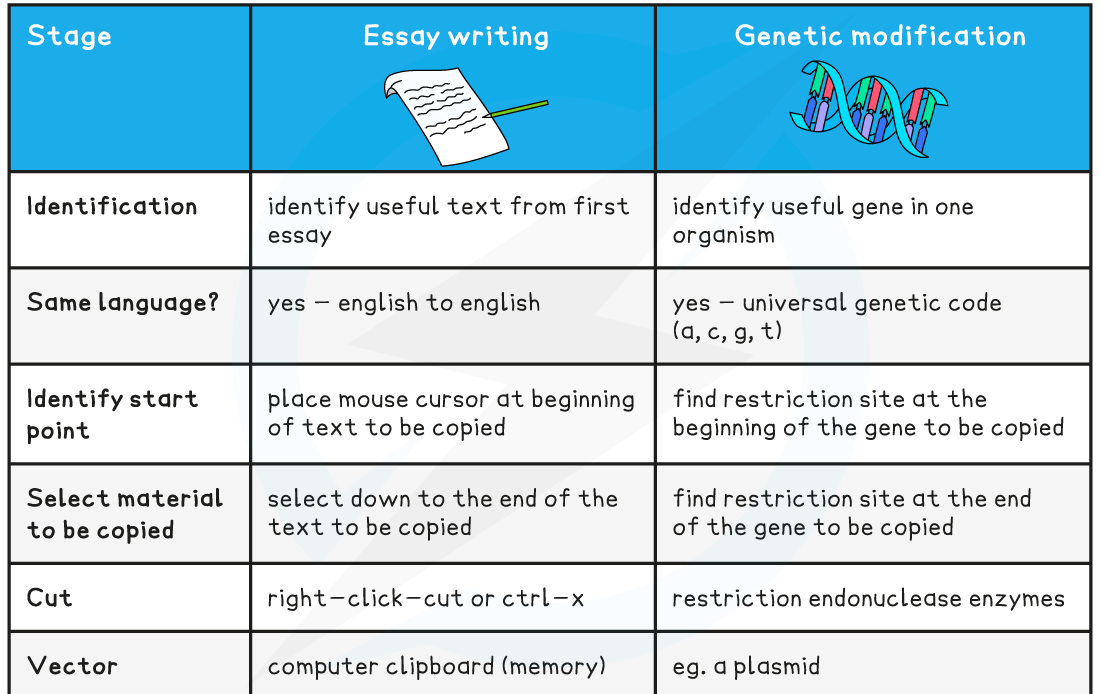
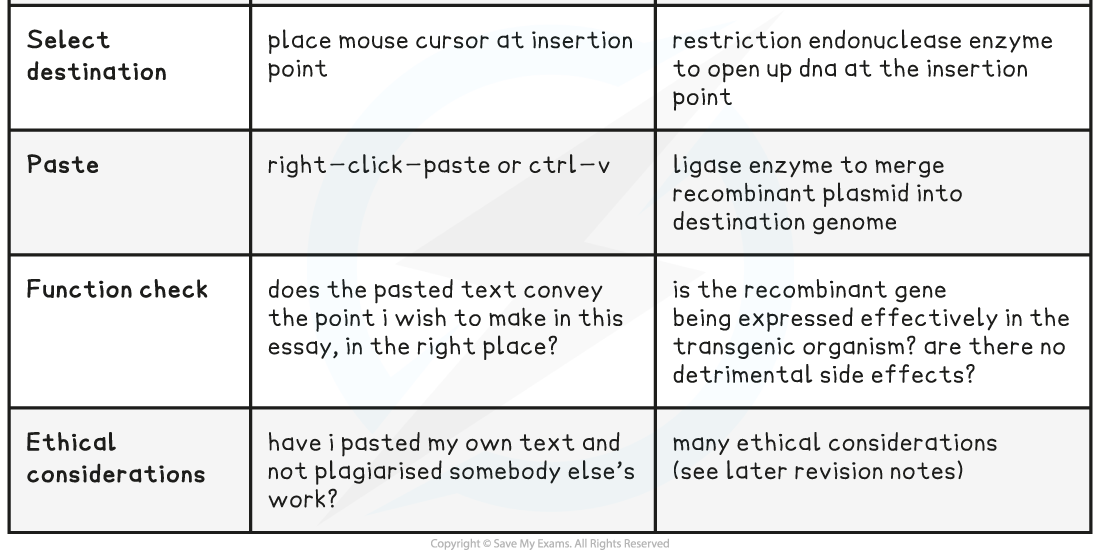
Genetic Modification: Enzymes
Gene transfer to bacteria using plasmids makes use of restriction endonucleases and DNA ligase
- In order for an organism to be genetically modified the following steps must be taken:
- Identification?of the?DNA fragment?or?gene
- Isolation?of the desired DNA fragment (either using restriction endonucleases or?reverse transcriptase)
- Multiplication?of the DNA fragment (using polymerase chain reaction - PCR)
- Transfer?into the organism using a?vector?(e.g. plasmids, viruses, liposomes)
- A plasmid is a?small, circular loop of DNA?found in the cytoplasm of bacteria,?separate from its main loop?of DNA
- Plasmids form part of the?bacterial genome
- Plasmids are extremely useful in genetic modification because of their?small size?and their?ability to be manipulated separately?to the bacterium's main genome
- Identification?of the cells with the new DNA fragment (by using a?marker), which is then cloned
- Geneticists need the following 'tools' to modify an organism:
- Enzymes
- Restriction endonucleases?- used to cut genes at specific base sequences (restriction sites). Different restriction enzymes cut at different restriction sites
- These can create?sticky ends
- Ligase?- used to join together the cut ends of DNA by forming covalent bonds and sealing up nicks where fragments have not quite been joined firmly with covalent bonds
- Reverse transcriptase?- used to build double-stranded DNA from single-stranded RNA
- This DNA is called?cDNA?(complementary DNA)
- Vectors?- used to deliver DNA fragments into a cell
- Plasmids?- transfer DNA into bacteria or yeast
- Viruses?- transfer DNA into human cells or bacteria
- Liposomes?- fuse with cell membranes to transfer DNA into cells
- Markers?- genes that code for identifiable substances that can be tracked
- eg.?Fluorescent
- such as green fluorescent protein (GFP) which fluoresces under UV light
- Enzymes
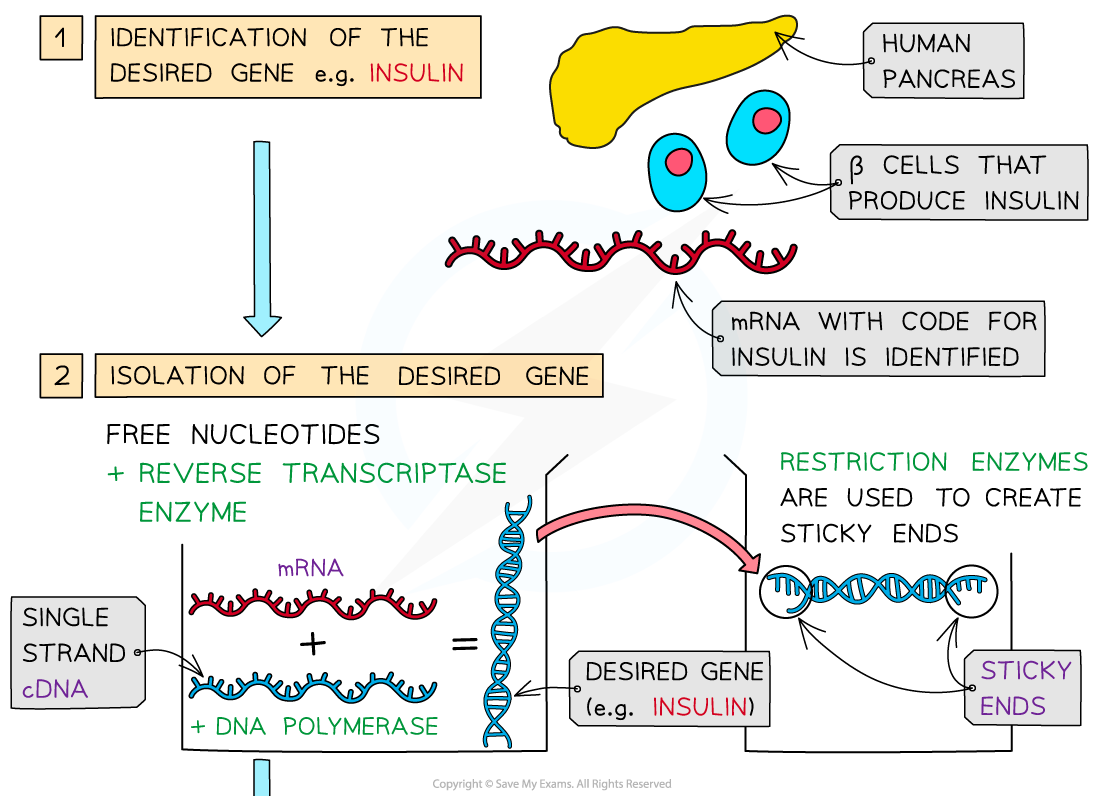
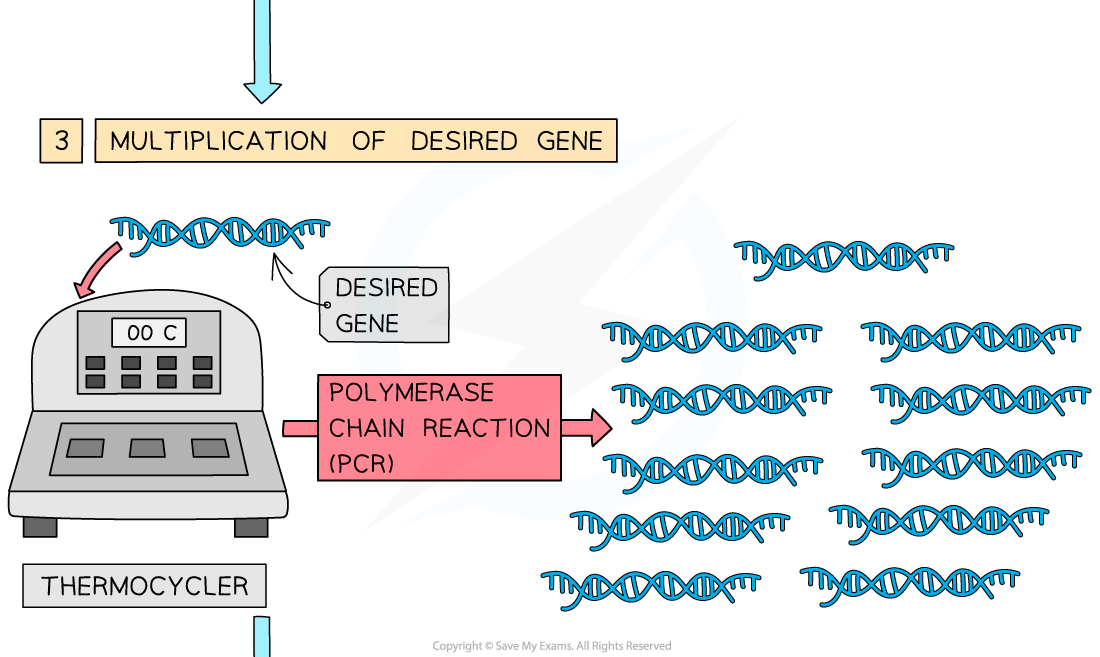
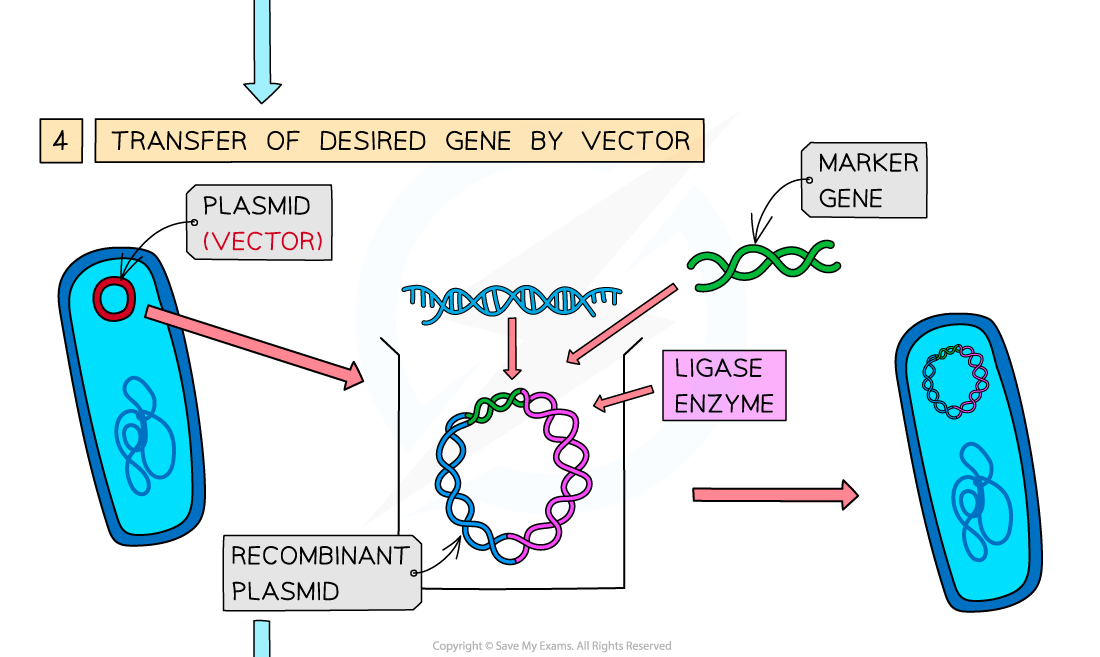
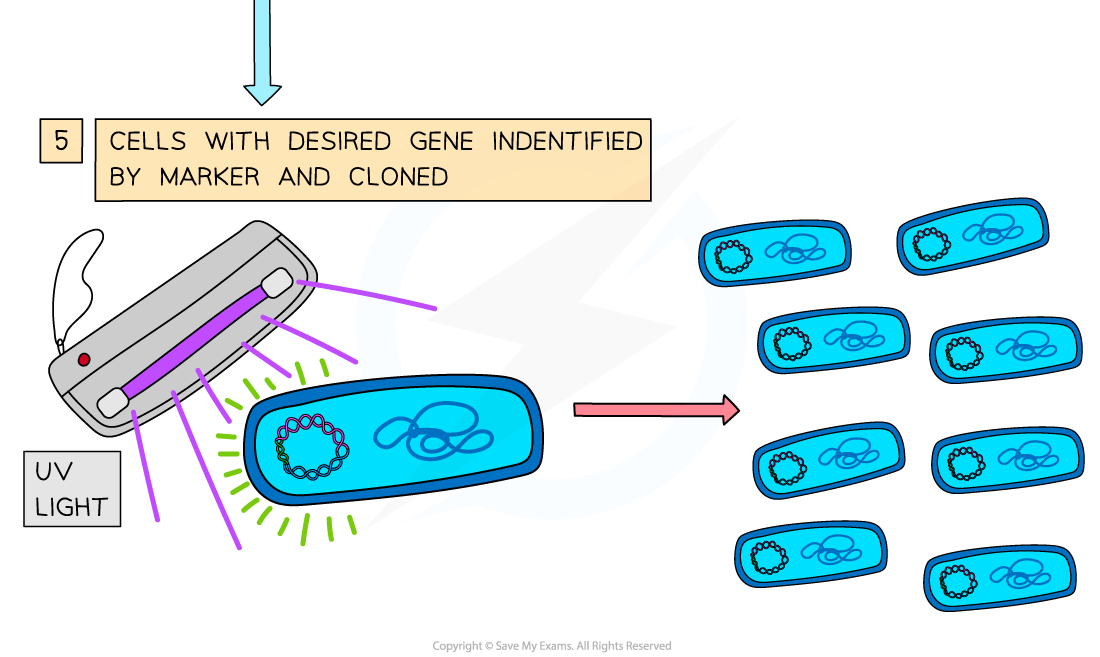
An overview of the steps taken to genetically modify an organism (in this case bacteria are being genetically modified to produce human insulin)
NOS: Assessing risks associated with scientific research; scientists attempt to assess the risks associated with genetically modified crops or livestock
- There are?obvious benefits?of genetically modified organisms being able to express useful genes for human gain
- Nevertheless, there are some?potential risks?that this technology may raise, which scientists (and society in general) need to evaluate alongside the benefits
- For example, there was much concern that using microorganisms in genetic modification could spread pathogenic disease more widely than had been the case before
- This has led to?intense debates?between scientists and?within wider society?about the role that genetically modified crops can play in the world
- This topic generates?a lot of publicity, some parts of it better-informed scientifically than others
- Scientists must ask:
- What are the?risks of an accident?or other harmful effects of using GMOs in agriculture?
- How?dangerous?could those effects be?
- Many scientific innovations, like GMO crops, appear at first glance to be?a great leap forward?to improve the fortunes of humans as a species
- However, the science can be used in ways that are?morally questionable?(such as rapid generation of profits)
- This can lead to?unexpected problems, as set out in the possible risks section above
- It is important for humans from all walks of life, informed by scientists, to:
- Conduct?ethical discussions
- Carry out?risk-benefit analysis?and?risk assessment
- Apply the?precautionary principle
- When a discovery raises a significant threat of harm to the environment or human health, there should be?an assumption that harm will be caused, until evidence is put forward to the contrary
- Like all of science, claims and hypotheses have to backed up with?experimental evidence
- Experiments have to be?controlled, reliable?and?repeatable?in order to draw meaningful conclusions
- One such example is the effect of?Bacillus thuringiensis (Bt)?toxin-containing pollen in maize plants, on the distribution and health of monarch butterfly larvae
Exam Tip
When answering questions about genetic modification you should remember to include the names of any enzymes (restriction endonucleases,?reverse transcriptase,?ligase) involved?and?mention that?vectors?(transfer the desired gene) are also used.
Genetic Modification of Crops: Risks & benefits
NOS: Assessing risks associated with scientific research - scientists attempt to assess the risks associated with genetically modified crops or livestock
- Although plants and animals have been genetically modified to produce proteins used in medicine, the main purpose for genetically modifying them is to meet the?global demand for food
- The benefits of using genetic modification rather than the more traditional selective breeding techniques to solve the global demand for food are:
- Organisms with the?desired characteristics?are?produced more quickly
- All organisms?will contain the desired characteristic (there is no chance that recessive allele may arise in the population)
- The desired characteristic may?come from a different species/kingdom
- Companies that produce genetically modified (GM) seed are?very skilled?at explaining the benefits of their use
- The companies make claims about?improved crop yields?and reduction in the use of chemical pesticides/herbicides
- These?claims make good sense?at first, in a world where a?rapidly growing human population?needs a reliable supply of food
Potential benefits of GM crops
- Pest-resistant?crop varieties can be created using genes that produce a toxin
- This reduces insecticide use on the crop
- In turn, there is less effect on non-pest insects such as bees in the vicinity of the crop
- Less ploughing and spraying?of the crop is required, so less machinery (and fuel to run it) is required
- Crop shelf-life?can be improved, so there is less wastage in the supply chain
- This makes the land used to grow those crops?more productive
- Crops can be made?frost-resistant?or?drought-resistant, allowing farmers on relatively poor agricultural land to grow crops and earn a living
- Crops can be?enriched?eg. with vitamins, to increase their nutritional value
- Herbicide-resistant crops can be created, so that use of herbicides?eliminates competition from other plants
- More of the crop can grow as it is not competing with other plants for sunlight, space, soil nutrients etc.
- Disease-resistant varieties?can grow which again,?increases crop yields
Potential risks of GM crops
- Many people object to the use of GMOs in?food production?due to a?lack of long-term research?on the effects on human health
- It is unknown whether it will cause allergies or be toxic over time (although there has been no evidence to suggest this would occur to date)
- Organic farmers have claimed that the pollen from GM crops may?contaminate nearby non-GM crops?that have been certified as organic
- Environmentalists are concerned about the?reduction in biodiversity?for future generations, caused by?monocultures?of GM varieties
- There is a theory that agricultural monocultures are?not sustainable?without heavy use of fertilisers
- Crops with less genetic diversity are more?vulnerable to extinction
- GM crops may become weeds or?invade the natural habitats?bordering the farmland
- Herbicide-resistance genes could transfer to weed plants resulting in "superweeds"
- GM crops that produce toxins may cause harm to non-target species like the Monarch butterflies
- The antibiotic-resistance genes that are commonly used as?marker genes?in genetic modification could transfer to pathogenic organisms that would then be untreatable with antibiotics - "superbug"
- Tampering with viral genomes could result in a completely?novel animal virus?that can affect humans or cause existing ones to become?more harmful?to the host
- This is only an issue if the pathogens are able to escape the lab and enter the wild
- Over time?mutations may occur in the inserted genes?that cause them to have unwanted effects on organisms
轉(zhuǎn)載自savemyexams
以上就是關(guān)于【IB DP Biology: SL復(fù)習(xí)筆記3.4.3 Genetic Modification】的解答,如需了解學(xué)校/賽事/課程動態(tài),可至翰林教育官網(wǎng)獲取更多信息。
往期文章閱讀推薦:
斯坦福大學(xué)官方推薦書單!名校學(xué)霸們暑假都在讀什么?
MIT官方發(fā)布【2026年夏季推薦閱讀書單】!橫跨科學(xué)/人文/經(jīng)濟(jì)...


翰林AMC8視頻課重磅上線!

國際競賽真題資源免費(fèi)領(lǐng)取






