IB DP Biology: SL復(fù)習(xí)筆記6.2.2 The Blood System: Vessels

Arteries
Introduction to blood vessels
- The?circulatory system?of the human body contains several different types of?blood vessel:
- Arteries
- Arterioles
- Capillaries
- Venules
- Veins
- Each type of blood vessel has a?specialised structure?that relates to the function of that vessel
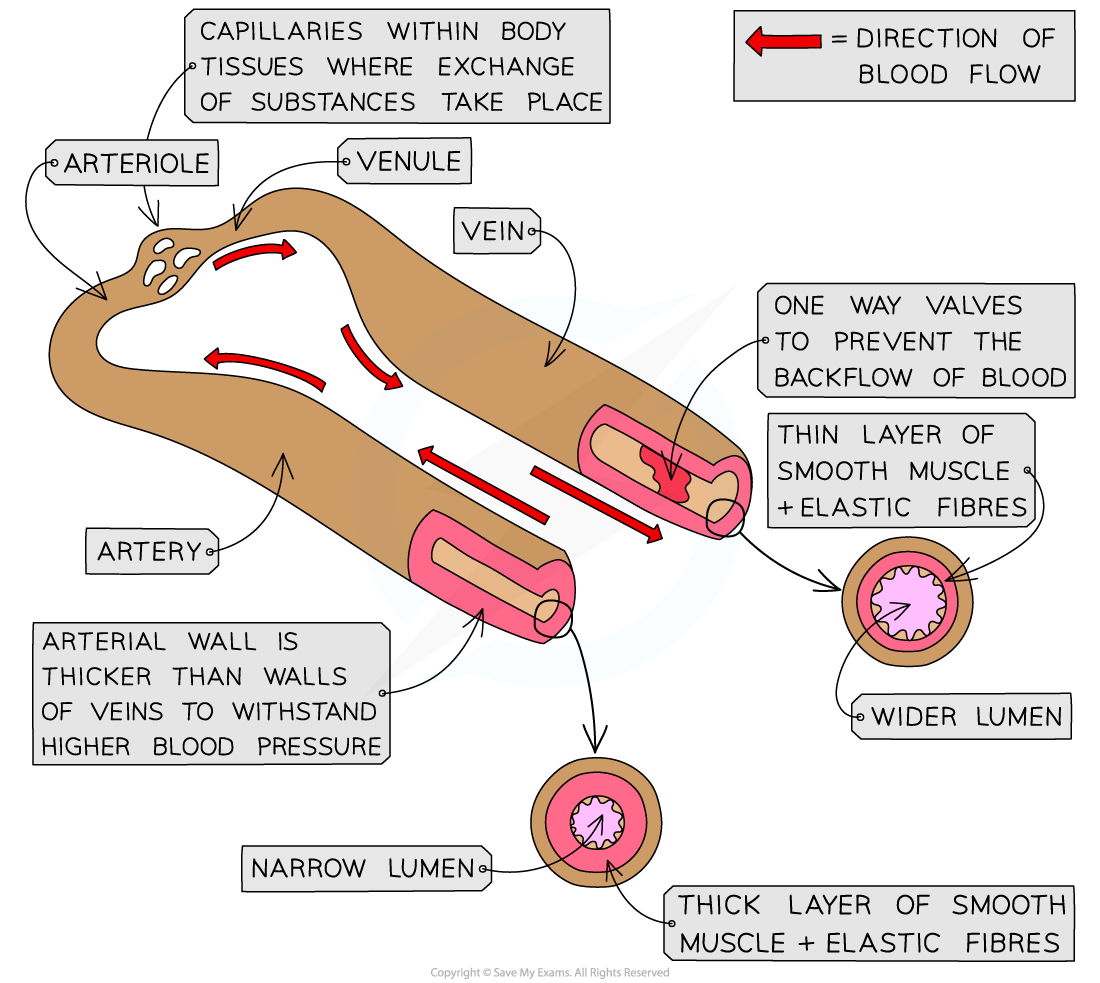
The circulatory system includes several blood vessels, each specialised to carry out its function
Structure and function of arteries
- Arteries?transport blood away from the heart at high pressure
- Blood travels from the ventricles to the tissues of the body
- Remember;?arteries carry blood?away from the heart
- Artery walls consist of?three layers:
- The?tunica intima?is the innermost layer and is made up of?an?endothelial layer, a layer of connective tissue?and?a layer of elastic fibres
- The endothelium is one cell thick and lines the lumen of all blood vessels. It is very smooth and reduces friction for free blood flow
- The?tunica media?is made up of?smooth muscle cells?and a?thick layer of elastic tissue
- Arteries have a?thick?tunica media
- The layer of muscle cells strengthen the arteries so they can?withstand high pressure
- Blood leaves the heart under high pressure
- Muscles cells can also?contract or relax?to control the diameter of the lumen and?regulate blood pressure
- The elastic tissue helps to?maintain blood pressure?in the arteries. It?stretches?and?recoils?to even out fluctuations in pressure
- The?tunica externa?covers the exterior of the artery and is mostly made up of?collagen
- Collagen is a strong protein and protects blood vessels from damage by over-stretching
- The?tunica intima?is the innermost layer and is made up of?an?endothelial layer, a layer of connective tissue?and?a layer of elastic fibres
- Arteries have a?narrow lumen?which helps to maintain a high blood pressure
- A?pulse?is present in arteries due to blood leaving the heart under high pressure
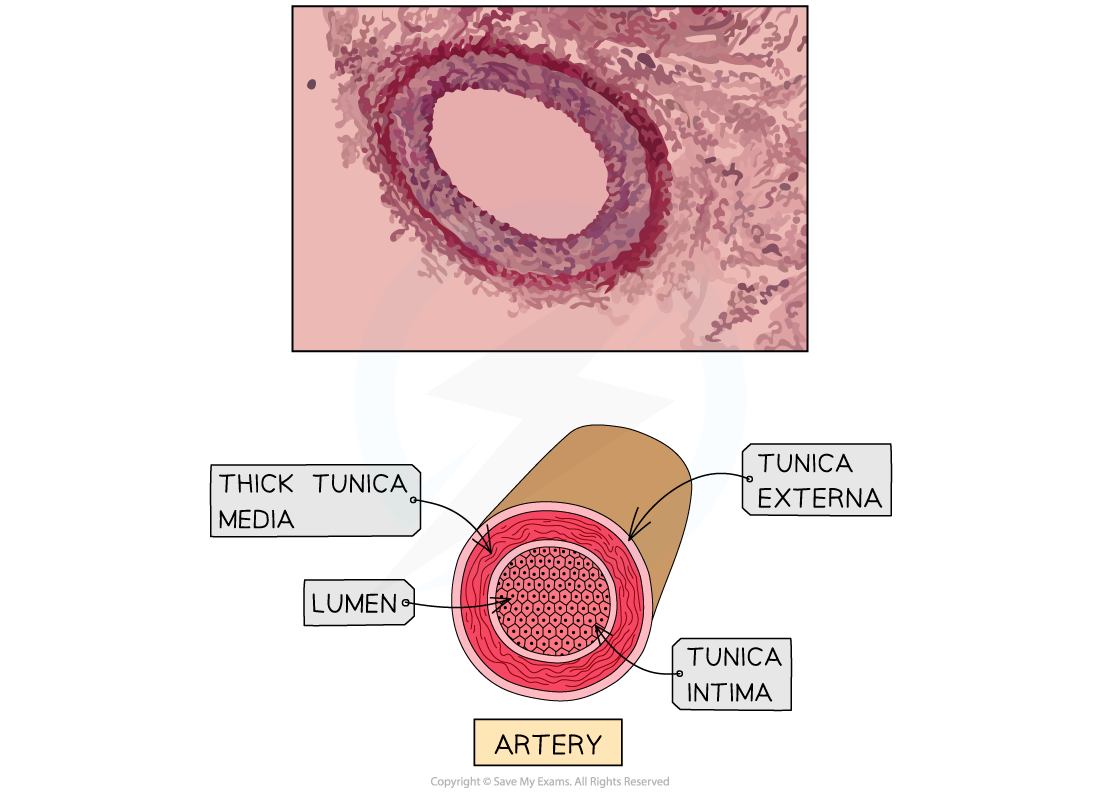
Arteries have thick muscular walls made up of three layers of tissue and a narrow lumen
Structure and function of arterioles
- Arterioles?branch off from arteries forming narrower blood vessels which transport blood into capillaries
- Arterioles are similar in structure to arteries, but they have a?lower proportion of elastic fibres?and a?large number of muscle cells
- The presence of muscle cells allows them to?contract?and close their lumen to?regulate blood flow?to specific organs
- Eg. during exercise blood flow to the stomach and intestine is reduced while blood flow to the muscles increases
Arterial blood pressure
- Arteries, and to a slightly lesser extent arterioles, must be able to?withstand high pressure?generated by the contracting heart, and both must?maintain this pressure?when the heart is relaxed
- Muscle?and?elastic fibres?in the arteries help to maintain the?blood pressure?as the heart contracts and relaxes
- Systolic pressure?is the peak pressure point reached in the arteries as the blood is forced out of the ventricles at high pressure
- At this point, the walls of the arteries are forced outwards, enabled by the?stretching?of elastic fibres
- Diastolic pressure?is the lowest pressure point reached within the artery as the heart relaxes
- At this point, the stretched elastic fibres?recoil?and force the blood onward through the lumen of the arteries
- This maintains high pressure throughout the heart beat cycle
- Systolic pressure?is the peak pressure point reached in the arteries as the blood is forced out of the ventricles at high pressure
- Vasoconstriction?of the circular muscles of the arteries can increase blood pressure by?decreasing the diameter of the lumen
- Vasodilation?of the circular muscles causes blood pressure to decrease by?increasing the diameter of the lumen
Exam Tip
Be careful with the language you use to describe the roles of muscle and elastic tissue; muscle can?contract?and?relax, while elastic tissue can?stretch?and?recoil.
Capillaries
Structure and function of capillaries
- Capillaries?provide the?exchange surface?in the tissues of the body through a network of vessels called capillary beds
- The wall of a capillary is made from a?single layer of endothelial cells?(this layer is also found lining the lumen in arteries and veins)
- Being just?one cell thick?reduces the?diffusion distance?for?oxygen?and?carbon dioxide?between the blood and the tissues of the body
- The thin endothelium cells also have gaps between them called?pores?which allow blood plasma to leak out and form?tissue fluid
- Tissue fluid contains?oxygen, glucose?and other small molecules from the blood plasma
- Large molecules such as proteins usually can't fit through the pores into the tissue fluid
- Tissue fluid surrounds the cells, enabling?exchange?of substances such as oxygen, glucose, and carbon dioxide
- The?permeability?of capillaries can vary depending on the requirements of a tissue
- Capillaries have a lumen with a?small diameter
- Red blood cells squeeze through capillaries in single-file
- This forces the blood to travel slowly which provides more opportunity for diffusion to occur
- Capillaries form?branches in between the cells;?this is the capillary bed
- These branches increase the?surface area?for diffusion of substances to and from the cells
- Being so close to the cells also reduces the?diffusion distance
- The wall of a capillary is made from a?single layer of endothelial cells?(this layer is also found lining the lumen in arteries and veins)
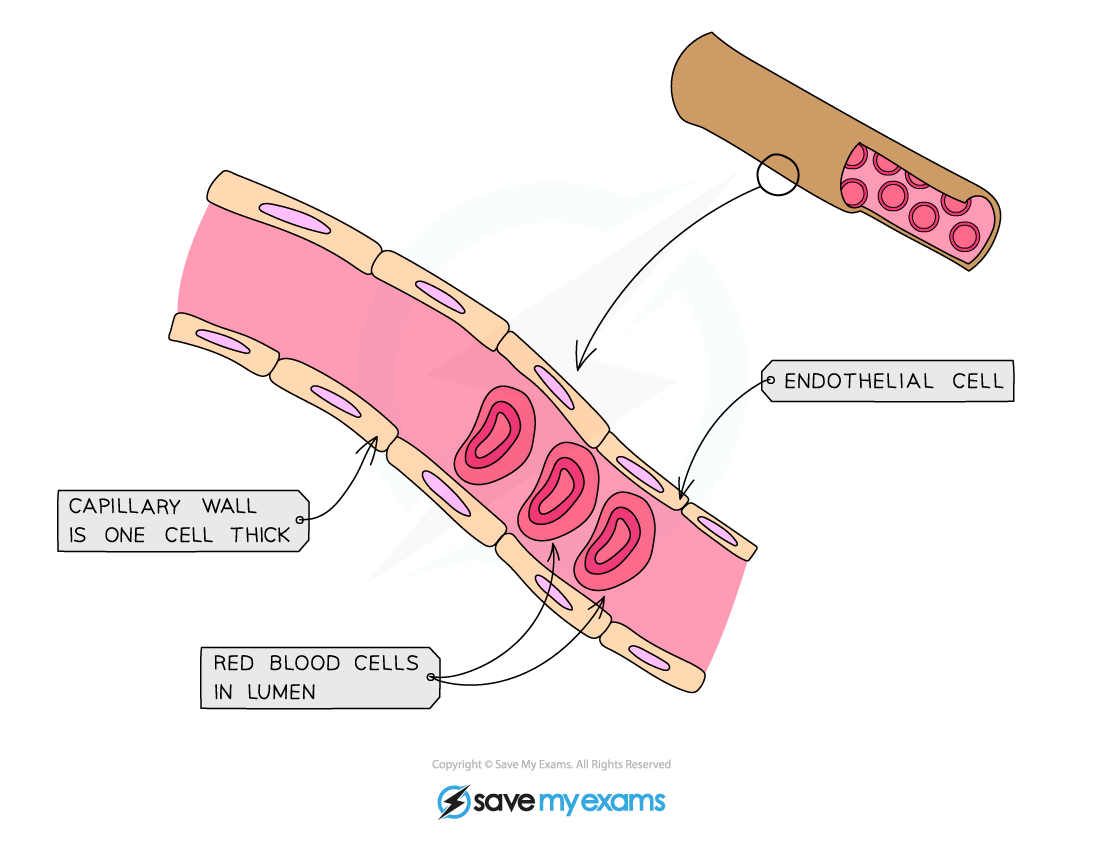
Capillaries have a narrow lumen and walls that are one cell thick
Veins
Structure and function of veins
- Veins?transport blood to the heart at?low pressure
- Remember; veins carry blood?into the heart
- They receive blood that has passed through capillary networks, across which?pressure has dropped?due to the slow flow of blood
- The structure of veins differs from arteries:
- The?tunica media?is much?thinner?in veins
- There is no need for a thick muscular and elastic layer as veins don't have to maintain or withstand high pressure
- The?lumen?of veins is much?wider in diameter?than that of arteries
- A larger lumen helps to ensure that blood returns to the heart at an adequate?speed
- A large lumen?reduces friction?between the blood and the endothelial layer of the vein
- The rate of blood flow is slower in veins but a larger lumen means the volume of blood delivered per unit of time is equal
- Veins contain?valves
- These?prevent the back flow?of blood that can result under low pressure, helping return blood to the heart
- Movement of the?skeletal muscles?pushes the blood through the veins, and any blood that gets pushed backwards gets caught in the valves; this blood can then be moved forwards by the next skeletal muscle movement
- The?tunica media?is much?thinner?in veins
- A pulse is?absent?in veins; the pressure changes taking place due to the beating of the heart are no longer present
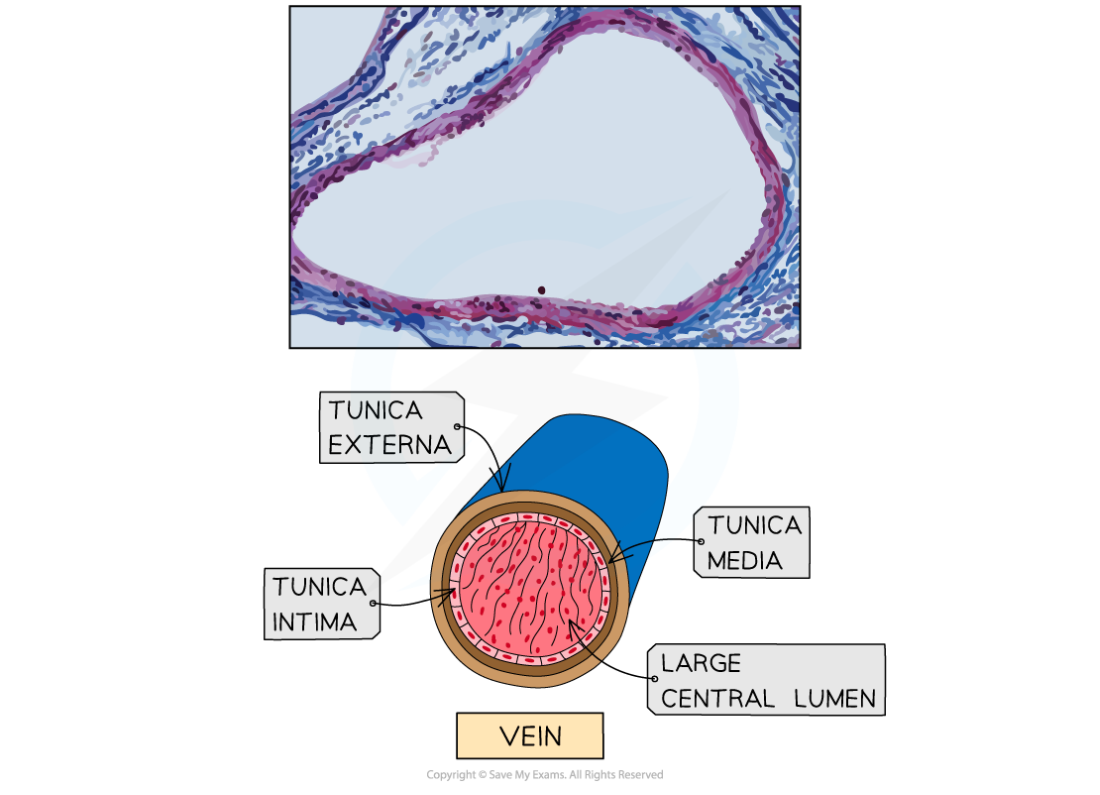
Veins have a structure similar to arteries with three layers of tissue and a large lumen
Structure and function of venules
- Venules connect the?capillaries to the veins
- They have?few?or?no elastic fibres?and a?large lumen
- As the blood is at low pressure after passing through the capillaries there is no need for a muscular layer to maintain pressure
- The large lumen enables a large volume of blood to be transported
Exam Tip
For “Explain” questions, remember to pair a description of a structural feature to an explanation of how it helps the blood vessel to function. For example, “Capillaries have walls that are one-cell thick, enabling quick and efficient diffusion of substances due to a short diffusion distance."
轉(zhuǎn)載自savemyexams
以上就是關(guān)于【IB DP Biology: SL復(fù)習(xí)筆記6.2.2 The Blood System: Vessels】的解答,如需了解學(xué)校/賽事/課程動態(tài),可至翰林教育官網(wǎng)獲取更多信息。
往期文章閱讀推薦:
斯坦福大學(xué)官方推薦書單!名校學(xué)霸們暑假都在讀什么?
MIT官方發(fā)布【2026年夏季推薦閱讀書單】!橫跨科學(xué)/人文/經(jīng)濟(jì)...


翰林AMC8視頻課重磅上線!

國際競賽真題資源免費(fèi)領(lǐng)取






