IB DP Chemistry: SL復(fù)習(xí)筆記1.2.1 Reacting Masses

Reacting Masses & Limiting Reactants
- The number of moles of a substance can be found by using the following equation:

- It is important to be clear about the type of particle you are referring to when dealing with moles
- Eg. 1 mole of CaF2?contains one mole of CaF2?formula units, but one mole of Ca2+?and two moles of F-?ions
Reacting masses
- The?masses?of reactants are useful to determine how much of the reactants?exactly?react with each other to prevent waste
- To calculate the reacting masses, the chemical equation is required
- This equation shows the ratio of moles of all the reactants and products, also called the?stoichiometry, of the reaction
- To find the mass of products formed in a reaction the following pieces of information are needed:
- The mass of the reactants
- The molar mass of the reactants
- The balanced equation
Worked Example
Calculate the mass of magnesium oxide that can be made by completely burning 6.0 g of magnesium in oxygen.
magnesium (s) + oxygen (g) → magnesium oxide (s)
Answer:
Step 1:?The symbol equation is:
2Mg(s)????+ ????O2(g)??????→??????2MgO(s)
Step 2:?The relative atomic masses are:
magnesium : 24.31? ? ? ? ?oxygen : 16.00
Step 3:?Calculate the moles of magnesium used in reaction

Step 4:?Find the ratio of magnesium to magnesium oxide using the balanced chemical equation
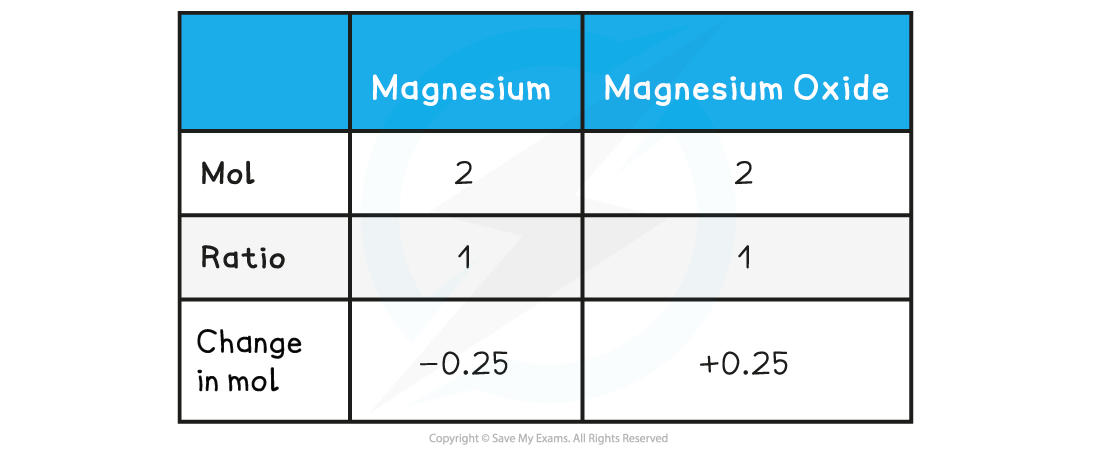
Therefore, 0.25 mol of MgO is formed
Step 5:?Find the mass of magnesium oxide
mass =?mol?x?M
mass?= 0.25?mol?x 40.31?g mol-1
mass?= 10.08 g
Therefore,?mass of magnesium oxide produced is 10 g?(2 sig figs)
Excess & limiting reactants
- Sometimes, there is an?excess?of one or more of the reactants (excess reactant)
- The reactant which is not in excess is called the?limiting reactant
- To determine which reactant is limiting:
- The number of moles of the reactants should be calculated
- The ratio of the reactants shown in the equation should be taken into account eg:
C? + 2H2????? →???? CH4
What is limiting when 10 mol of carbon are reacted with 3 mol of hydrogen?
- Hydrogen is the?limiting reactant?and since the ratio of C : H2?is 1:2 only 1.5 mol of C will react with 3 mol of H2
Exam Tip
An easy way to determine the limiting reactant is to find the moles of each substance and divide the moles by the coefficient in the equationThe?lowest?number resulting is the?limiting reactant
- In the example above:
- divide 10 moles of C by 1, giving 10
- divide 3 moles of H by 2, giving 1.5, so hydrogen is limiting
Worked Example
9.2 g of sodium metal is reacted with 8.0 g of sulfur to produce sodium sulfide, Na2S.Which reactant is in excess and which is limiting?
Answer:
Step 1:?Calculate the moles of each reactant
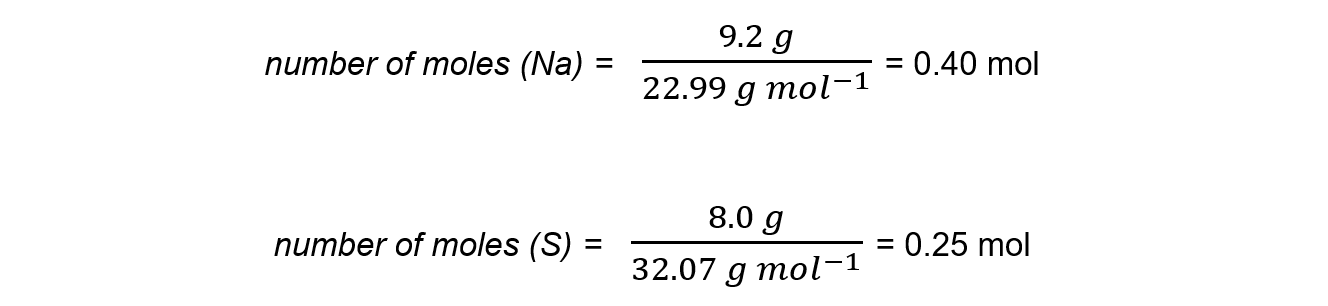
Step 2:?Write the balanced equation and determine the coefficients
2Na + S → Na2S
Step 3:?Divide the moles by the coefficient and determine the limiting reagent
-
- divide 0.40 moles of Na by 2, giving 0.20- lowest
- divide 0.25 moles of S by 1, giving 0.25
Therefore,?sodium is limiting?and?sulfur is in excess
轉(zhuǎn)載自savemyexams
以上就是關(guān)于【IB DP Chemistry: SL復(fù)習(xí)筆記1.2.1 Reacting Masses】的解答,如需了解學(xué)校/賽事/課程動(dòng)態(tài),可至翰林教育官網(wǎng)獲取更多信息。
往期文章閱讀推薦:
斯坦福大學(xué)官方推薦書(shū)單!名校學(xué)霸們暑假都在讀什么?
MIT官方發(fā)布【2026年夏季推薦閱讀書(shū)單】!橫跨科學(xué)/人文/經(jīng)濟(jì)...


翰林AMC8視頻課重磅上線!

國(guó)際競(jìng)賽真題資源免費(fèi)領(lǐng)取






