IB DP Chemistry: SL復習筆記4.1.2 Ionic Compounds

Ionic Lattices
- The ions form a?lattice?structure?which is an evenly distributed?crystalline?structure
- Ions in a lattice are arranged in a?regular?repeating?pattern?so that positive charges cancel out negative charges
- Therefore the final lattice is overall electrically?neutral
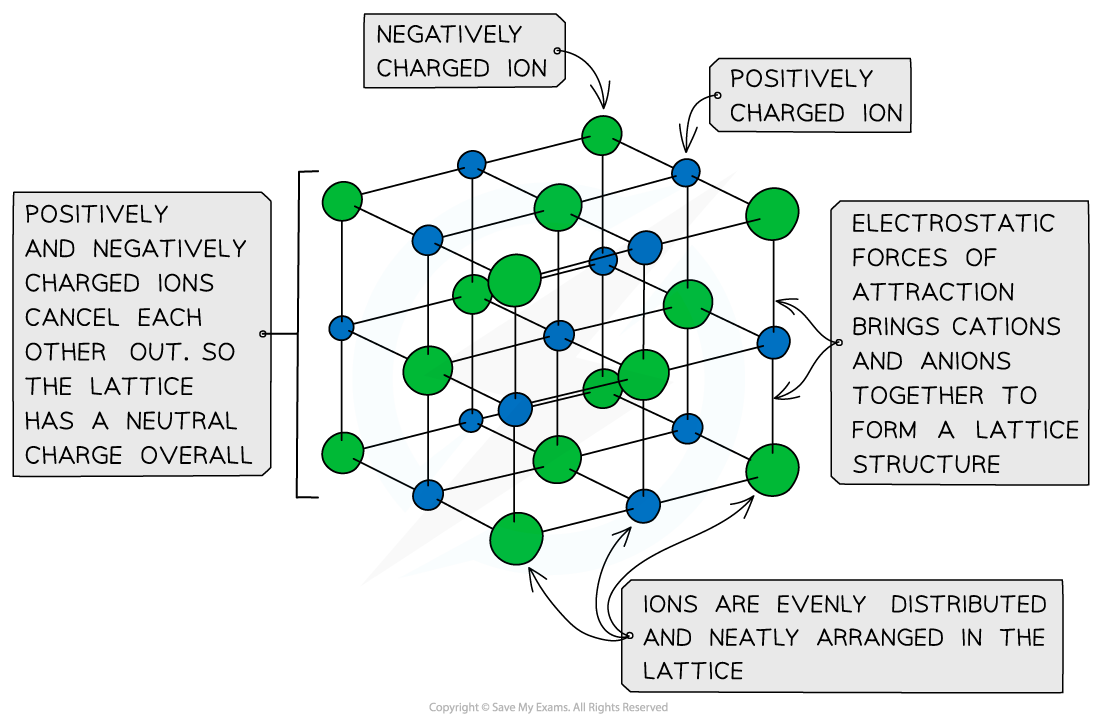
Ionic solids are arranged in lattice structures
Properties of Ionic Compounds
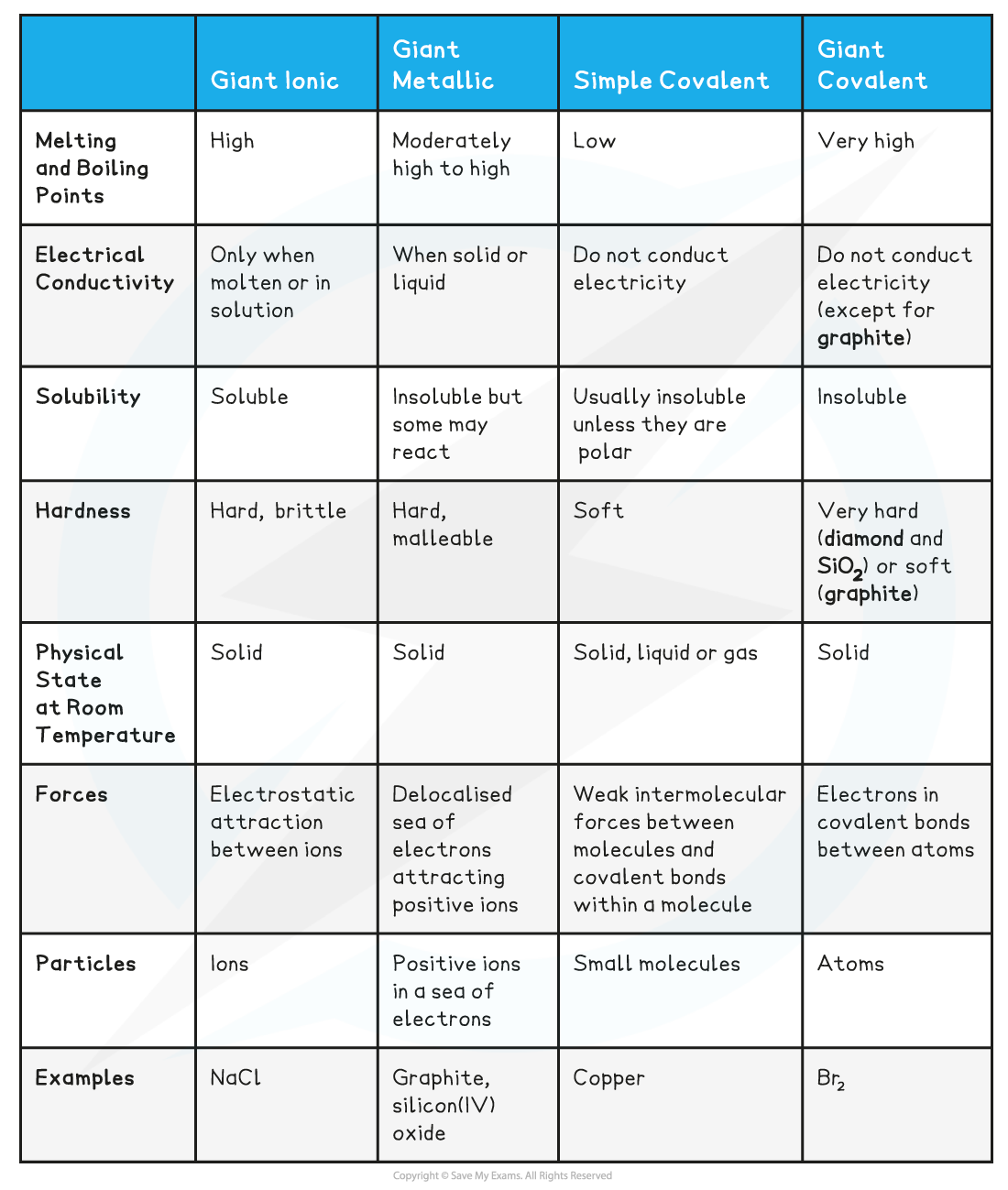
- Different types of?structure?and?bonding?have different effects on the?physical properties?of substances such as their?melting?and?boiling points,?electrical conductivity?and?solubility
Ionic bonding & giant ionic lattice structures
- Ionic compounds are?strong
- The?strong electrostatic forces?in ionic compounds keep the ions strongly together
- They are?brittle?as ionic crystals can split apart
- Ionic compounds have?high melting?and?boiling?points
- The strong electrostatic forces between the ions in the lattice act in all directions and keep them strongly together
- Melting and boiling points increase with charge density of the ions due to the greater?electrostatic attraction?of charges
- Mg2+O2-?has a higher melting point than Na+Cl-
- Ionic compounds are?soluble?in water as they can form?ion - dipole bonds
- Ionic compounds only?conduct?electricity?when?molten?or in?solution
- When molten or in solution, the ions can freely move around and conduct electricity
- In the solid state they’re in a fixed position and unable to move around
Characteristics of Giant Ionic Lattices compared to other Structures
Worked Example
The table below shows the physical properties of substances X, Y and Z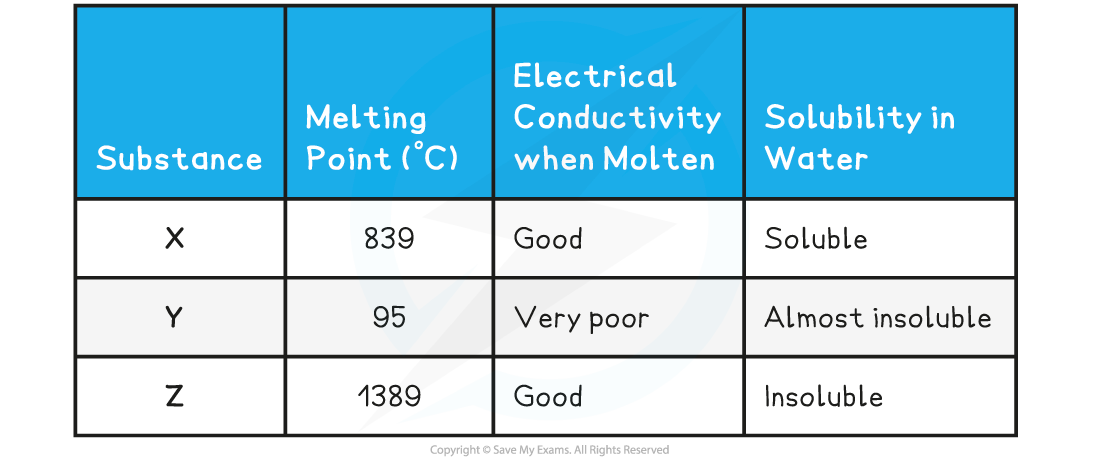
Which one of the following statements about X and Y is completely true??Statement 1:?X has a giant ionic structure, Y has a giant molecular structure, Z is a metal?Statement 2:?X is a metal, Y has a simple molecular structure, Z has a giant molecular structure?Statement 3:?X is a metal, Y has a simple molecular structure, Z has a giant ionic structure?Statement 4:?X has a giant ionic structure, Y has a simple molecular structure, Z is a metal
Answer:
The correct answer is?Statement 4
-
- The relatively high melting point, solubility in water and electrical conductivity when molten suggest that X is an?giant ionic structure
- The low melting point of Y ?suggests that little energy is needed to break the lattice which corresponds to a?simple molecular structure. This is further supported by the low electrical conductivity and almost insoluble in water
- Compound Z has a very high melting point which is characteristic of either metallic or giant molecular lattices, however since it conducts electricity, compound Z must be a?giant metallic lattice
轉載自savemyexams
以上就是關于【IB DP Chemistry: SL復習筆記4.1.2 Ionic Compounds】的解答,如需了解學校/賽事/課程動態,可至翰林教育官網獲取更多信息。
往期文章閱讀推薦:
MIT官方發布【2026年夏季推薦閱讀書單】!橫跨科學/人文/經濟...


翰林AMC8視頻課重磅上線!

國際競賽真題資源免費領取






