IB DP Chemistry: SL復習筆記10.2.10 Alcohols - Oxidation

Oxidation of Primary Alcohols
- The products of oxidation of?alcohols?depends on the class of?alcohols
- Here is a reminder of the three classes of alcohols:
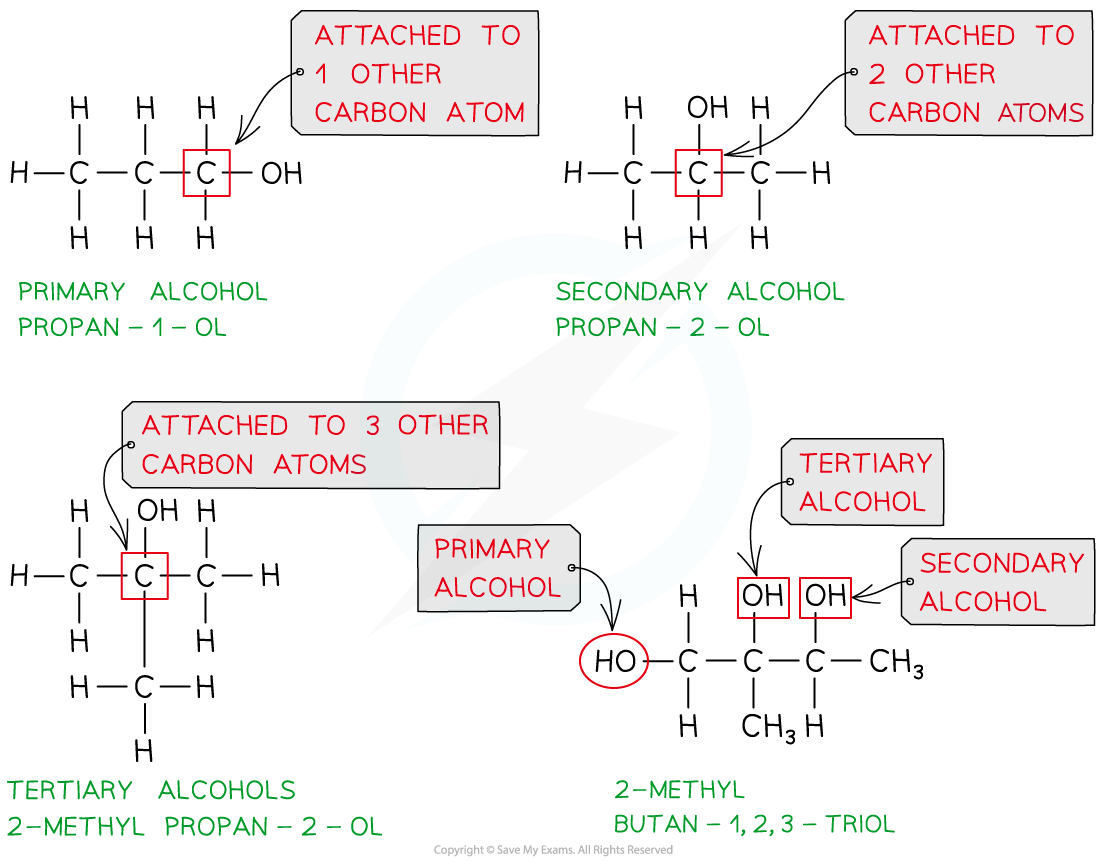 The three classes of alcohols
Primary alcohols
- Primary alcohols?can be oxidised to form?aldehydes?which can undergo further oxidation to form?carboxylic?acids
- The oxidising agents of alcohols include?acidified K2Cr2O7?or?acidified KMnO4
- Acidified potassium dichromate(VI), K2Cr2O7, is an orange oxidising agent
- Acidified means that that the potassium dichromate(VI) is in a solution of?dilute?acid?(such as dilute sulfuric acid)
- For potassium dichromate(VI) to act as an oxidising agent, it itself needs to be reduced
- When alcohols are?oxidised?the orange dichromate ions (Cr2O72-) are reduced to green Cr3+?ions
- Acidified potassium manganate(VII), KMnO4, is a purple oxidising agent
- As with acidified KMnO4?the potassium manganate(VII) is in an acidic medium to allow reduction of potassium manganate(VII) to take place
- When alcohols are?oxidised,?the purple manganate ions (MnO4-) are reduced to colourless Mn2+?ions
- As with acidified KMnO4?the potassium manganate(VII) is in an acidic medium to allow reduction of potassium manganate(VII) to take place
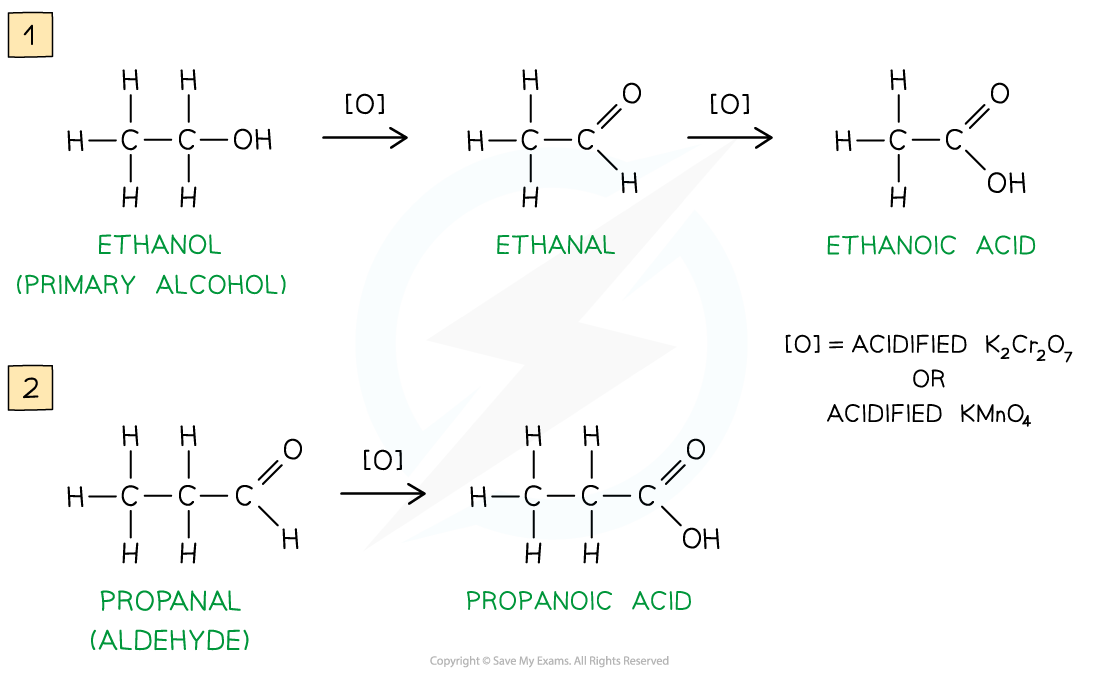
Further Oxidation
- If the?aldehyde?is not distilled off, further oxidation?with?excess?oxidising agent will oxidise it to a?carboxylic acid
- The reaction takes some time to complete and requires sustained heating
Test for alcohols
- The oxidation using?acidified dichromate?provides the basis for the test for?alcohols?as the reaction gives a strong colour change from?orange to green
- Unfortunately, it does not work for tertiary alcohols, which cannot be oxidised
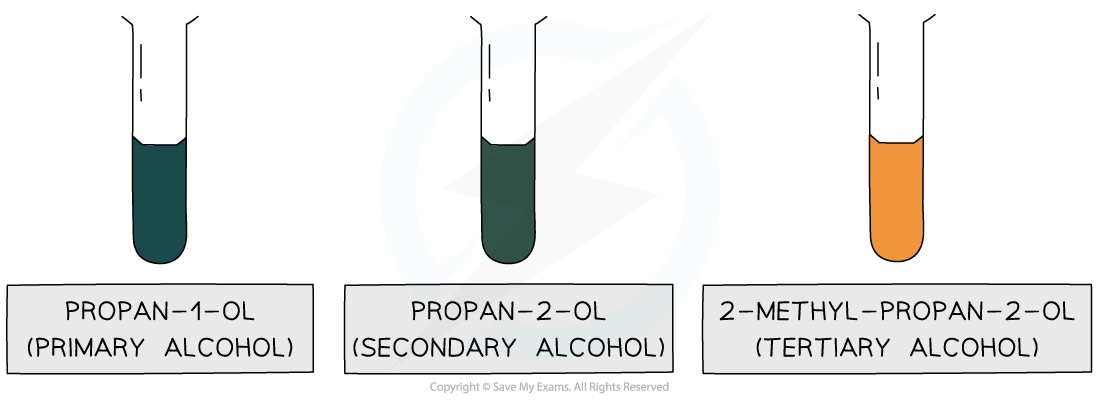
The test for primary and secondary alcohols
Oxidation of Secondary Alcohols
- Secondary alcohols?can be oxidised to form?ketones?only
- To get a good yield of the?ketone?the reaction requires some sustained heating
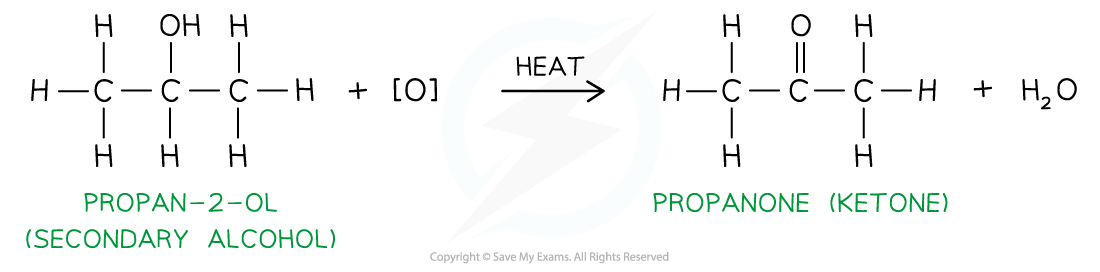 Oxidation of Secondary Alcohols
- Tertiary alcohols?do not undergo oxidation
- This is because there must be a hydrogen on the functional group carbon, which breaks off to form water
- There are only?C-C?bonds on the functional group carbon in a?tertiary alcohol
Distillation & Reflux
The difference between using distillation and heating under reflux
- To? produce an aldehyde from a primary alcohol the reaction mixture must be heated
- The?aldehyde?product has a lower boiling point than the?alcohol?( since it has lost the?H-bonding) so it can be?distilled off?as soon as it forms
- Distillation?can be carried out using a simple side arm arrangement which acts as an air condenser or the vapours can be made to pass through a condenser
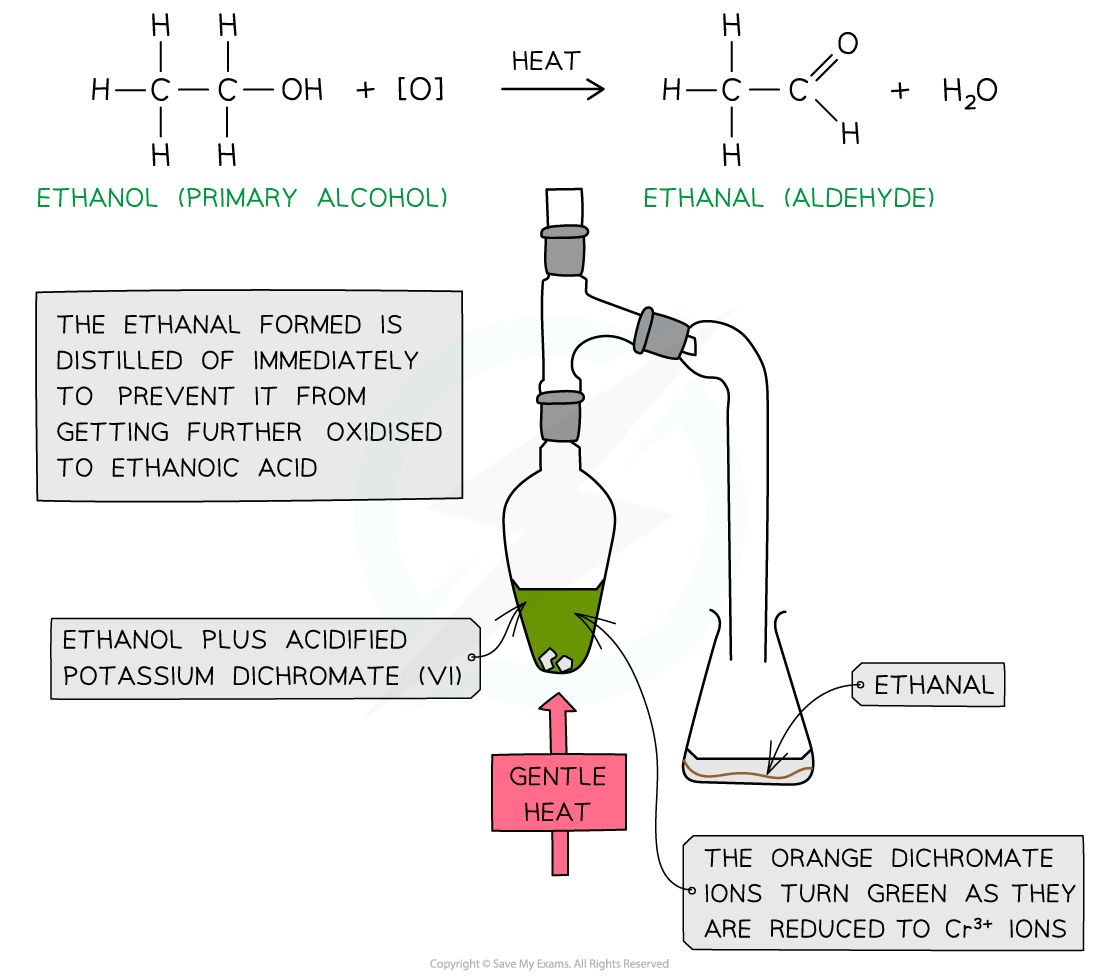
Oxidation of ethanol by acidified K2Cr2O7?to form an aldehyde by distillation
Heating under reflux
- For reactions that require sustained heating the apparatus has to be modified
- To prevent loss of volatile reactants the apparatus includes a condenser in the vertical position which returns components back into the reaction flask
- This is known as?heating under reflux?(reflux means re-boiling)
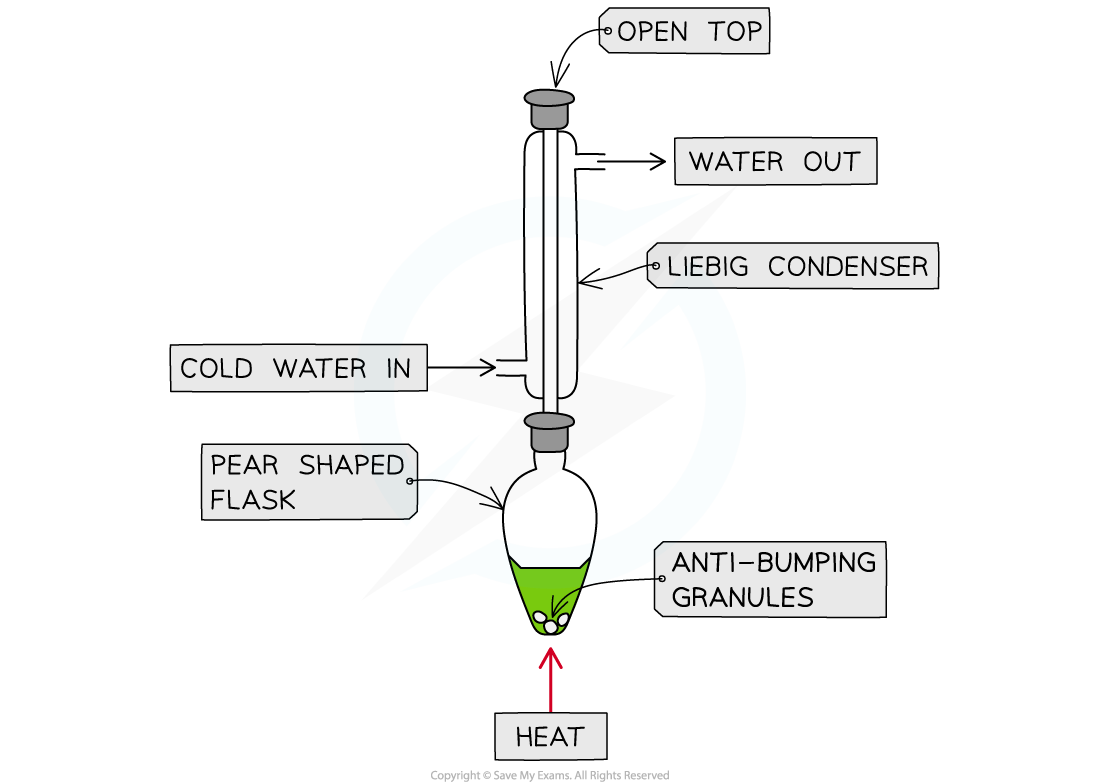
Heating under Reflux Apparatus
轉載自savemyexams
以上就是關于【IB DP Chemistry: SL復習筆記10.2.10 Alcohols - Oxidation】的解答,如需了解學校/賽事/課程動態(tài),可至翰林教育官網(wǎng)獲取更多信息。
往期文章閱讀推薦:
MIT官方發(fā)布【2026年夏季推薦閱讀書單】!橫跨科學/人文/經(jīng)濟...


翰林AMC8視頻課重磅上線!

國際競賽真題資源免費領取






