IB DP Physics: SL復(fù)習(xí)筆記1.1.1 SI Units

SI Base Quantities
International System (S.I.) Units
- There is a seemingly endless number of units in Physics
- These can all be reduced to seven base units from which every other unit can be derived
- These seven units are referred to as the?SI Base Units; making up the system of measurement officially used in almost every country around the world
SI Base Quantities Table
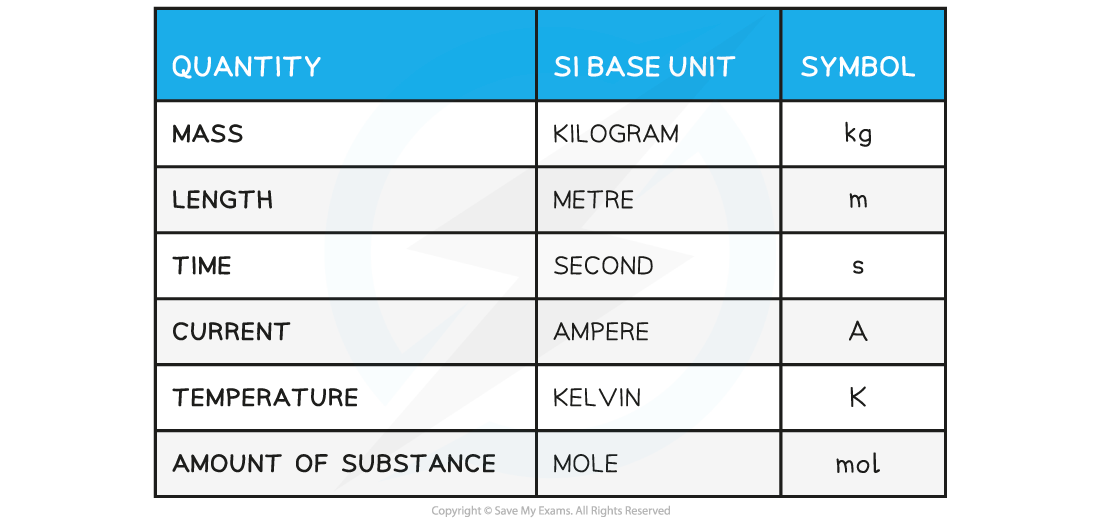
Six SI quantities are shown. The seventh quantity, the candela, measures luminous intensity, and is not covered in IB Physics. You may meet it later if you continue with Physics at university.
Derived Units
Derived Units
- Derived units are derived from the seven SI Base units
- The base units of physical quantities such as:
- Newtons,?N
- Joules,?J
- Pascals,?Pa,?can be deduced
- To deduce the base units, it is necessary to use the definition of the quantity
- The Newton (N), the unit of force, is defined by the equation:
- Force = mass × acceleration
- N = kg × m s–2?= kg m s–2
- Therefore, the Newton (N) in SI base units is?kg m s–2
- The Joule (J), the unit of energy, is defined by the equation:
- Energy = ? × mass × velocity2
- J = kg × (m s–1)2?= kg m2?s–2
- Therefore, the Joule (J) in SI base units is?kg m2?s–2
- The Pascal (Pa), the unit of pressure, is defined by the equation:
- Pressure = force ÷ area
- Pa = N ÷ m2?= (kg m s–2) ÷ m2?= kg m–1?s–2
- Therefore, the Pascal (Pa) in SI base units is?kg m–1?s–2
轉(zhuǎn)載自savemyexams
以上就是關(guān)于【IB DP Physics: SL復(fù)習(xí)筆記1.1.1 SI Units】的解答,如需了解學(xué)校/賽事/課程動態(tài),可至翰林教育官網(wǎng)獲取更多信息。
往期文章閱讀推薦:
斯坦福大學(xué)官方推薦書單!名校學(xué)霸們暑假都在讀什么?
MIT官方發(fā)布【2026年夏季推薦閱讀書單】!橫跨科學(xué)/人文/經(jīng)濟...


翰林AMC8視頻課重磅上線!

國際競賽真題資源免費領(lǐng)取






