IB DP Physics: SL復習筆記2.1.3 Acceleration

Acceleration
- Acceleration?is defined as the?rate of change of velocity
- In other words, it describes how much an object's velocity?changes?every?second
- The equation below is used to calculate the average acceleration of an object:


- Where:
- a?= acceleration in metres per second squared (m s–2)
- Δv?= change in velocity in metres per second (m s–1)
- t?= time taken in seconds (s)
- The?change in velocity?is found by the?difference?between the initial and final velocity, as written below:
change in velocity = final velocity ? initial velocity
Equations linking displacement, velocity, and acceleration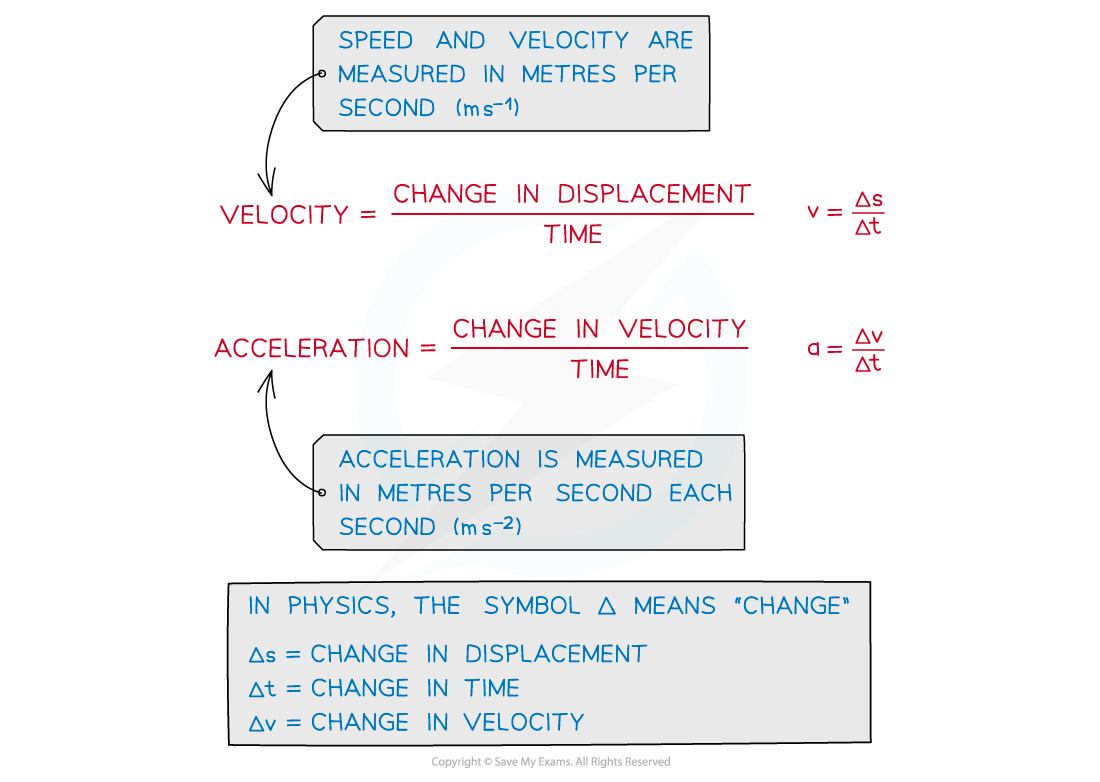
Speeding Up and Slowing Down
- An object that speeds up is?accelerating
- An object that slows down is?decelerating
- The?acceleration?of an object can be?positive?or?negative, depending on whether the object is speeding up or slowing down
- If an object is?speeding up, its acceleration is?positive
- If an object is?slowing down, its acceleration is?negative?(sometimes called?deceleration)
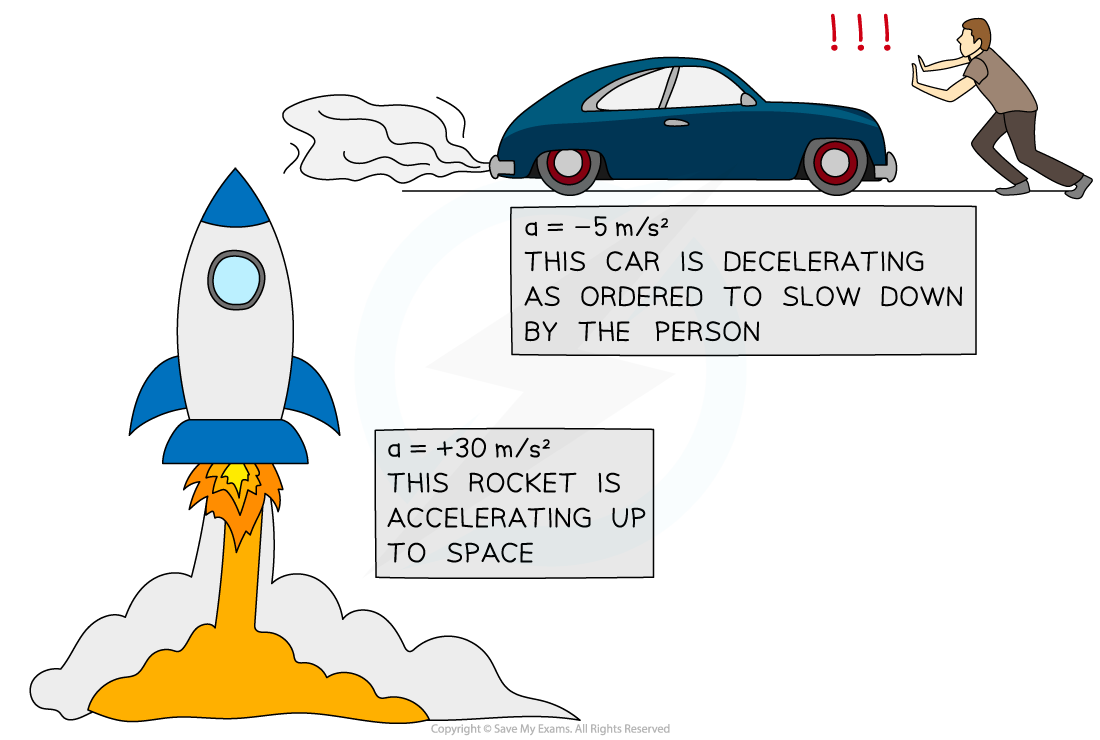
A rocket speeding up (accelerating) and a car slowing down (decelerating)
Worked Example
A Japanese bullet train decelerates at a constant rate in a straight line.The velocity of the train decreases from 50 m s–1?to 42 m s–1?in 30 seconds.
(a) Calculate the change in velocity of the train.
(b) Calculate the deceleration of the train, and explain how your answer shows the train is slowing down.
Part (a)
Step 1: List the known quantities
-
- Initial velocity = 50 m s–1
- Final velocity = 42 m s–1
Step 2: Write the relevant equation
change in velocity = final velocity ? initial velocity
Step 3: Substitute values for final and initial velocity
change in velocity = 42 ? 50 = ?8 m s–1
Part (b)
Step 1: List the known quantities
-
- Change in velocity, Δv?= ?8 m s–1
- Time taken,?t?= 30 s
Step 2: Write the relevant equation
Step 3: Substitute the values for change in velocity and time
a?= ?8 ÷ 30 = ?0.27 m s–1
Step 4: Interpret the value for deceleration
-
- The answer is?negative, which indicates the train is?slowing down
Exam Tip
Remember the units for acceleration are?metres per second squared, m s–2In other words, acceleration measures how much the velocity (in m s–1) changes every second, m s–1?s–1.
轉載自savemyexams
以上就是關于【IB DP Physics: SL復習筆記2.1.3 Acceleration】的解答,如需了解學校/賽事/課程動態,可至翰林教育官網獲取更多信息。
往期文章閱讀推薦:
MIT官方發布【2026年夏季推薦閱讀書單】!橫跨科學/人文/經濟...


翰林AMC8視頻課重磅上線!

國際競賽真題資源免費領取






