IB DP Physics: SL復(fù)習(xí)筆記5.2.2 Resistance & Resistors

Resistance
- As?electrons?move through the metal wire of a circuit (or any other component), they transfer some of their electrical potential energy to the positive ions of the metal
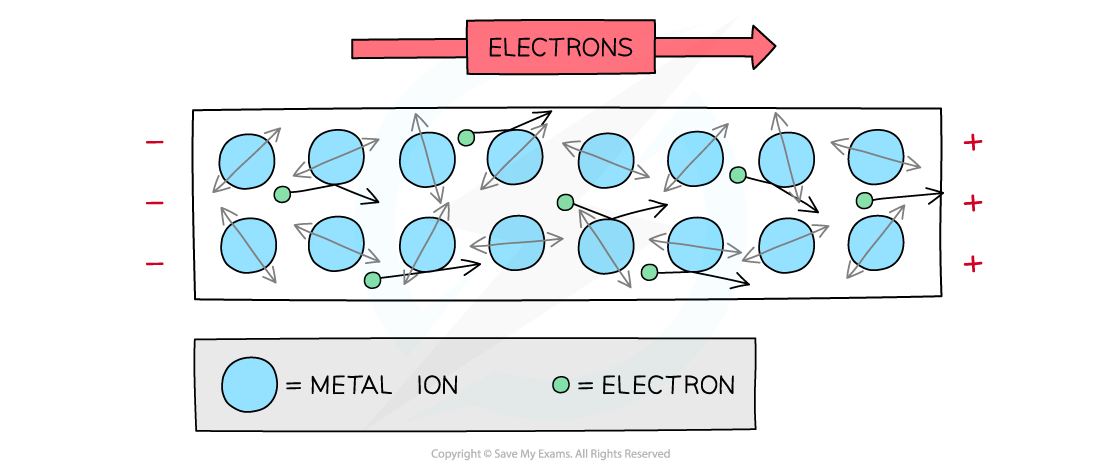
Free electrons collide with metal ions which resist their flow
- This energy results in an increase in the?kinetic energy?of the lattice
- Which means a higher?internal energy?of the metal
- The macroscopic result of this transfer is the?heating up?of the wire
- Some metals heat up more than others
- The higher the heating, the higher the?resistance
- Wires are often made from?copper?because copper has a low electrical resistance
- The resistance?R?of a component is defined as:
The ratio of the?potential difference?across the component to the?current?flowing through it
- It is calculated as follows:

- Where:
- V?= potential difference in volts (V)
- I?= electric current in amperes (A)
- R?= resistance in?ohms?(Ω)
- This means that the higher the resistance of a component, the lower the current flowing through it and vice versa
- In terms of?SI base units: 1 Ω = 1 kg m2?s–3?A–2
Worked Example
A charge of 5.0 C passes through a resistor at a constant rate in 30 s. The potential difference across the resistor is 2.0 V.
Calculate the resistance R of the resistor.
Step 1: Write down the known quantities
-
- Charge,?Δq?= 5.0 C
- Time,?Δt?= 30 s
- Potential difference,?V?= 2.0 V
Step 2: Write down the equation for the resistance?R
Step 3: Calculate the current?I?from the charge and time

Step 4: Substitute the numbers into the above equation

I?= 0.17 A
Step 5: Substitute this value of the current into the equation for the resistance given in Step 2

R?= 12 Ω
Resistors in Series & Parallel
Resistors in Series
- When two or more components are connected?in series:
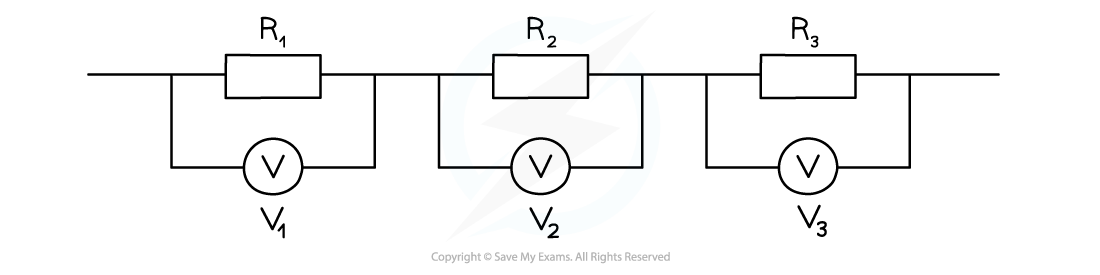
The combined resistance of the components is equal to the sum of individual resistances

- This means as more resistors are added, their combined resistance increases and is, therefore, more than the resistance of the individual components
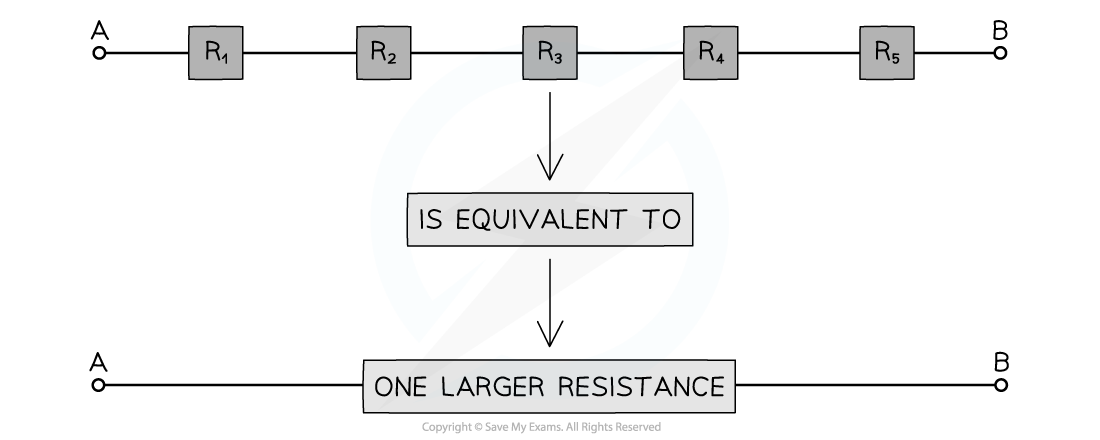
Connecting more resistors in series increases the overall resistance
Worked Example
The combined resistance?R?in the following series circuit is 60 Ω. What is the resistance value of?R2?
A.? ? ?100 Ω? ? ? ? ? ? ? ?B.? ? ?30 Ω? ? ? ? ? ? ? ?C.? ? ?20 Ω? ? ? ? ? ? ? ?D.? ? ?40 Ω
Step 1: Write down the known quantities
-
- Total resistance,?R?= 60 Ω
- Resistance of first resistor,?R1?= 30 Ω
- Resistance of third resistor,?R3?= 10 Ω
Step 2: Write down the equation for the combined resistance of resistors in series
R = R1?+ R2?+ R3
Step 3: Rearrange the above equation to calculate the resistance?R2?of the second resistor
R2?= R – R1?– R3
Step 4: Substitute the numbers into the above equation
R2?= (60 – 30 – 10) Ω
R2?= 20 Ω
ANSWER:?C
Resistors in Parallel
- When two or more components are connected in parallel:

The reciprocal of the combined resistance is the sum of the reciprocals of the individual resistances

- This means as more resistors are added, their combined resistance decreases and is, therefore, less than the resistance of the individual components
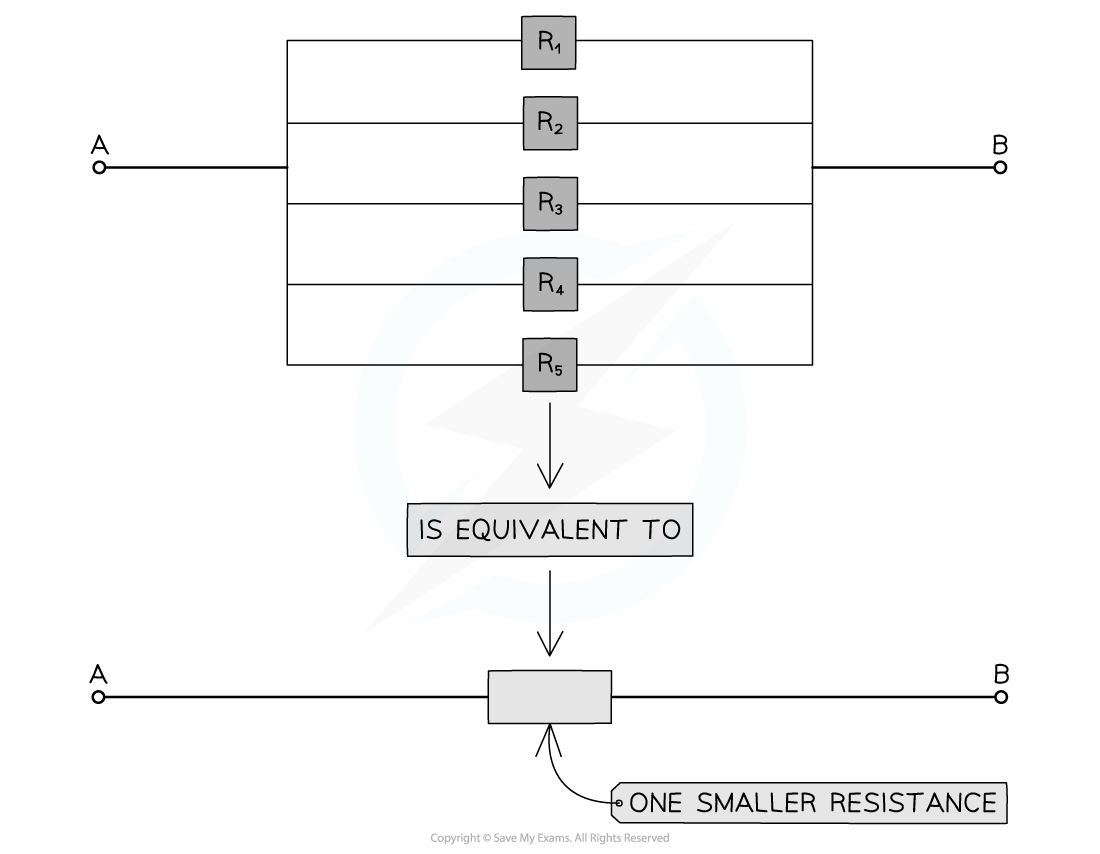
Connecting more resistors in parallel decreases the overall resistance
Worked Example
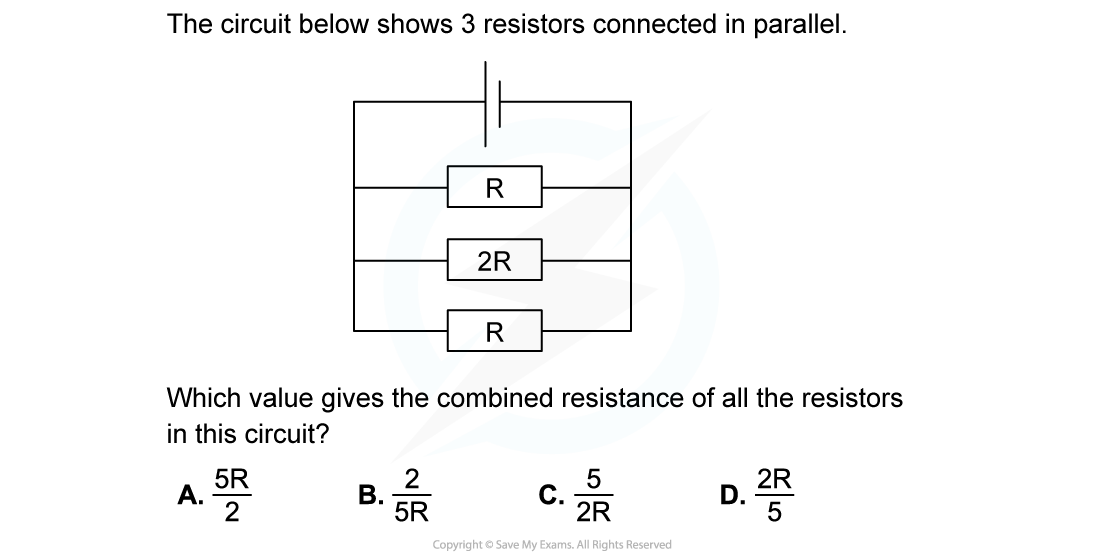
Step 1: Write down the known quantities
-
- Resistance of first resistor,?R1?=?R
- Resistance of second resistor,?R2?= 2R
- Resistance of third resistor,?R3?=?R
Step 2: Write down the equation for the reciprocal of the combined resistance (1/RTOT) of resistors in parallel

Step 3: Substitute the given quantities into the above equation


Step 4: Take the reciprocal of the second equation above to get the combined resistance?RTOT

ANSWER:?D
Exam Tip
The most common mistake in questions about parallel resistors is to forget to find the reciprocal of?RT?(i.e. 1/RT) instead of?RT. Here is a maths tip to rejig your memory on reciprocals:
- The reciprocal of a value is 1 / value
- For example, the reciprocal of a whole number such as 2 equals ?
- Conversely, the reciprocal of ? is 2
- If the number is already a fraction, the numerator and denominator are ‘flipped’ round
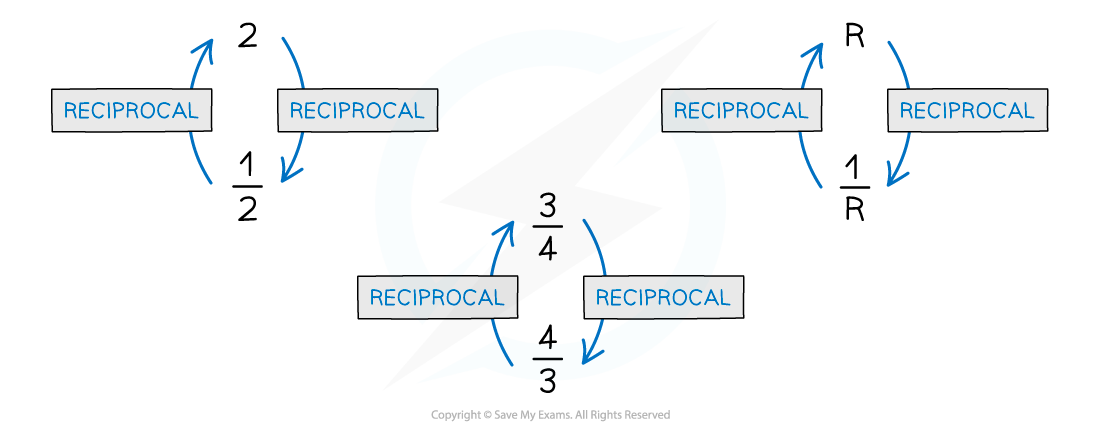 The reciprocal of a number is 1 ÷ number
- In the case of the resistance?R, this becomes 1/R
- To get the value of?R?from 1/R, you must calculate 1?÷?your answer
- You can also use the reciprocal button on your calculator (labelled either?x?–1?or 1/x, depending on your calculator)
轉(zhuǎn)載自savemyexams
以上就是關(guān)于【IB DP Physics: SL復(fù)習(xí)筆記5.2.2 Resistance & Resistors】的解答,如需了解學(xué)校/賽事/課程動(dòng)態(tài),可至翰林教育官網(wǎng)獲取更多信息。
往期文章閱讀推薦:
斯坦福大學(xué)官方推薦書(shū)單!名校學(xué)霸們暑假都在讀什么?
MIT官方發(fā)布【2026年夏季推薦閱讀書(shū)單】!橫跨科學(xué)/人文/經(jīng)濟(jì)...


翰林AMC8視頻課重磅上線!

國(guó)際競(jìng)賽真題資源免費(fèi)領(lǐng)取






