IB DP Physics: SL復習筆記6.2.3 Gravitational Field Strength

Gravitational Field Strength
- There is a universal force of attraction between all matter with?mass
- This force is known as the ‘force due to gravity’ or the?weight
- The Earth’s gravitational field is responsible for the weight of all objects on Earth
- A gravitational field is defined as:
A region of space where a test mass experiences a force due to the gravitational attraction of another mass
- The direction of the gravitational field is always towards the centre of the mass causing the field
- Gravitational forces?cannot?be repulsive
- Gravity has an infinite range, meaning it affects all objects in the universe
- There is a?greater?gravitational force around objects with a?large mass?(such as planets)
- There is a?smaller?gravitational force around objects with a?small mass?(almost negligible for atoms)
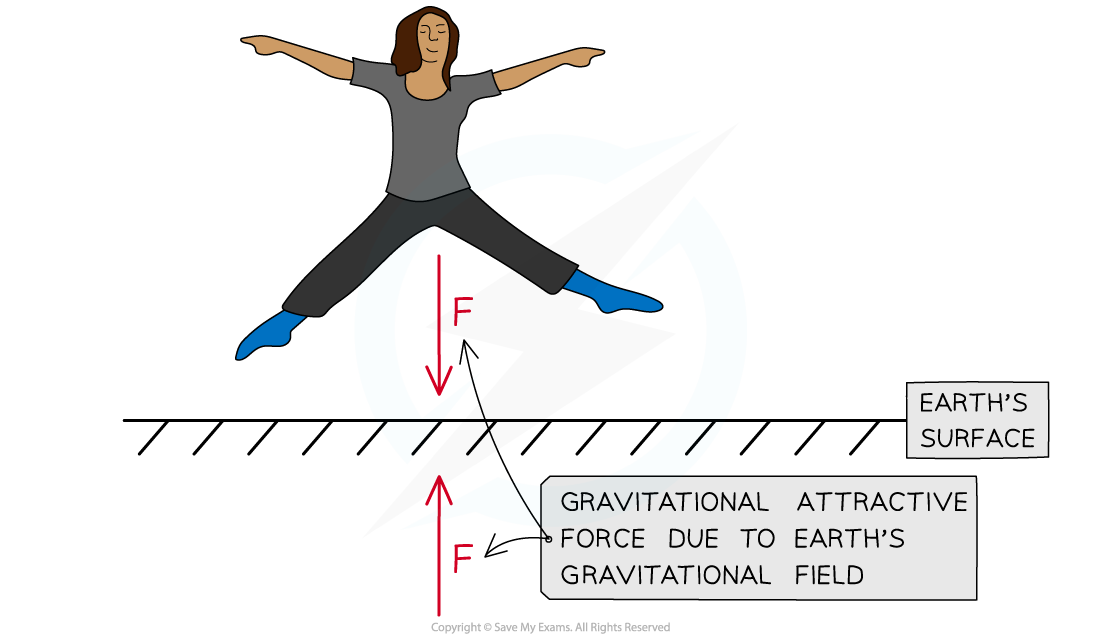
The Earth's gravitational field produces an attractive force. The force of gravity is always attractive
- The gravitational field strength at a point is defined as:
The force per unit mass experienced by a test mass at that point
- This can be written in equation form as:

- Where:
- g?=?gravitational field strength?(N kg?1)
- F?= force due to gravity, or weight (N)
- m?= mass of test mass in the field (kg)
- This equation shows that:
- On planets with a large value of?g, the gravitational force per unit mass is?greater?than on planets with a smaller value of?g
- An object's mass remains the?same?at all points in space
- However, on planets such as Jupiter, the?weight?of an object will be greater than on a less massive planet, such as Earth
- This means the gravitational force would be so high that humans, for example, would not be unable to fully stand up
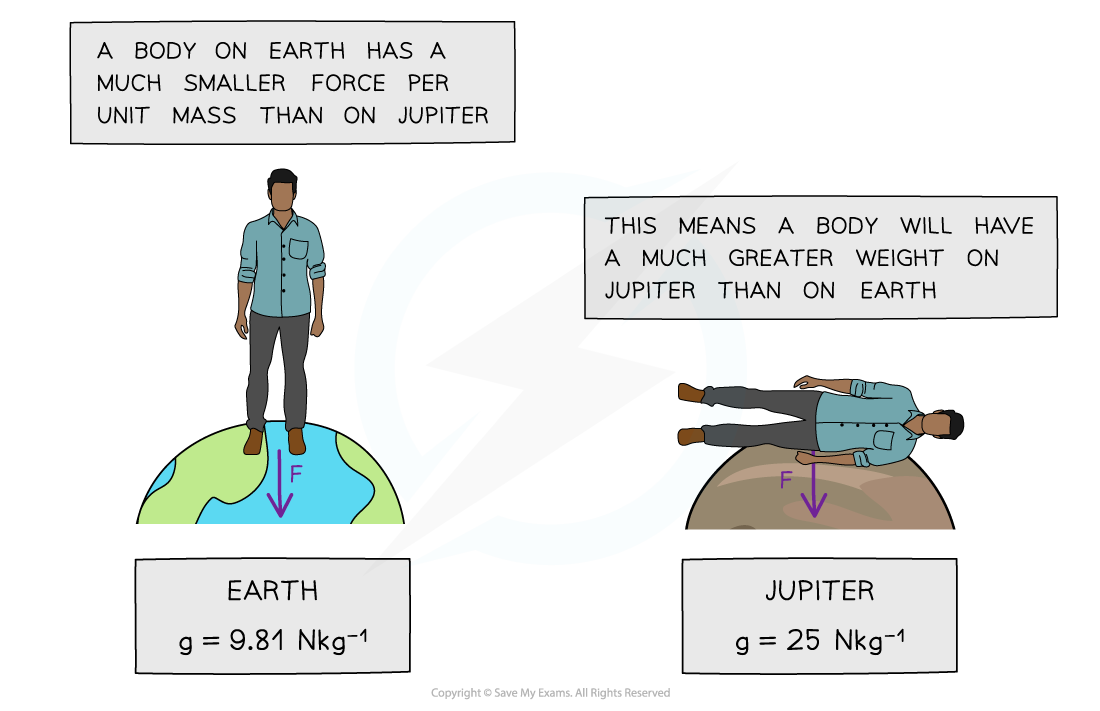
A person’s weight on Jupiter would be so large that a human would be unable to fully stand up
- Factors that affect the gravitational field strength at the surface of a planet are:
- The?radius?r?(or diameter) of the planet
- The?mass?M?(or density) of the planet
- This can be shown by equating the equation?F?=?mg?with Newton's law of gravitation:

- Substituting the force?F?with the gravitational force?mg?leads to:

- Cancelling the mass of the test mass,?m, leads to the equation:

- Where:
- G?=?Newton's Gravitational Constant
- M = mass of the body causing the field (kg)
- r?= distance from the mass where you are calculating the field strength (m)
- This equation shows that:
- The gravitational field strength?g?depends only on the mass of the body?M?causing the field
- Hence, objects with any mass?m?in that field will experience the?same gravitational field strength
- The gravitational field strength?g?is?inversely proportional?to the?square?of the radial distance,?r2
Worked Example
Calculate the mass of an object with weight 10 N on Earth.
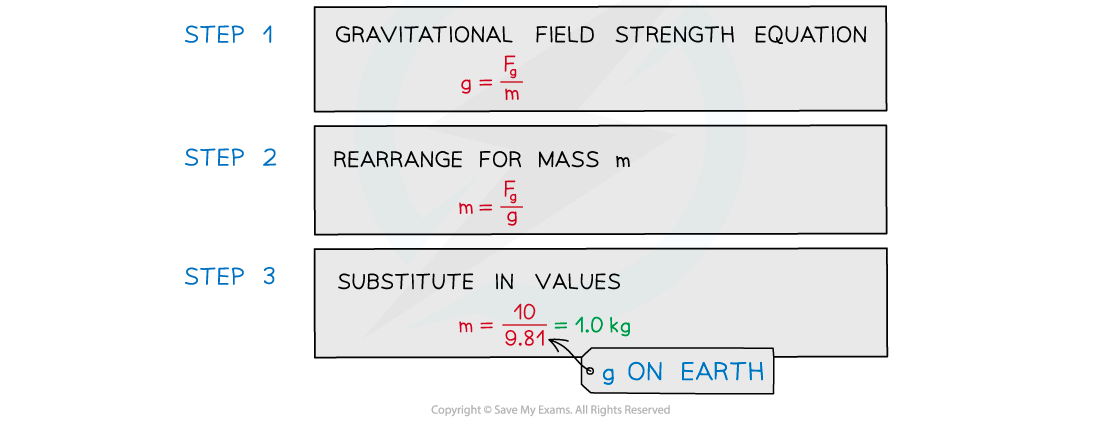
Worked Example
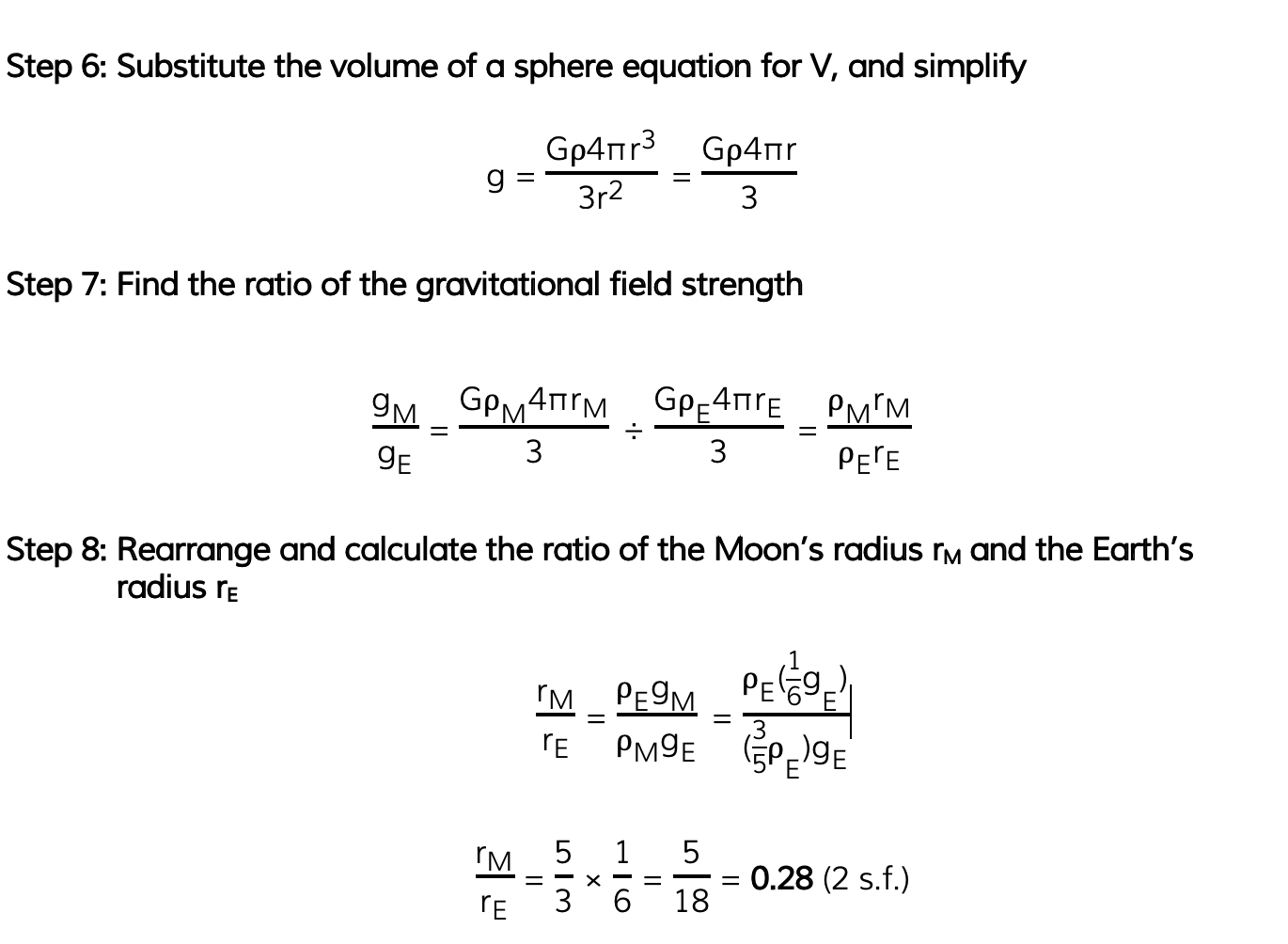
The mean density of the Moon is 3/5 times the mean density of the Earth. The gravitational field strength on the Moon is 1/6 of the value on Earth.
Determine the ratio of the Moon's radius?rM?and the Earth's radius?rE.
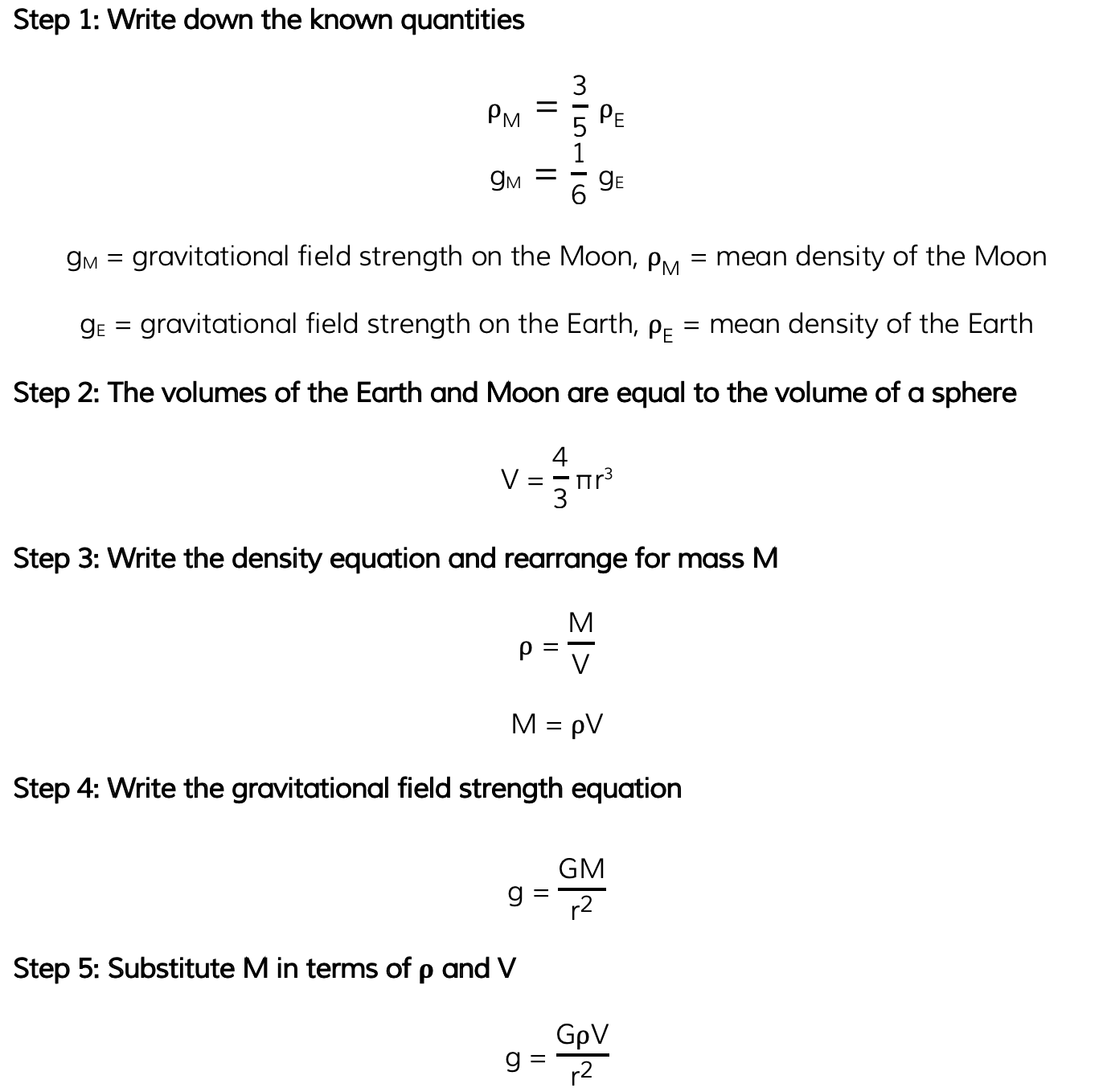
Exam Tip
There is a big difference between?g?and?G?(sometimes referred to as ‘little g’ and ‘big G’ respectively),?g?is the gravitational field strength and?G?is Newton’s gravitational constant. Make sure not to use these interchangeably! Remember the equation density ρ = mass?m?÷ volume?V,?which may come in handy with some calculations
Resultant Gravitational Field Strength
- In a similar way to other vectors, such as force or velocity, the gravitational field strength due to two bodies can be determined
- This is because gravitational field strength is a vector, meaning it has both a magnitude and direction
- The resultant gravitational field strength is, therefore, the vector sum of the gravitational field strength due to each body
Worked Example
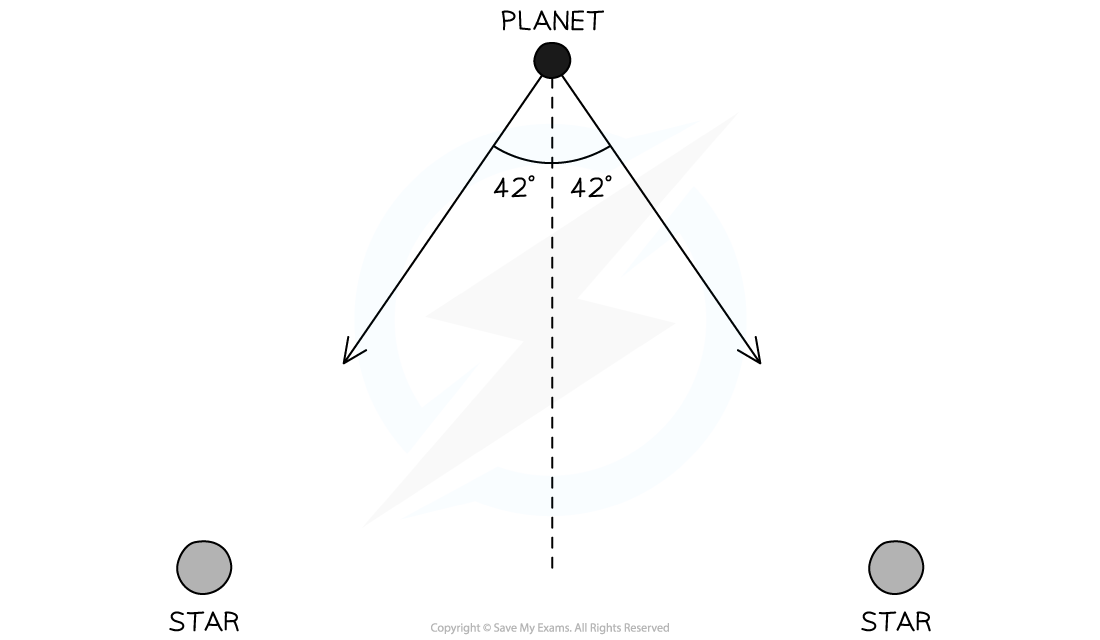
A planet is equidistant from two stars in a binary system. Each star has a mass of 5.0 × 1030?kg and the planet is at a distance of 3.0 × 10¹²?m from each star.?Calculate the magnitude of the resultant gravitational field strength at the position of the planet.
Step 1: List the known quantities
-
- Mass of one star,?M?= 5.0 × 1030?kg
- Distance between one star and the planet,?r?= 3.0 × 10¹²?m
- Angle between the gravitational field strength and the planet, θ = 42°
Step 2: Write out the equation for gravitational field strength
Step 3: Calculate the gravitational field strength due to one star
 g?= 3.7 × 10?5N kg?1
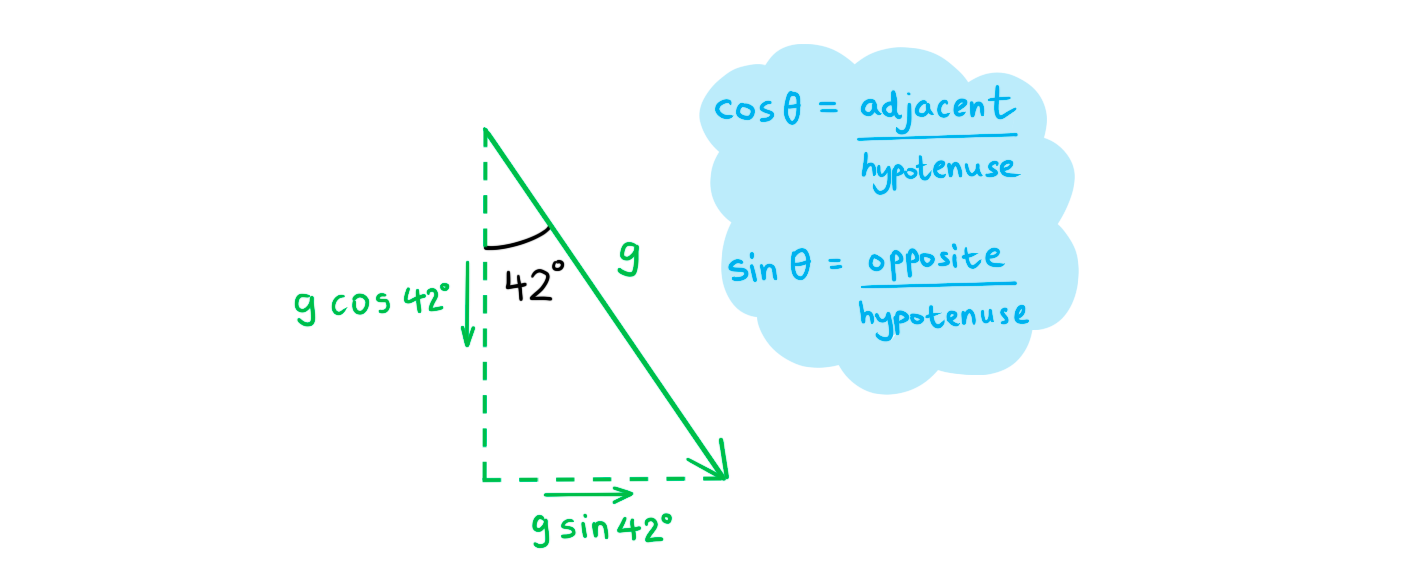
Step 4: Resolve the vectors vertically
-
- The vertical component of each vector is?g?cos 42°
Step 5: Use vector addition to determine the resultant gravitational field strength
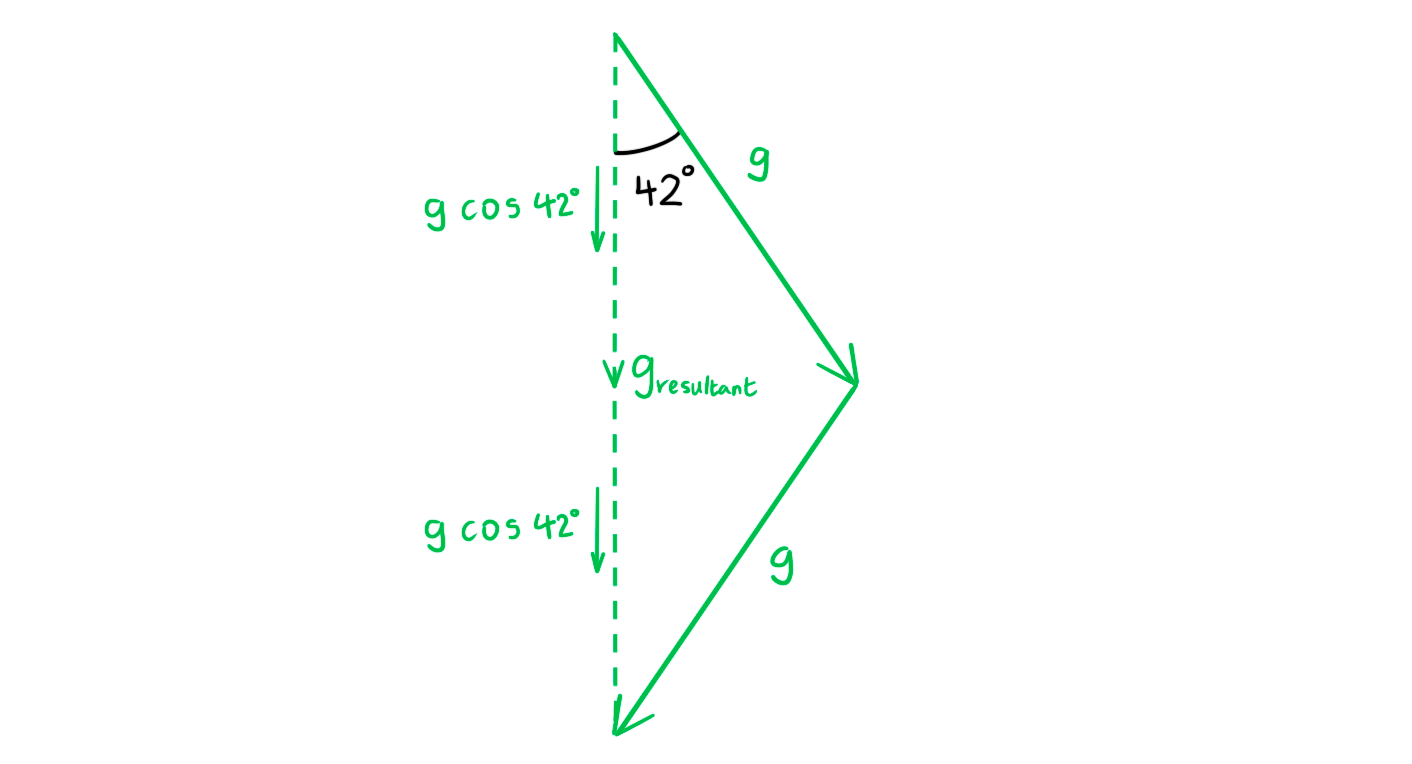 gresultant?=?g?cos 42° +?g?cos 42° = 2g?cos 42°
gresultant?= 2 × (3.7 × 10?5) × cos 42°
gresultant?= 5.5 × 10?5?N kg?1
Exam Tip
Don't worry, for calculation questions involving resultant gravitational field strength - only two bodies along a straight line will be tested!
轉載自savemyexams
以上就是關于【IB DP Physics: SL復習筆記6.2.3 Gravitational Field Strength】的解答,如需了解學校/賽事/課程動態,可至翰林教育官網獲取更多信息。
往期文章閱讀推薦:
MIT官方發布【2026年夏季推薦閱讀書單】!橫跨科學/人文/經濟...


翰林AMC8視頻課重磅上線!

國際競賽真題資源免費領取






