Edexcel A Level Economics A:復習筆記1.3.2 Externalities

Externalities & Different Types of Costs
- Externalities?occur when there is an external impact?on a third party?not involved in the economic transaction
- These impacts can be?positive or negative?and are often referred to as?spillover effects
- These impacts can be on the?production side?of the market (producer supply) or on the?consumption side?of the market (consumer demand)
- External costs?occur when the?social costs?of an economic transaction are greater than the?private costs
- A?private cost?for the producer is?what they actually pay?to produce a good/service
- An?external cost (negative externality)?is the damage not factored in to the economic activity (for example, generating air pollution when producing electricity)
- Private cost + external cost = social costs
- External benefits?occur when the?social benefits?of an economic transaction are greater than the?private benefits
- A?private benefit?for the consumer is?what they actually gain?from consuming a good/service
- An?external benefit (positive externality)?is the benefit not factored in to the economic activity (for example, someone who studies law enjoys private benefits but society benefits from having strong legal institutions)
- Private benefit + external benefit = social benefits
External Costs of Production
- Negative externalities of production are often created during the production of a good/service
- The market is failing due to?over-provision?of these goods/services as only the?private costs are considered?by the producers and not the?external costs
- If the?external costs?were considered, the quantity of the goods/services provided?would decrease?and they would be sold at a higher price
- Marginal analysis?in economics considers the?cost or benefit of the next unit produced or consumed
- The?marginal private cost (MPC)?is the cost of?the next unit?produced or consumed
- The?marginal private benefit (MPB)?is the benefit derived from the production or consumption of?the next unit
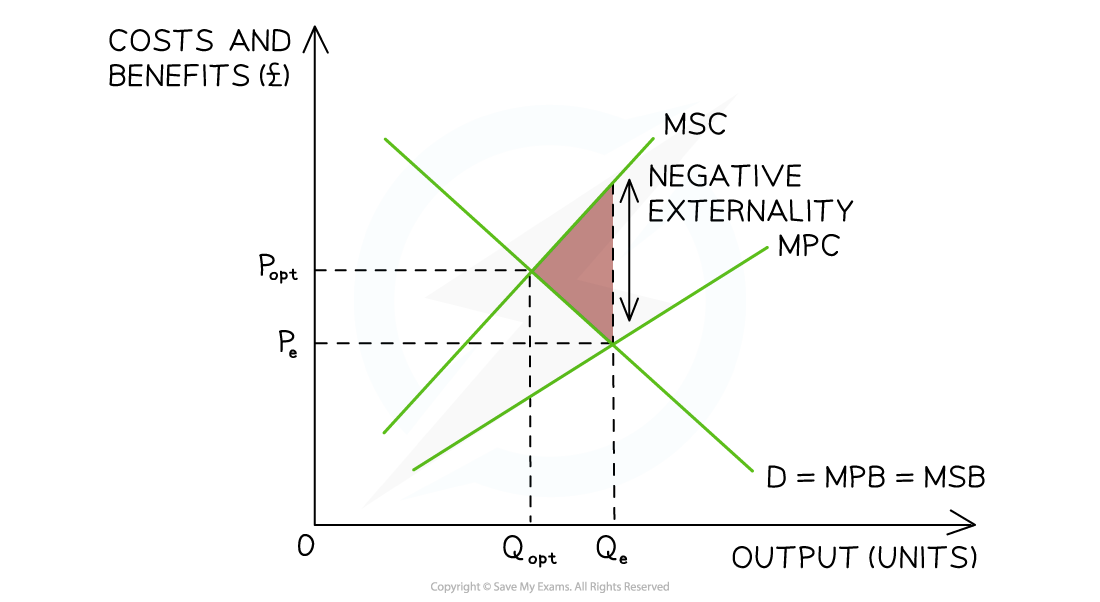
External costs of production (negative externality) result in an over-provision shown by the gap between Qopt?and Qe
Diagram Analysis
- The?marginal social benefit (MSB)?is assumed to be equal to the?marginal private benefit (MPB)?as the focus is on the?producer side?of the market
- The free-market equilibrium can be seen at PeQe. This is where the?MPC = MSB
- The larger the?external costs?in production, the larger the gap between the?MPC?and the?marginal social cost (MSC)
- The optimal allocation of resources from?society’s point of view, would generate an equilibrium where?MSB = MSC.?This can be found at?PoptQopt. There is?no market failure?at this equilibrium
- The free market is failing due to?over-provision?of this good/service at?Qe
- The factors of production used to manufacture this?over-provision?represent a?welfare loss to society?(pink triangle)
- To be?socially efficient, fewer factors of production should be allocated to producing this good/service
- There is an opportunity for?government intervention?(indirect taxes, legislation, regulation etc.), to force this market to be more?socially efficient
- Any intervention that?reduces the welfare loss?will be beneficial
External Benefits of Consumption
- Positive externalities of consumption?are created during the consumption of a good/service (merit goods)
- The market is failing due to?under-consumption?of these goods/services as only the?private benefits?are considered by the consumers and not the external benefits
- If the?external benefits?were considered, the quantity of the goods/services consumed?would increase?and they would be sold at a higher price
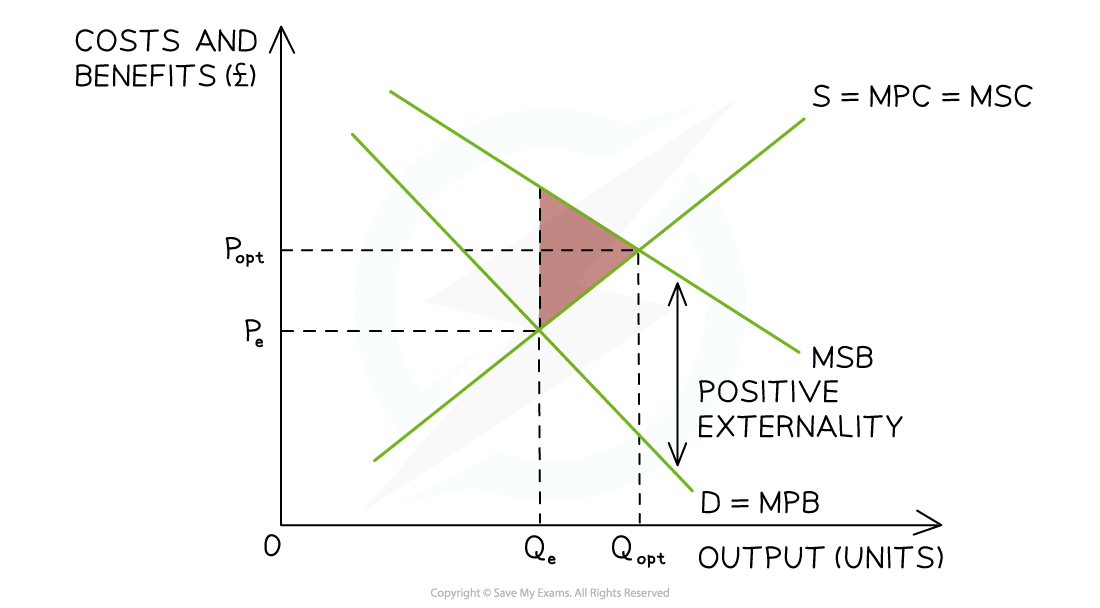
External benefits of consumption (positive externality) result in an under-consumption represented by the gap between Qe?and Qopt
Diagram Analysis
- MSC?is assumed to be equal to the?MPC?as the?focus is on the consumer?side of the market
- The free-market equilibrium can be seen at?PeQe. This is where the?MPB = MSC
- The larger the external benefits in consumption?(positive externality), the larger the gap between the MPB and MSB
- The?optimal allocation?of resources from society’s point of view would generate an equilibrium where?MSB = MSC.?This can be found at?PoptQopt.?There is no market failure here
- The free market is failing due to an?under-consumption?of this good/service at Qe
- More factors of production?should be allocated to producing the optimal quantity as?societal welfare will be gained?(pink triangle)
- There is an opportunity for?government intervention?(subsidies, partial provision etc.) to force this market to be more?socially efficient
- Any intervention that?gains welfare?will be beneficial
Exam Tip
Your understanding of externalities is frequently examined in MCQ.? You will be asked questions in language which can seem confusing, such as:
- MSC is greater than MSB at free market equilibrium
- The free-market quantity is less than the social optimum quantity
- Increasing output will lead to a net welfare gain
It is intentionally confusing as there is only one right answer. Work through the options step by step and apply your theory and one option will stand out. That is the correct answer!
The Impact of Externalities & Government Intervention in Different Markets
- Analysing?externalities?and the?government intervention?necessary to?correct them?is best done by considering?real world examples
- Analysis should always include the?impact on stakeholders including producers, consumers, government, and relevant third parties
The Impact of Negative Externalities & Government Intervention
| Example | External Costs | Possible Stakeholders | Government Intervention |
|
Extraction of iron ore (mining) |
|
|
|
The Impact of Positive Externalities & Government Intervention
| Example | External Benefits | Possible Stakeholders | Government Intervention |
|
Leisure Centres |
|
|
|
轉載自savemyexams
以上就是關于【Edexcel A Level Economics A:復習筆記1.3.2 Externalities】的解答,如需了解學校/賽事/課程動態,可至翰林教育官網獲取更多信息。
往期文章閱讀推薦:
MIT官方發布【2026年夏季推薦閱讀書單】!橫跨科學/人文/經濟...


翰林AMC8視頻課重磅上線!

國際競賽真題資源免費領取






