Edexcel A Level Economics A:復(fù)習(xí)筆記2.5.1 Causes of Growth

Causes of Economic Growth
- Economic growth can occur in the short-run or long-run and each is explained differently
Short-run Economic Growth
- Changes to any of the?components of aggregate demand?(AD) will cause?short-run economic growth?to occur
- This is illustrated on an?AD/AS diagram?by a?rightward shift in AD
- It can also be illustrated by using the?production possibilities frontier model?by moving from a?point inside?the curve to a?point closer to the curve
1. Short-run Economic Growth on AD/AS Diagram
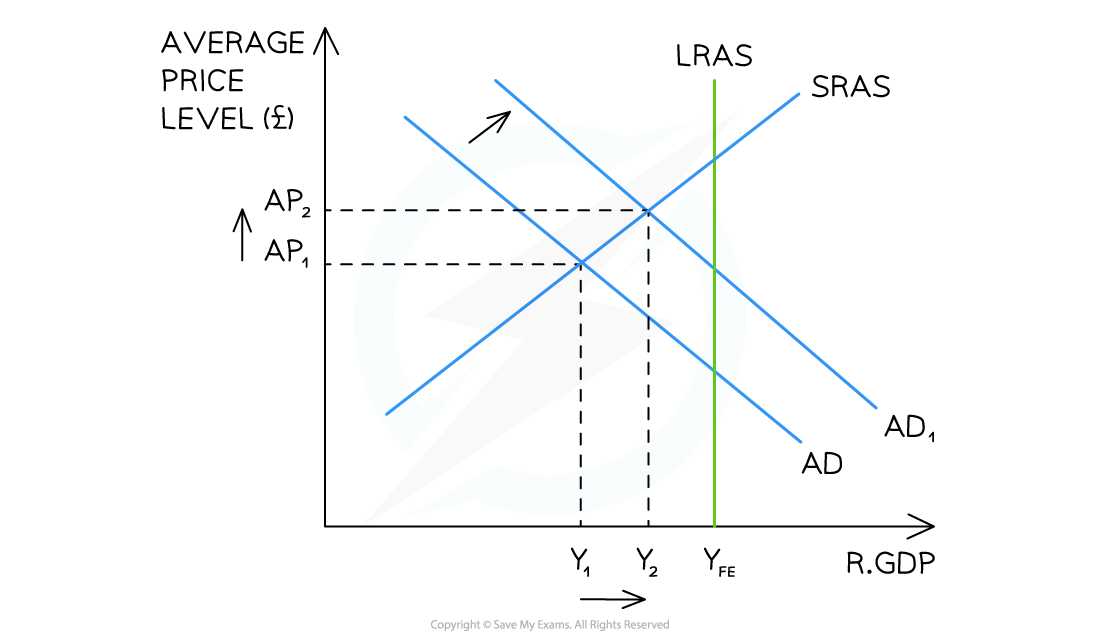
A diagram illustrating short-run economic growth through a shift of aggregate demand from AD→AD1
Diagram Analysis
- An increase in consumption, investment, government spending or net exports has caused a shift in AD from?AD→AD1
- The current?real output has increased from Y1→Y2?which represents an increase in real GDP
- An increase in real GDP = economic growth
- This?short-run growth?has led to an increase in?average prices from AP1→AP2
2. Short-run Economic Growth on Production Possibilities Frontier (PPF)
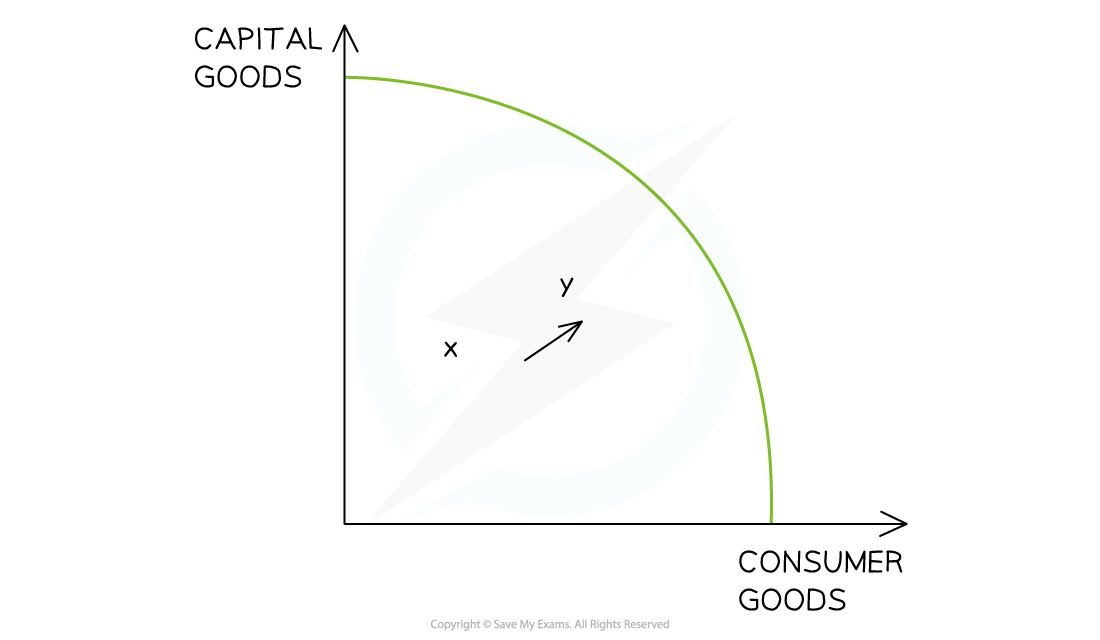
A diagram illustrating short-run economic growth on a production possibilities frontier (PPF) model
Diagram Analysis
- An increase in production has caused a shift in production combinations from?X→Y
- The current?real output has increased moving closer to the maximum possible output of the economy
- ?This represents an increase in real GDP
- An increase in real GDP = economic growth
Long-run Economic Growth
- Long-run economic growth is caused by any improvements to the?quality or quantity?of the?factors of production
- These factors include all of the?determinants of long-run aggregate supply
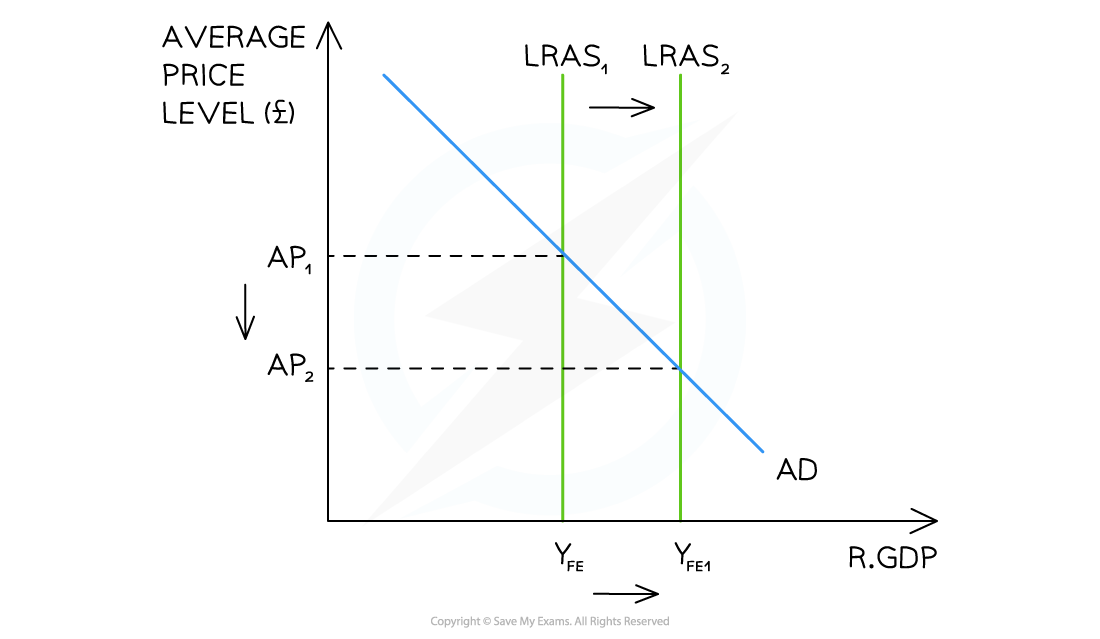
A diagram illustrating long-run economic growth through an increase in the long-run aggregate supply (LRAS) of the economy
Diagram Analysis
- A change to the?quantity/quality?of the factors of production has increased potential output of the economy from YFE→YFE1
- E.g. More?rigorous competition policy?creates a higher number of firms in each industry leading to?greater aggregate supply?in the economy
- This shifts the long-run aggregate supply?curve to the right LRAS1→LRAS2?resulting in economic growth
- E.g. More?rigorous competition policy?creates a higher number of firms in each industry leading to?greater aggregate supply?in the economy
- The final?impact on price levels?depends on the?shape of the long-run aggregate supply?curve (Keynesian or Classical)
Actual & Potential Growth
- Actual economic growth?occurs when there is an increase in the?quantity of goods/services?produced in an economy in a given period of time
- This is often measured by the?percentage change?in?real gross domestic product (GDP)
- Potential growth?is the increase in the?productive potential of an economy?as demonstrated by a shift outward of the?production possibilities frontier (PPF)?or the long-run aggregate supply (LRAS) curve
- At any given point in time, the?actual economic growth?may be less than the?potential growth?available to the economy
International Trade & Export-led Economic Growth
- International trade?is an important source of income for many countries
- Export-led economic growth?refers to growth that occurs as a result of?an increase?in the sale of goods/services to foreign countries
- Net exports is a component of?aggregate demand (AD)
- For many?developing countries, the exports represent a high percentage of the?annual AD and gross domestic product (GDP)
- When the value of the exports rise, the real GDP rises significantly - and vice versa
- E.g. China experienced significant?export-led economic growth?from 1988 to the global financial crisis of 2008
轉(zhuǎn)載自savemyexams

國(guó)際競(jìng)賽真題資源免費(fèi)領(lǐng)取


美高學(xué)分項(xiàng)目重磅來(lái)襲!立即了解