Edexcel IGCSE Physics: Double Science 復習筆記: 1.2.9 Hooke's Law

Edexcel IGCSE Physics: Double Science 復習筆記: 1.2.9 Hooke's Law
Hooke's Law
- The relationship between the extension of an elastic object and the applied force is defined by?Hooke's Law
- Hooke's Law states that:
The extension of an elastic object is directly proportional to the force applied, up to the limit of proportionality
- Directly proportional means that as more force is applied, the greater the extension (and vice versa)
- The?limit of proportionality?is where if more force is added, the object may extend but will?not?return to its original shape when the force is removed (it will be?inelastically?deformed)
- This limit varies according to the material
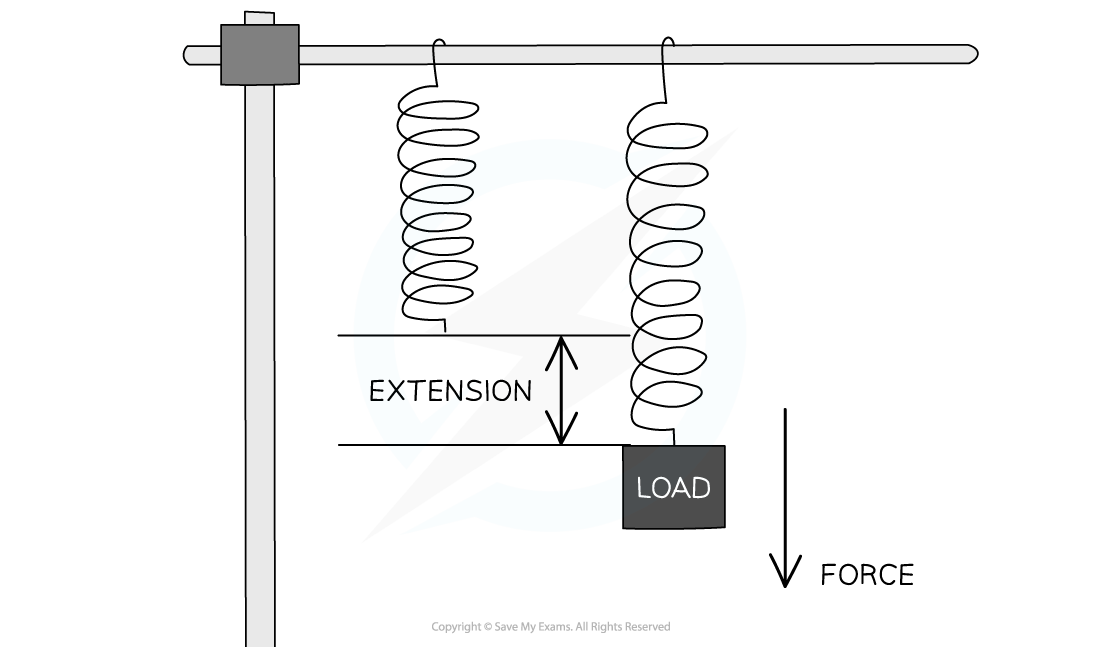
Hooke's Law states that a force applied to a spring will cause it to extend by an amount proportional to the force
The Force-Extension Graph
- Hooke’s law is the?linear?relationship between force and extension
- This is represented by a?straight line?on a force-extension graph
- Any material beyond its?limit of proportionality?will have a non-linear relationship between force and extension
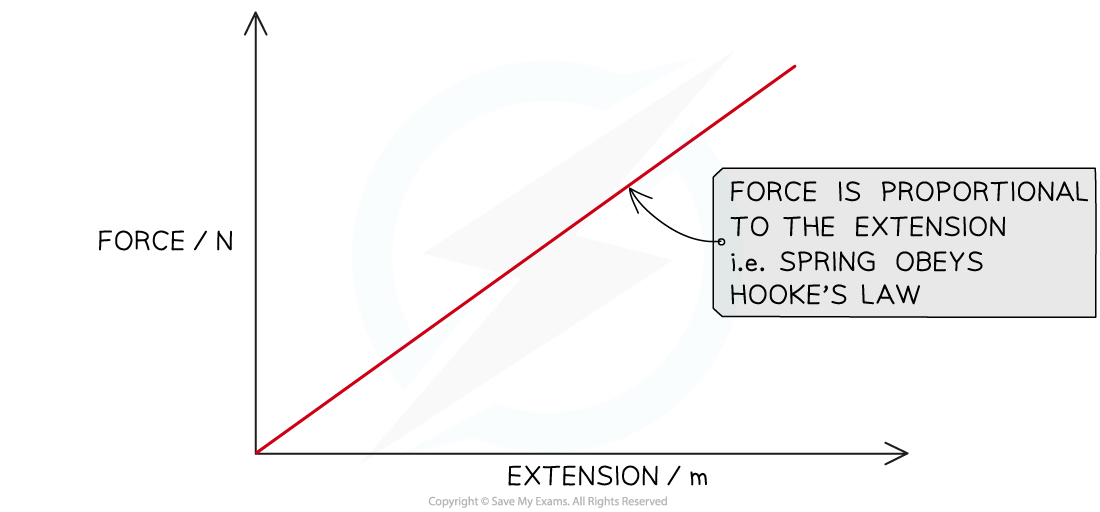
Hooke's Law is associated with the linear region of a force-extension graph
Elastic Behaviour
- When some objects, such as springs or rubber bands, are stretched they will return to their original shape and length once the forces are removed
- Other materials, such as plastic, remain permanently deformed (stretched)
- A change of shape is called a?deformation?and can either be:
- Elastic
- Inelastic
Elastic Deformation
- Elastic deformation occurs:
When objects return to their original shape when the stretching force is removed
- Examples of materials that undergo elastic deformation are:
- Rubber bands
- Fabrics
- Steel springs
Inelastic Deformation
- Inelastic deformation occurs:
When objects remain stretched and do not return completely to their original shape even when the stretching force is removed
- Examples of materials that undergo inelastic deformation are:
- Plastic
- Clay
- Glass
轉載自savemyexams
以上就是關于【Edexcel IGCSE Physics: Double Science 復習筆記: 1.2.9 Hooke's Law】的解答,如需了解學校/賽事/課程動態,可至翰林教育官網獲取更多信息。
往期文章閱讀推薦:
MIT官方發布【2026年夏季推薦閱讀書單】!橫跨科學/人文/經濟...


翰林AMC8視頻課重磅上線!

國際競賽真題資源免費領取






