Edexcel A Level Maths: Mechanics:復習筆記4.1.2 Using Moments - Equilibrium

Using Moments - Equilibrium
What happens with moments if a rigid body is in equilibrium?
- If a rigid body is in?equilibrium?then:
- The?resultant force?is 0 N
- The?resultant moment?about?any point?is 0 N m
- The sum of the magnitudes of the?clockwise moments?equals?the sum of the magnitudes of the?anti-clockwise moments
How do I solve problems involving moments and equilibrium?
- Step 1: Identify?all forces?and?perpendicular distances?from the pivot
- Step 2: Use the fact that the?resultant force is 0 N?to form an equation
- Step 3: Use the fact that the?resultant moment?about any point is?0 N m?to form equations
- If there is an unknown force you can choose a pivot that is on the line of action of that force – this will mean that the moment of that force is 0 N m
- Step 4:?Solve?the equations
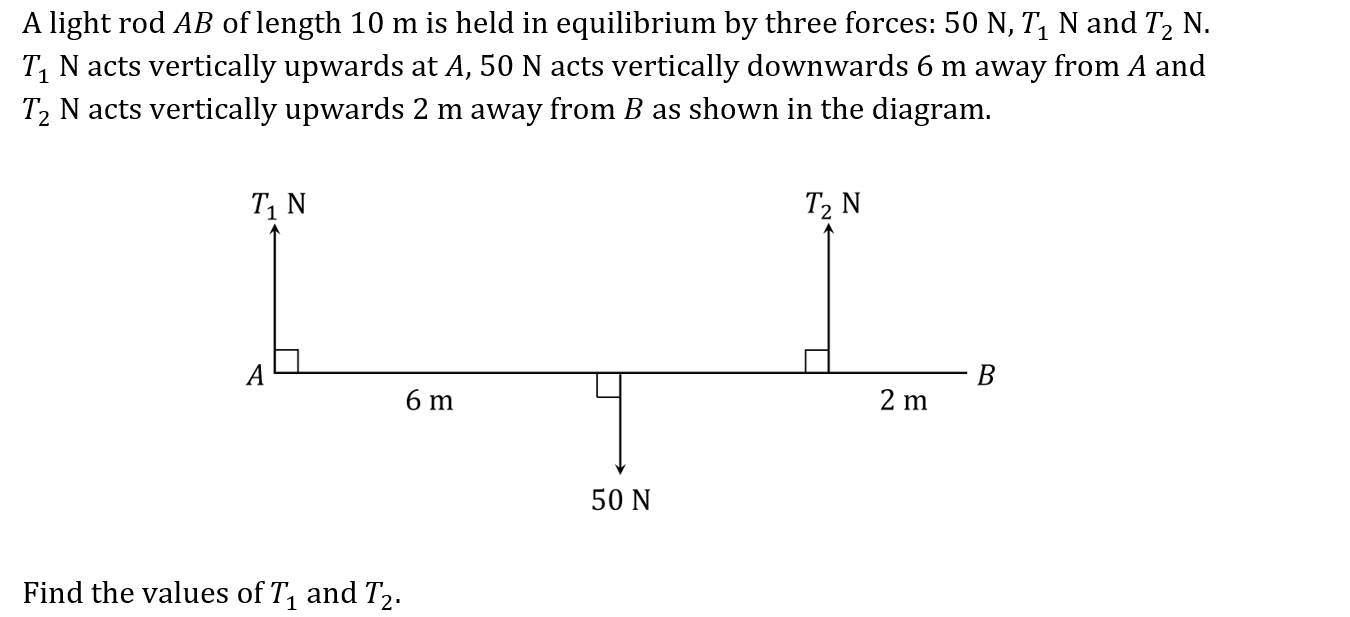
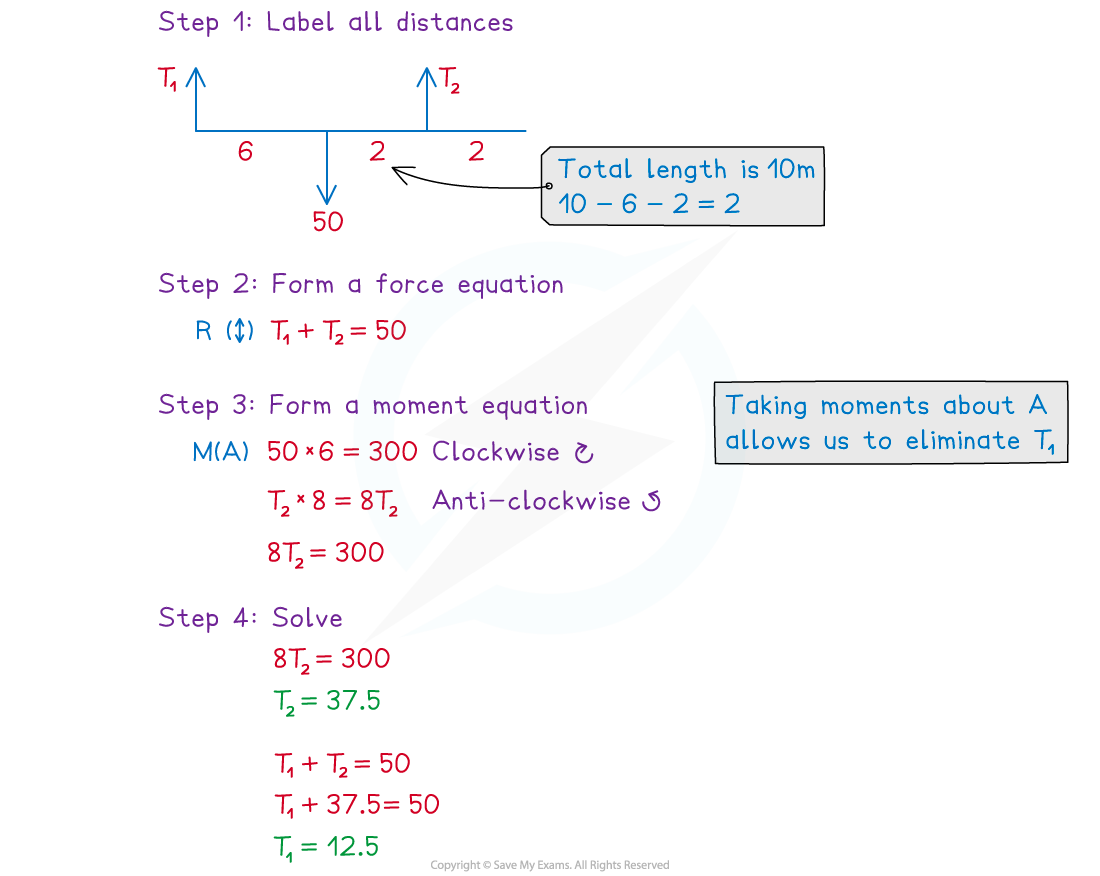
Worked Example
Exam Tip
- If you see a force diagram that involves distances then you can be fairly sure that moments will be involved! A clear diagram showing all the distances is key.
- If you pick a pivot and form a moment equation which involves more than one unknown, try choosing another pivot to form simultaneous equations.
- Pick your pivot wisely as unknown and unwanted forces can be eliminated from the equation by choosing the point to be on the line of action of a force.
轉載自savemyexams
以上就是關于【Edexcel A Level Maths: Mechanics:復習筆記4.1.2 Using Moments - Equilibrium】的解答,如需了解學校/賽事/課程動態,可至翰林教育官網獲取更多信息。
往期文章閱讀推薦:
MIT官方發布【2026年夏季推薦閱讀書單】!橫跨科學/人文/經濟...


翰林AMC8視頻課重磅上線!

國際競賽真題資源免費領取






