Edexcel IGCSE Physics: Double Science 復習筆記:4.1.4 Conduction, Convection & Radiation

Conduction
- Thermal energy transfers from hotter areas to cooler areas by the processes of:
- Conduction
- Convection
- Radiation

- Objects will?always?lose heat until they are in thermal equilibrium (same temperature) with their surroundings
- For example, a mug of hot tea will cool down until it reaches room temperature
- Conduction is the main method of thermal energy transfer in solids
- Metals are extremely good at conducting heat
- Non-metals are poor at conducting heat whilst liquids and gases are extremely poor
- Poor conductors are called?insulators
- Materials containing small pockets of?trapped air?are especially good at insulating, as air is a gas and hence a poor conductor
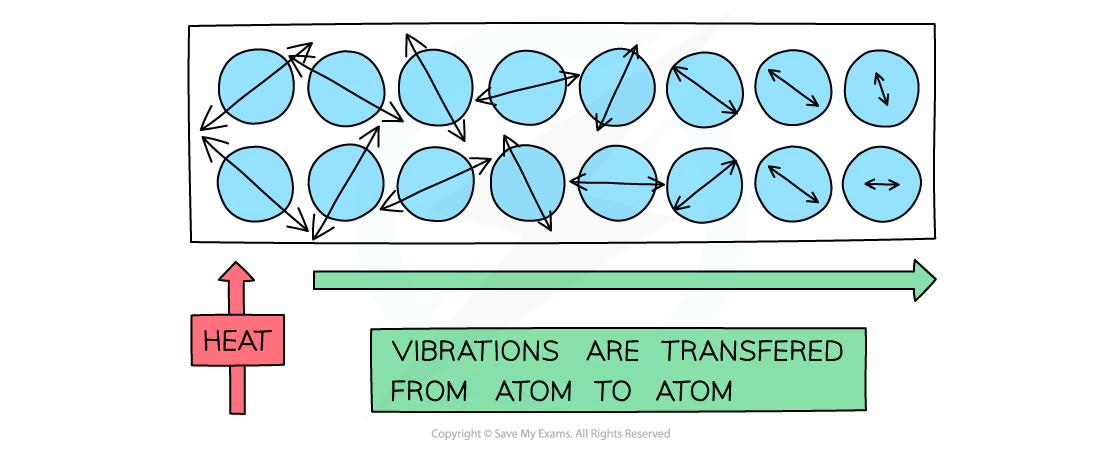
Conduction: the atoms in a solid vibrate and bump into each other
- When a substance is heated, the atoms?start to move around (vibrate) more
- As they do so they?bump into each other, transferring energy from atom to atom
- Metals are especially good at conducting heat as the?delocalised electrons?can collide with the atoms, helping to transfer the?vibrations?through the material and hence transfer heat better
Exam Tip
If a question mentions thermal energy transfers and?metals, the answer will probably have something to do with conduction!
Convection
- Convection is the main way that heat travels through?liquids?and?gases
- Convection?cannot occur in solids
- When a fluid (a liquid or a gas) is heated:
- The molecules push each other apart, making the fluid?expand
- This makes the hot fluid?less dense?than the surroundings
- The?hot fluid rises, and the cooler (surrounding) fluid moves in to take its place
- Eventually, the hot fluid cools, contracts and sinks back down again
- The resulting motion is called a?convection current

A convection current caused by the heat transfer from the fire
Exam Tip
If a question refers to thermal energy transfers and a?liquid or gas?(that isn’t trapped) then make sure your answer mentions that convection currents will probably form!
Thermal Radiation
- All bodies (objects), no matter what temperature, emit a spectrum of thermal radiation in the form of electromagnetic waves
- Thermal radiation is heat transfer by?infrared?(part of the electromagnetic spectrum)
- The?hotter?object, the?more?infrared radiation it radiates in a given time
 The infrared emitted from a hot object can be detected using a special camera
- The colour of an object affects how well it?emits?and?absorbs?thermal radiation
- Black objects are the?best?at emitting and absorbing thermal radiation
- Shiny objects are the?worst?at emitting and absorbing thermal radiation
- The table below summarises the absorbing and emitting abilities of different colours:
Absorbing and Emitting of Difference Colours Table

Exam Tip
If a question refers to the colour of something (black, white or shiny) then the answer will probably have something to do with thermal radiation!If the question involves a?vacuum?(empty space) then mention?radiation?as it is the?only?way in which heat can travel through a vacuum as conduction and convection require particles to transfer heat!
轉載自savemyexams
以上就是關于【Edexcel IGCSE Physics: Double Science 復習筆記:4.1.4 Conduction, Convection & Radiation】的解答,如需了解學校/賽事/課程動態(tài),可至翰林教育官網獲取更多信息。
往期文章閱讀推薦:
MIT官方發(fā)布【2026年夏季推薦閱讀書單】!橫跨科學/人文/經濟...


翰林AMC8視頻課重磅上線!

國際競賽真題資源免費領取






