Edexcel A Level Maths: Statistics:復習筆記3.2.1 Set Notation & Conditional Probability

Set Notation
What is set notation?
- Set?notation?is a formal way of writing groups of numbers (or other mathematical entities such as shapes) that share a common feature – each number in a set is called an?element?of the set
- You should have come across common sets of numbers such as the?natural?numbers, denoted by
 ?, or the set of?real?numbers, denoted by
- You should have come across common sets of numbers such as the?natural?numbers, denoted by
- In?probability, set notation allows us to talk about the?sample?space?and?events?within in it
- S, U,
 ,
,  ?are common symbols used for the Universal set
In probability this is the entire sample space, or the rectangle in a?Venn diagram - Events?are denoted by capital letters,?A, B, C?etc
- The?events
 are denoted by
  ?etc
?etc
(Strictly pronounced “A? prime” but often called “A? dash”)
 is called the?complement?of?A
- S, U,
- In probability we are often looking at combined events
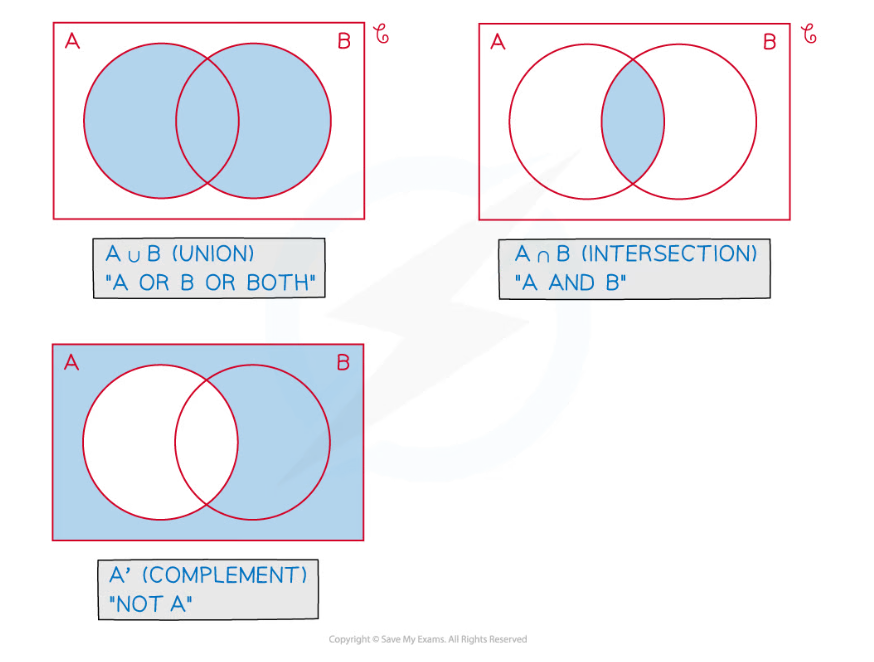
- The event?A?and?B?is called the?intersection?of events?A?and?B?, and the symbol ∩ ?is used
i.e.??A?and?B ?is written as
- On a?Venn?diagram?this would be the?overlap?between the bubble for event?A?and the bubble for event

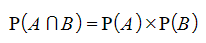
- From?Basic?Probability, for?independent?events
- On a?Venn?diagram?this would be the?overlap?between the bubble for event?A?and the bubble for event
- The event?A?and?B?is called the?intersection?of events?A?and?B?, and the symbol ∩ ?is used
-
- The event A or B is called the union of events A and B , and the symbol∪?is used
i.e. ?A or B??is written as
- On a?Venn?diagram?this would be?both?the bubbles for event A and event B including their?overlap?(intersection)
- From?Basic?Probability, for?mutually?exclusive?events
-

- The other set you may come across in probability is the?empty?set
The empty set has no elements and is denoted by
The?intersection?of?mutually?exclusive events is the empty set,
- And finally,

How do I solve problems given in set notation?
- Recognise the notation and symbols used and then interpret them in terms of?AND (∩),?OR (∪) and/or?NOT?(‘) statements
- Venn diagrams lend themselves particularly well to deducing which sets or parts of sets are involved- draw mini-Venn diagrams and shade them
- Practice shading various parts of Venn diagrams and then writing what you have shaded in set notation
- With combinations of?union,?intersection?and?complement?there may be more than one way to write the set required
- e.g.?
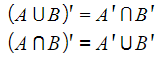
Not convinced?? Sketch a Venn diagram and shade it in!
- In such questions it can be the?unshaded?part that represents the solution
- e.g.?
Worked Example
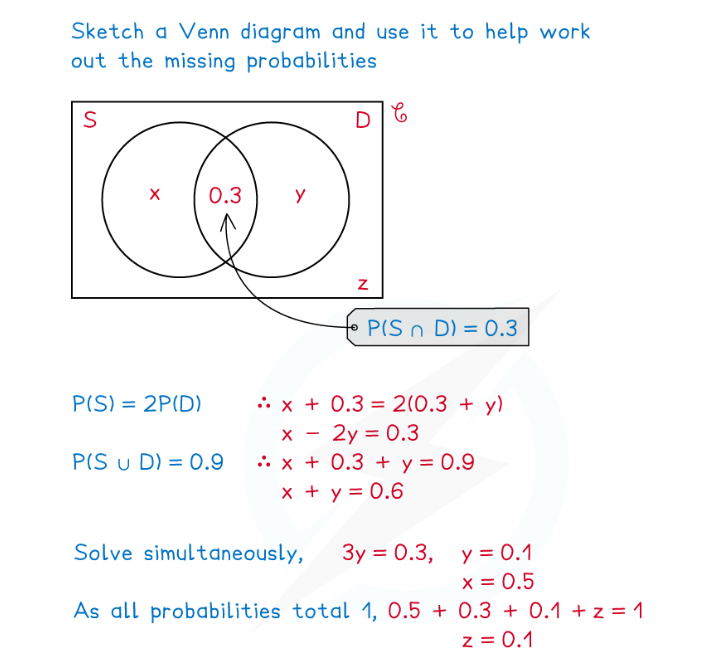
The members of a local tennis club can decide whether to play in a singles competition, a doubles competition, both or neither.
Once all members have made their choice the chairman of the club selects, at random, one member to interview about their decision.
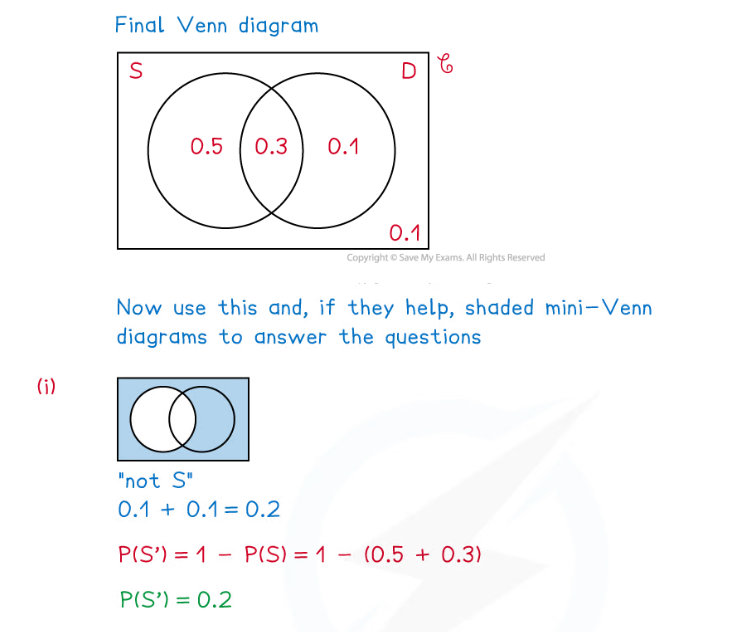
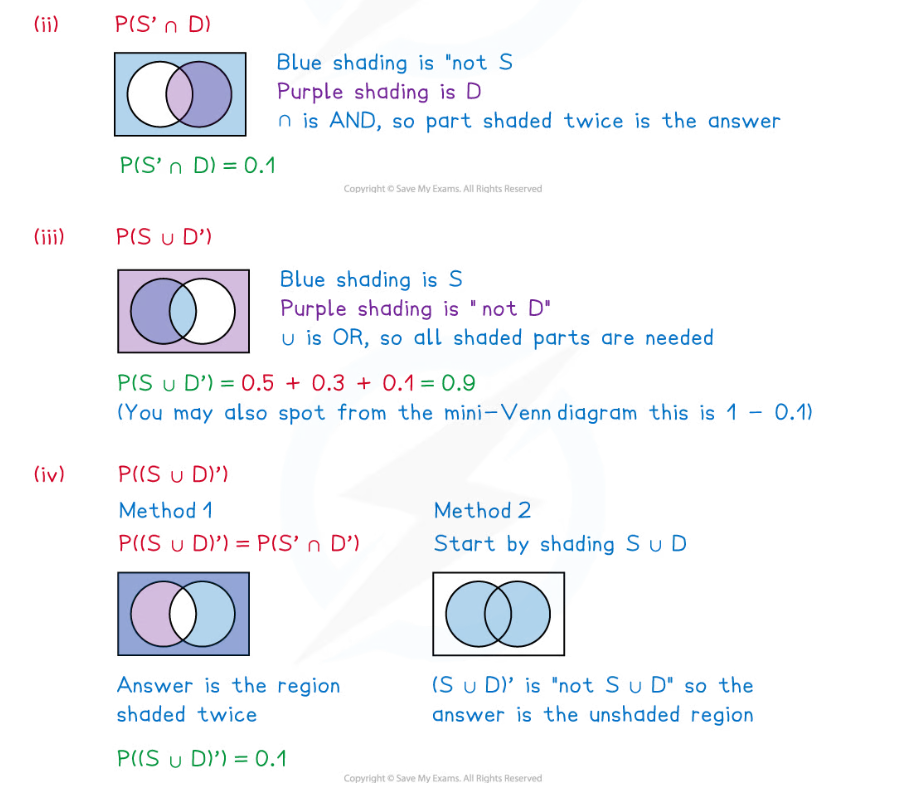
 is the event a member selected the singles competition.
 is the event a member selected the doubles competition.
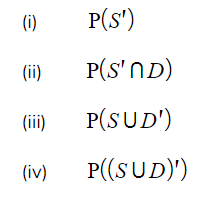
Given that  ?, find
Exam Tip
- Do not try to do everything using a single diagram – whether given one in the question or using your own; use mini-Venn diagrams and shading for each part of a question
- Do double check whether you are dealing with?union (∪) or?intersection (∩) (or both) – when these symbols are used several times near each other in a question, it is easy to get them muddled up or misread them
Conditional Probability
What is conditional probability?
Conditional?probability?is where the probability of an?event?happening can vary depending on the outcome of a prior event
- You have already been using?conditional?probability
e.g.? drawing more than one counter/bead/etc from a bag?without?replacement
(Note that, mathematically, that drawing one, not replacing then
drawing another is the same as drawing two at the same time.)
- Consider the following example
e.g.??????? Bag with 6 white and 3 red buttons. One is drawn at random and not? replaced.? A second button is drawn. The probability that the second button is white?given?that the first button is white is  .
.
- The key phrase here is “given?that” – it essentially means something has already happened.
- In set notation, “given?that” is indicated by a vertical line (?|?) so the above example would be written

- There are other phrases that imply or mean the same things as “given that”
- In set notation, “given?that” is indicated by a vertical line (?|?) so the above example would be written
- Venn diagrams?are helpful again but beware – the denominator of fractional probabilities will no longer be the total of all the frequencies or probabilities shown
- “given?that” questions usually reduce the sample space as an event (a subset of the outcomes of the first event) has already occurred
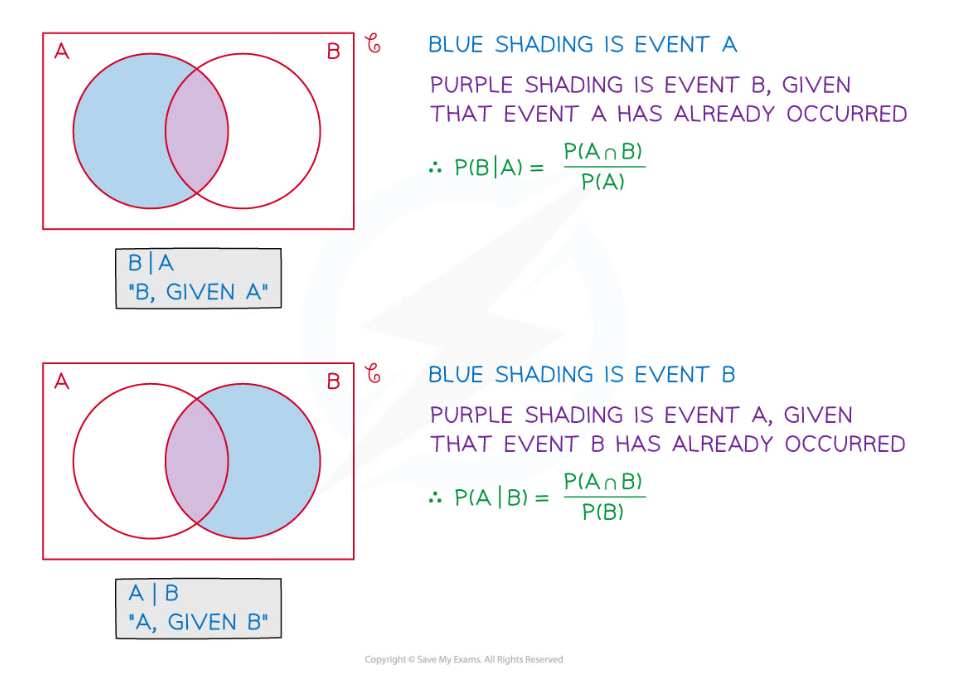
- The diagrams above also show two more?conditional?probability?results


(These are essentially the same as letters are interchangeable)
- For?independent?events we know
 ?so
?so
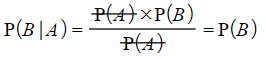
and similarly
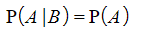 The independent result should make sense logically – if events?A?and?B???are independent then the fact that event?B??has already occurred has no effect on the probability of event?A?happening
Worked Example
The Venn diagram below illustrates the probabilities of three events, 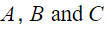 .
.
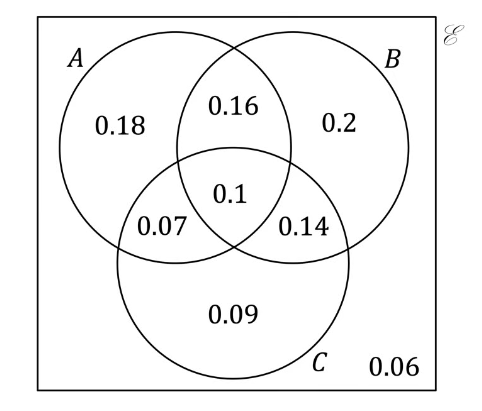
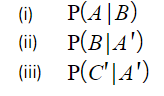
 and
and  ?are independent.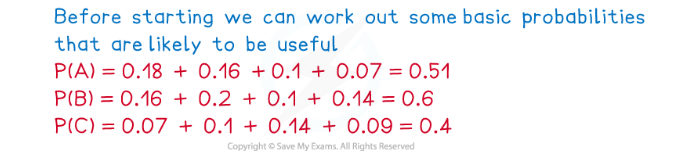
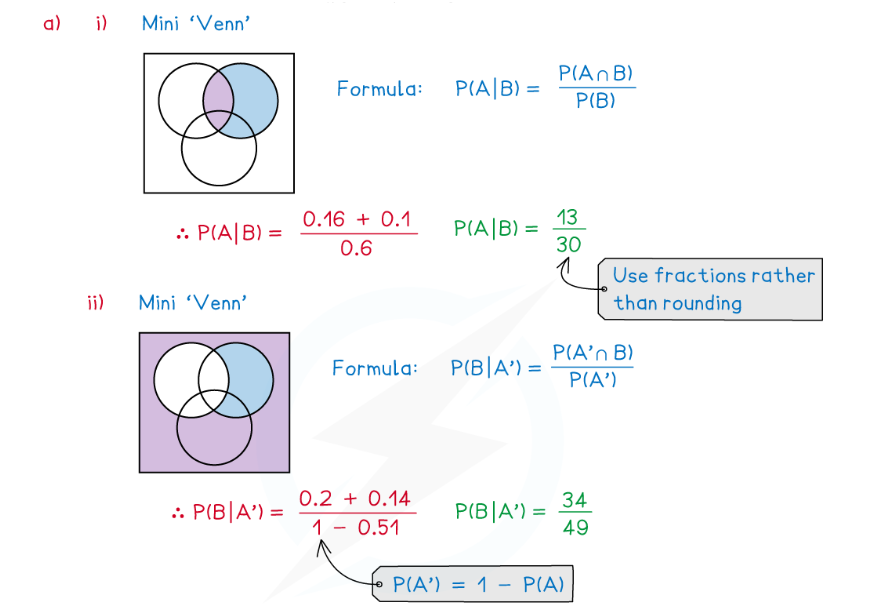
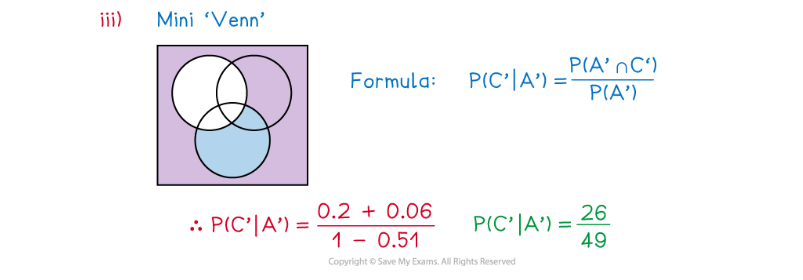
and ?are independent.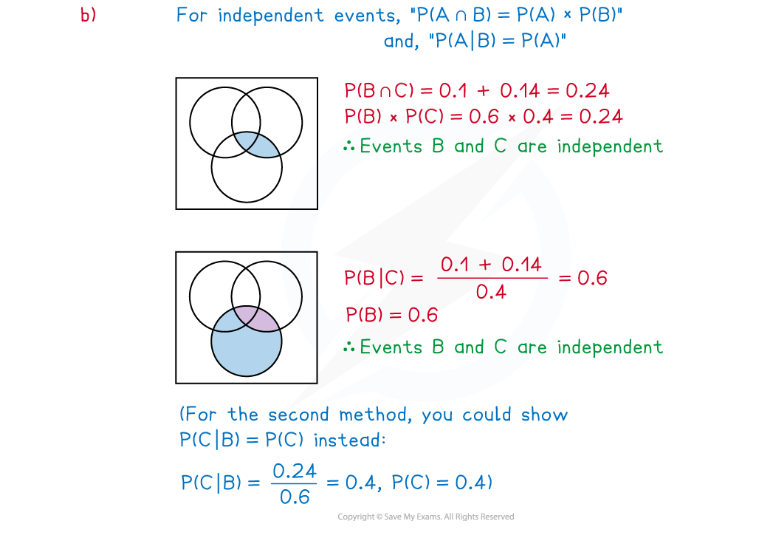
Exam Tip
- There are now several symbols used from set notation in probability – make sure you are familiar with them
- union (∪)
- intersection (∩?)
- not?(‘)
- given that?( | )
- If given a Venn diagram with all the separate probabilities you may find it easier to work out P(A), P(B) etc first
Two-Way Tables
What are two-way tables?
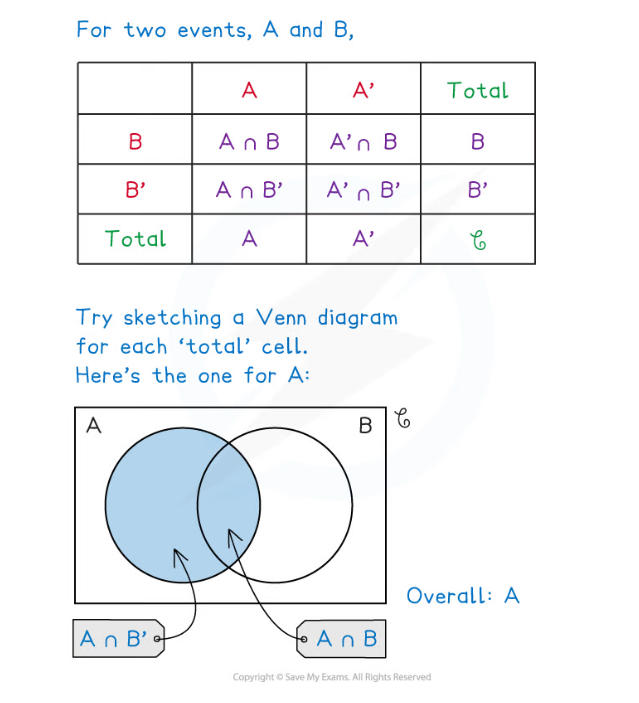
- In?probability,?two-way?tables?list the frequencies for the outcomes of two events – one event along the top (columns), one event down the side (rows)
- The frequencies, along with a “Total” row and “Total” column instantly show the values involved in finding probabilities
How do I solve problems given involving two-way tables?
- Questions will usually be wordy – and may not even mention two-way tables
- Questions will need to be interpreted in terms of?AND (∩?,?intersection),?OR (∪,?union),?NOT?(‘) and?GIVEN?THAT?( |?)
- Complete as much of the table as possible from the information given in the question
- If any empty cells remain, see if they can be calculated by looking for a row or column with just one missing value
- Each cell in the table is?similar?to a region in a Venn diagram
- With event?A?outcomes on columns and event?B?outcomes on rows
 (intersection, AND) will be the cell where outcome??meets outcome
 (union,?OR) will be all the cells for outcomes ?and ?including the cell for both
- Beware! As?union?includes the cell for?both?outcomes, avoid counting this cell?twice?when calculating?frequencies?or?probabilities
- With event?A?outcomes on columns and event?B?outcomes on rows
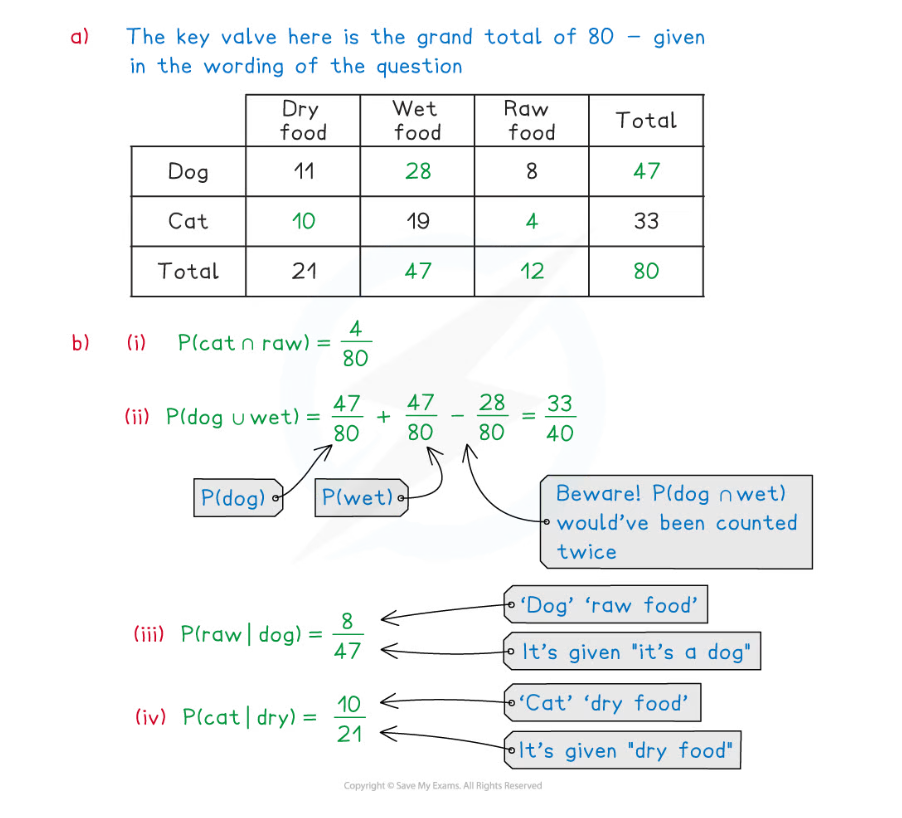
(see Worked Example Q(b)(ii))
- You may need to use the results

 ?(for independent events)
Worked Example
The incomplete two-way table below shows the type of main meal provided by 80 owners to their cat(s) or dog(s).
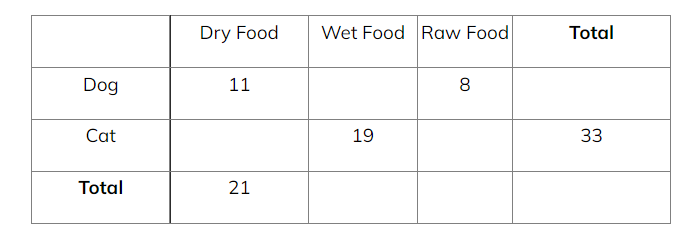
Find the probability
Exam Tip
- Ensure any table – given or drawn - has a “Total” row and a “Total” column
- Do not confuse a two-way table with a?sample?space?diagram – a two-way table does not necessarily display?all?outcomes?from an?experiment, just those (events) we are interested in
轉載自savemyexams
以上就是關于【Edexcel A Level Maths: Statistics:復習筆記3.2.1 Set Notation & Conditional Probability】的解答,如需了解學校/賽事/課程動態,可至翰林教育官網獲取更多信息。
往期文章閱讀推薦:
MIT官方發布【2026年夏季推薦閱讀書單】!橫跨科學/人文/經濟...


翰林AMC8視頻課重磅上線!

國際競賽真題資源免費領取






