OCR A Level Biology:復(fù)習(xí)筆記2.2.8 Lipids: Structure & Function

Lipids: Structure & Function
Triglycerides
- Triglycerides are?fats and oils
- Fatty acid and glycerol molecules?are the components that make up triglycerides
- Fats and oils have a number of important functions in organisms: energy storage, insulation, buoyancy, and protection
Energy storage
- The?long hydrocarbon chains?in triglycerides contain many carbon-hydrogen bonds with little oxygen (triglycerides are highly reduced)
- So when triglycerides are?oxidised?during cellular respiration this causes these bonds to break?releasing energy?used to produce ATP
- Triglycerides, therefore, store?more energy per gram?than carbohydrates and proteins (37kJ compared to 17kJ)
- As triglycerides are?hydrophobic?they do not cause?osmotic water uptake?in cells so more can be stored
- Plants store triglycerides, in the form of oils, in their seeds and fruits. If extracted from seeds and fruits these are generally liquid at room temperature due to the presence of double bonds which add kinks to the fatty acid chains altering their properties
- Mammals store triglycerides as oil droplets in adipose tissue to help them survive when food is scarce (e.g. hibernating bears)
- The oxidation of the carbon-hydrogen bonds releases large numbers of water molecules (metabolic water) during cellular respiration
- Desert animals retain this water if there is no liquid water to drink
- Bird and reptile embryos in their shells also use this water
Insulation
- Triglycerides are part of the composition of the?myelin sheath?that surrounds nerve fibres
- The myelin sheath provides insulation which increases the?speed of transmission?of nerve impulses
- Triglycerides compose part of the adipose tissue layer below the skin which acts as insulation?against heat loss?(eg. blubber of whales)
Buoyancy
- The?low density?of fat tissue increases the ability of animals to float more easily
Protection
- The adipose tissue in mammals contains stored triglycerides and this tissue helps protect organs from the risk of damage
Phospholipids
- Phospholipids are a type of lipid, therefore they are formed from the monomer glycerol and fatty acids
- Unlike triglycerides, there are only?two fatty acids?bonded to a glycerol molecule in a phospholipid as one has been replaced by a?phosphate ion (PO43-)
- As the phosphate is?polar?it is soluble in water (hydrophilic)
- The fatty acid ‘tails’ are?non-polar?and therefore insoluble in water (hydrophobic)
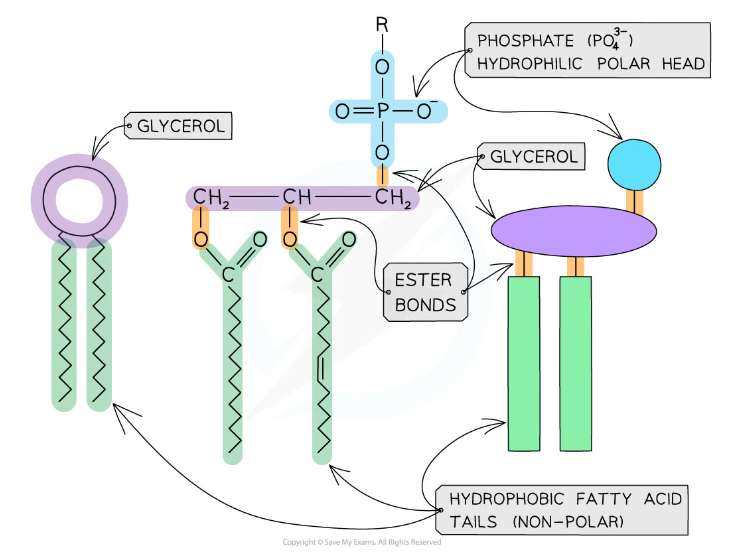
Phospholipids are the major components of cell surface membranes. They have fatty acid tails that are hydrophobic and a phosphate head, that is hydrophilic, attached to a glycerol molecule.
- Phospholipids are?amphipathic?(they have both hydrophobic and hydrophilic parts)
- As a result of having hydrophobic and hydrophilic parts phospholipid molecules form monolayers or bilayers in water
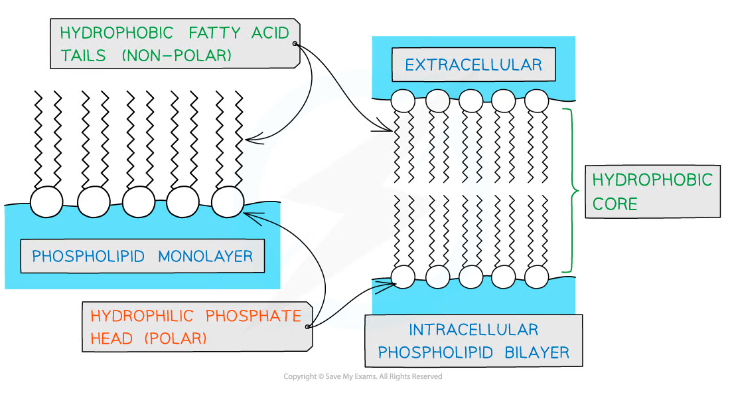
In the presence of water due to the hydrophobic and hydrophilic parts phospholipids will form monolayers or bilayers
- Phospholipids are the main component (building block) of cell membranes
- Due to the presence of hydrophobic fatty acid tails, a?hydrophobic core?is created when a phospholipid bilayer forms
- The core acts as a?barrier?to water-soluble molecules
- The?hydrophilic?phosphate heads form H-bonds with water allowing the cell membrane to be used to compartmentalise
- Compartmentalisation enables cells to organise specific roles into organelles, helping with efficiency
- The composition of phospholipids contributes to the?fluidity?of the cell membrane
- If there are mainly?saturated?fatty acid tails then the membrane will be?less fluid
- If there are mainly?unsaturated?fatty acid tails then the membrane will be?more fluid
- Phospholipids control membrane?protein orientation
- Weak hydrophobic interactions between the phospholipids and membrane proteins hold the proteins within the membrane but still allow movement within the layer
Cholesterol
- Another important lipid molecule found in the?cell membrane of eukaryotic cells?is cholesterol
- Just like phospholipid molecules, cholesterol molecules have?hydrophobic and hydrophilic regions
- Their chemical structure allows them to exist in the bilayer of the membrane
- Molecules of cholesterol are synthesised in the liver and transported via the blood
- Cholesterol?affects the fluidity and permeability?of the cell membrane
- It?disrupts the close-packing?of phospholipids, increasing the flexibility of the membrane
- It acts as a?barrier, fitting in the spaces between phospholipids. This prevents water-soluble substances from diffusing across the membrane
- Molecules of cholesterol are used to?produce steroid-based hormones?such as oestrogen, testosterone and progesterone
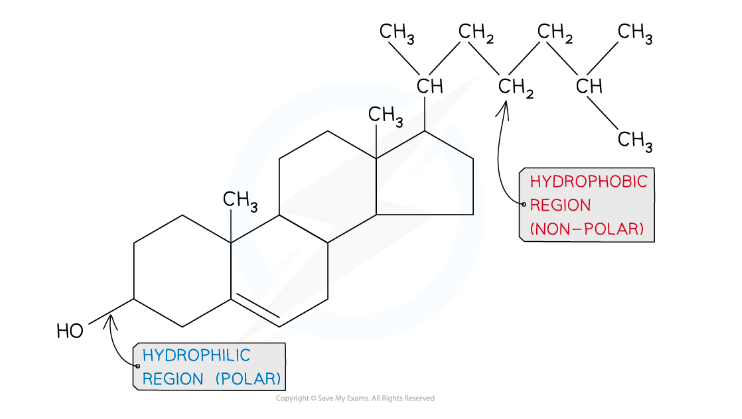
The structure of a cholesterol molecule possesses both a hydrophobic region and a hydrophilic region
Exam Tip
It is common to be asked why triglycerides are energy reserves (they store more energy per gram due to their hydrocarbon chains).
轉(zhuǎn)載自savemyexams
以上就是關(guān)于【OCR A Level Biology:復(fù)習(xí)筆記2.2.8 Lipids: Structure & Function】的解答,如需了解學(xué)校/賽事/課程動態(tài),可至翰林教育官網(wǎng)獲取更多信息。
往期文章閱讀推薦:
斯坦福大學(xué)官方推薦書單!名校學(xué)霸們暑假都在讀什么?
MIT官方發(fā)布【2026年夏季推薦閱讀書單】!橫跨科學(xué)/人文/經(jīng)濟(jì)...


翰林AMC8視頻課重磅上線!

國際競賽真題資源免費領(lǐng)取






