OCR A Level Biology:復習筆記2.6.5 The Stages of Meiosis

Stages of Meiosis
- Meiosis is a form of?nuclear division?that results in the?production of?haploid?cells?from diploid cells
- It produces?gametes?in plants and animals that are used in?sexual reproduction
- It has many similarities to mitosis however it has?two divisions: meiosis I and meiosis II
- Within each division there are the following stages: prophase, metaphase, anaphase and telophase
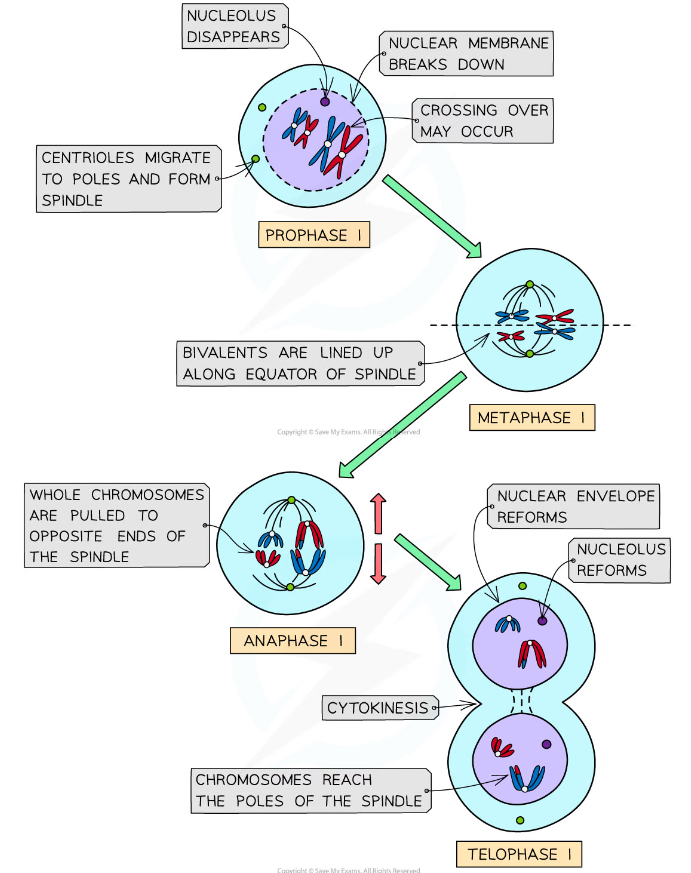
Prophase I
- DNA condenses?and becomes visible as chromosomes
- DNA replication has already occurred so each chromosome consists of?two sister?chromatids?joined together by a centromere
- The chromosomes are arranged side by side in?homologous pairs
- A pair of homologous chromosomes is called a bivalent
- As the homologous chromosomes are very close together the?crossing over?of non-sister chromatids may occur. The point at which the crossing over occurs is called the?chiasma?(chiasmata; plural)
- In this stage centrioles migrate to opposite poles and the?spindle is formed
- The?nuclear envelope breaks down?and the nucleolus disintegrates
Metaphase I
- The?bivalents line up along the equator of the spindle, with the spindle fibres attached to the centromeres
- The maternal and paternal chromosomes in each pair position themselves independently of the others; this is?independent assortment
- This means that the proportion of paternal or maternal chromosomes that end up on each side of the equator is due to chance
Anaphase I
- The homologous pairs of chromosomes are separated as?microtubules pull whole chromosomes to opposite ends?of the spindle
- The centromeres do not divide
Telophase I
- The chromosomes arrive at opposite poles
- Spindle fibres start to break down
- Nuclear envelopes form around the two groups of chromosomes?and nucleoli reform
- Some plant cells go straight into meiosis II without reformation of the nucleus in telophase I
Cytokinesis
- This is when the?division of the cytoplasm?occurs
- Cell organelles also get distributed between the two developing cells
- In animal cells: the?cell surface membrane?pinches inwards creating a?cleavage furrow?in the middle of the cell which contracts, dividing the cytoplasm in half
- In plant cells, vesicles from the Golgi apparatus gather along the equator of the spindle (the cell plate). The?vesicles?merge with each other to form the?new cell surface membrane?and also secrete a layer of calcium pectate which becomes the?middle lamella.?Layers of cellulose are laid upon the middle lamella to form the primary and secondary walls of the cell
- The end product of cytokinesis in meiosis I is?two haploid cells
Second division of Meiosis : Meiosis II
- There is no interphase between meiosis I and meiosis II so the DNA is not replicated
- The second division of meiosis is almost identical to the stages of mitosis
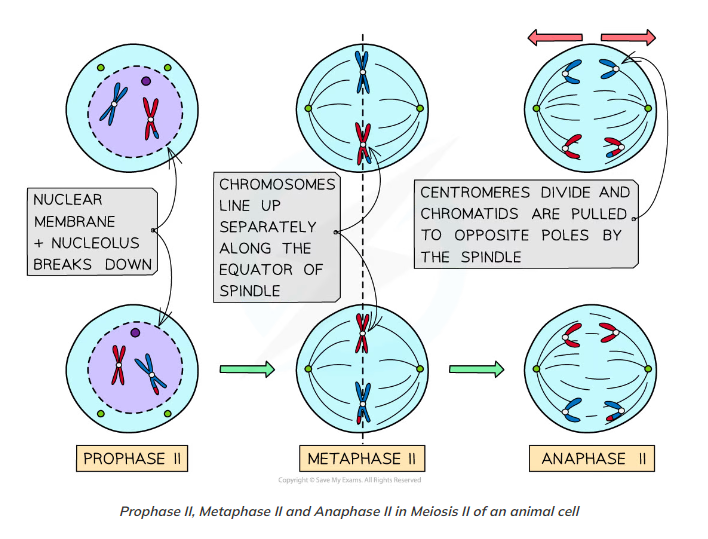
- Prophase II
- The?nuclear envelope breaks down?and?chromosomes condense
- A?spindle forms at a right angle to the old one
- Metaphase II
- Chromosomes?line up in a?single file along the equator?of the spindle
- Anaphase II
- Centromeres divide and individual?chromatids are pulled to opposite poles
- This creates?four groups of chromosomes?that have half the number of chromosomes compared to the original parent cell
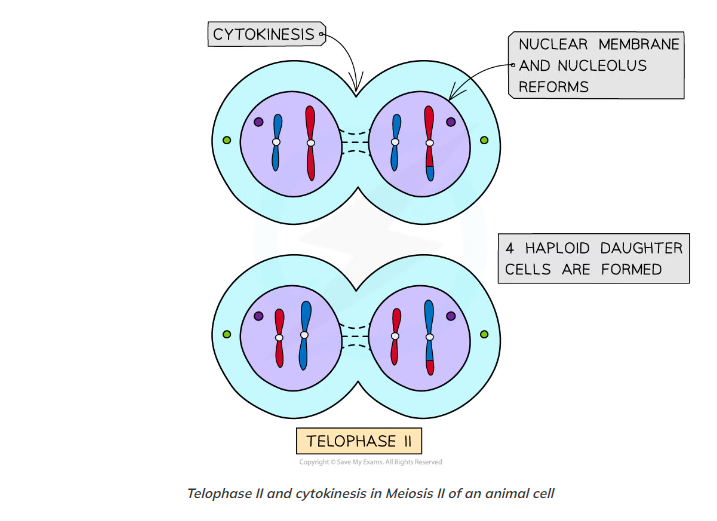
- Telophase II
- Nuclear membranes form?around each group of chromosomes
- Cytokinesis
- Cytoplasm divides?as new cell surface membranes are formed?creating four haploid cells
Exam Tip
Understanding the difference between chromosomes and chromatids can be difficult. We count chromosomes by the?number of centromeres present. So when the 46 chromosomes duplicate during interphase and the?amount of DNA in the cell doubles?there are still only 46 chromosomes present because there are still only 46 centromeres present. However, there are now 92 chromatids, which are strands of replicated chromosomes.
轉載自savemyexams
以上就是關于【OCR A Level Biology:復習筆記2.6.5 The Stages of Meiosis】的解答,如需了解學校/賽事/課程動態,可至翰林教育官網獲取更多信息。
往期文章閱讀推薦:
MIT官方發布【2026年夏季推薦閱讀書單】!橫跨科學/人文/經濟...


翰林AMC8視頻課重磅上線!

國際競賽真題資源免費領取






