AQA A Level Biology復習筆記5.4.4 Fertilisers

The Use of Natural & Artificial Fertilisers
- When organisms in natural ecosystems?die?or produce?waste, the waste and dead matter?decompose
- This decomposition is carried out by?saprobionts
- This ensures that valuable?nutrients?in the waste and dead matter are continually?recycled?back into these natural ecosystems
- For example, some bacteria in the soil convert the nitrogen in organic substances (such as the proteins and nucleic acids in dead organisms) into nitrate, which can then be taken up and used by producers
Agricultural Ecosystems
- In agricultural ecosystems, crops and livestock take in nutrients (e.g.?inorganic 'mineral' ions) from the soil (or from the grass that grows in the soil) as they?grow?and use these nutrients to generate?biomass
- However, agricultural ecosystems are not like natural ecosystems because the crops or livestock are eventually?removed?from the fields instead of?dying?and?decomposing?there naturally
- As a result, the mineral ions (e.g. nitrates and phosphates) now contained in the biomass of these crops or livestock are?not returned?to the soil by microorganisms
- This?interrupts?the crucial processes of nutrient recycling (e.g. the nitrogen and phosphorus cycles)
- If the interruption of these nutrient cycles occurs over a long enough time period, the?concentration of nutrients?in the soil will?decrease, eventually leading to a?decrease?in crop?yields?or meat and milk yields from livestock
- Adding?fertilisers?to fields is a way of?replacing?the minerals lost from agricultural ecosystems
- This ensures crops and livestock can continue to grow and increase in biomass as normal, ensuring yields remain?high
Fertilisers
- Fertilisers can be used to add important?mineral ions, such as ions of?nitrogen,?phosphorus?and?potassium,?back into the soil
- There are two types of fertilisers:
- Natural fertilisers
- Artificial fertilisers
Natural fertilisers
- Natural fertilisers are made up of?organic matter?in the form of the dead and decomposing?remains?of organisms and their?waste products
- This includes manure, composted vegetables, crops residues (crop parts left over after harvesting) and sewage
- They can also improve soil structure, which helps in reducing soil erosion and increase the water-holding ability of the soil
- Nutrients from natural fertilisers are released over?long time periods
- The nutrients present are?not very concentrated?so relatively?large amounts?are needed
Artificial fertilisers
- Artificial fertilisers are made up of?inorganic matter?in the form of?powders?or?pellets?that contain?pure chemical compounds?(e.g. ammonium nitrate)
- As the exact chemical composition is known, it is easier to?how much to apply?and the?effects?they will have on crop?yields
- The nutrients present are?concentrated?so?smaller amounts?are needed
- This means transport costs are lower
- These fertilisers are easy to apply?evenly?and are?clean, making them easy to handle
Environmental Issues Caused by Fertilisers
- As fertilisers are very effective in ensuring high crop yields, they are often applied to fields by farmers in?greater quantities?than are actually?needed?by the crop plants
- As the crop plants are?unable?to use all the fertiliser provided, the soluble?nitrate?and?phosphate ions?in the excess fertiliser are not taken up by the crop plants and?remain in the soil water
- These mineral ions can then be transported by?rainwater?or the water from?irrigation systems?into nearby bodies of water (such as?ponds?and?lakes) or waterways (such as?streams?and?rivers)
- This process is known as?leaching
- Leaching is more likely to occur if fertilisers are applied?just before heavy rainfall
- In?artificial?fertilisers, the inorganic ions are?readily soluble?and if they are not used immediately by crop plants, they can?quickly leach?into waterways
- In?natural?fertilisers, the minerals (e.g. nitrogen and phosphorus) are contained within organic matter that must first be decomposed by microorganisms before the mineral ions can be absorbed by crop plants
- This means the release of the mineral ions into the soil is?slower?and more?controlled, making leaching?less likely
- In general, phosphate leaching occurs to a?lesser extent?than nitrate leaching, as phosphates are?less soluble?in water
- Leaching can lead to a potentially damaging process known as?eutrophication
Eutrophication
- When the?mineral ions?from excess fertiliser leach from farmland into waterways, they cause?rapid growth?of?algae?at the surface of the water
- This is known as an?algal bloom
- This?blocks sunlight?so aquatic plants below the surface of the water start to?die?as they can no longer?photosynthesise
- The algae also start to?die?when competition for nutrients becomes too intense
- As aquatic plants and algae die in increasing numbers,?decomposing bacteria?feed on the dead organic matter and also?increase in number
- As they respire?aerobically, these bacteria use up the?dissolved oxygen?in the water
- As a result, the amount of dissolved oxygen in the water rapidly?decreases, so aquatic organisms such as?fish?and?insects?may be?unable to survive
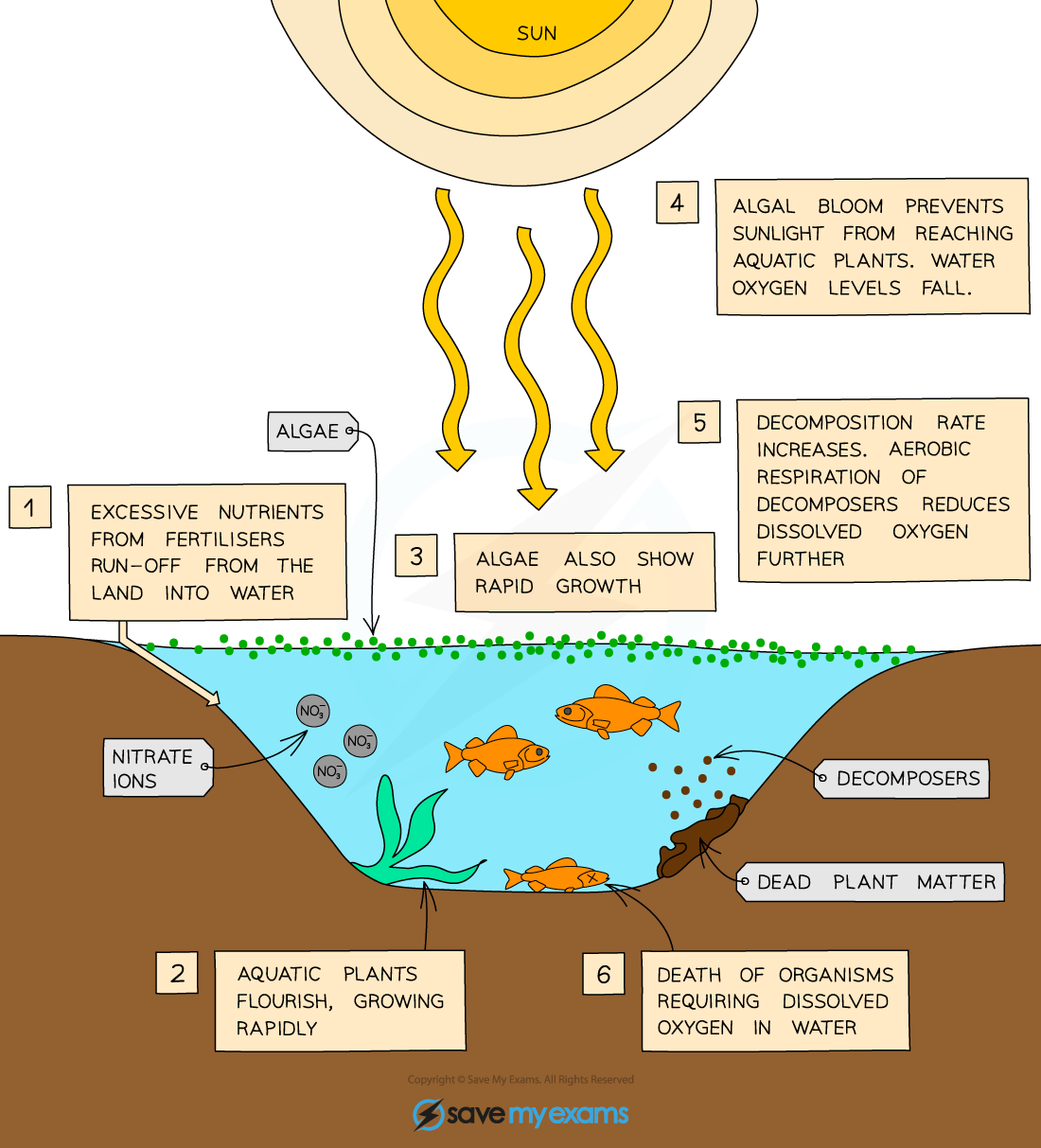
The sequence of events leading to eutrophication of water bodies and waterways
Exam Tip
Make sure you know the differences between natural and artificial fertilisers in terms of the forms they take, their relative costs, the likelihood of leaching and how they are applied.In addition, make sure you learn the difference between leaching and eutrophication. Leaching itself is not a damaging process but the knock-on effects of this (i.e. eutrophication) can be very damaging to aquatic ecosystems, which often contain organisms that are very sensitive to dissolved oxygen levels, such as fish and aquatic insects and their larvae.
轉載自savemyexams
以上就是關于【AQA A Level Biology復習筆記5.4.4 Fertilisers】的解答,如需了解學校/賽事/課程動態,可至翰林教育官網獲取更多信息。
往期文章閱讀推薦:
生物競賽金牌教練的實戰書單!生物學/生物化學/病理學...電子版免費領!
哈佛商學院2026暑期書單曝光!十余位教授私藏書單,本本是“商科天花板”


翰林AMC8視頻課重磅上線!

國際競賽真題資源免費領取






