IB DP Physics: HL復(fù)習(xí)筆記4.1.3 SHM Graphs

SHM Graphs
Displacement & Velocity
- The?displacement-time graph?for an object moving with?SHM?is a?sinusoidal curve?if:
- The object starts to oscillate from the equilibrium position.
- The equilibrium position is??x = 0?at?t = 0
- The?displacement-time graph?is a?cosine?curve if
- The object starts to oscillate from the position of maximum displacement.
- Maximum displacement is?x = x0?at?t = 0
- The maxima and minima on the graph are the values of?maximum displacement?(x0) of the oscillating object on either side of the equilibrium position
- The?velocity-time graph?is obtained by taking the?gradients?of tangents to all points on the?displacement-time?graph
- The?velocity-time graph?is a?cosine?curve if:
- The object starts to oscillate from the equilibrium position when?x = 0?at?t = 0?
- The displacement-time graph is a sine curve
- The?velocity-time graph?is a?sine?curve if:
- The object starts to oscillate from the position of maximum displacement when?x = x0?at?t = 0?
- The velocity-time graph is a cosine curve
- The maxima and minima on the graph are the values of?maximum velocity?(v0) of the oscillating object as it passes the equilibrium position
- The difference in the sign of the velocity accounts for the different directions of the velocity vector as the object passes through the equilibrium position (i.e. from right to left or vice versa)
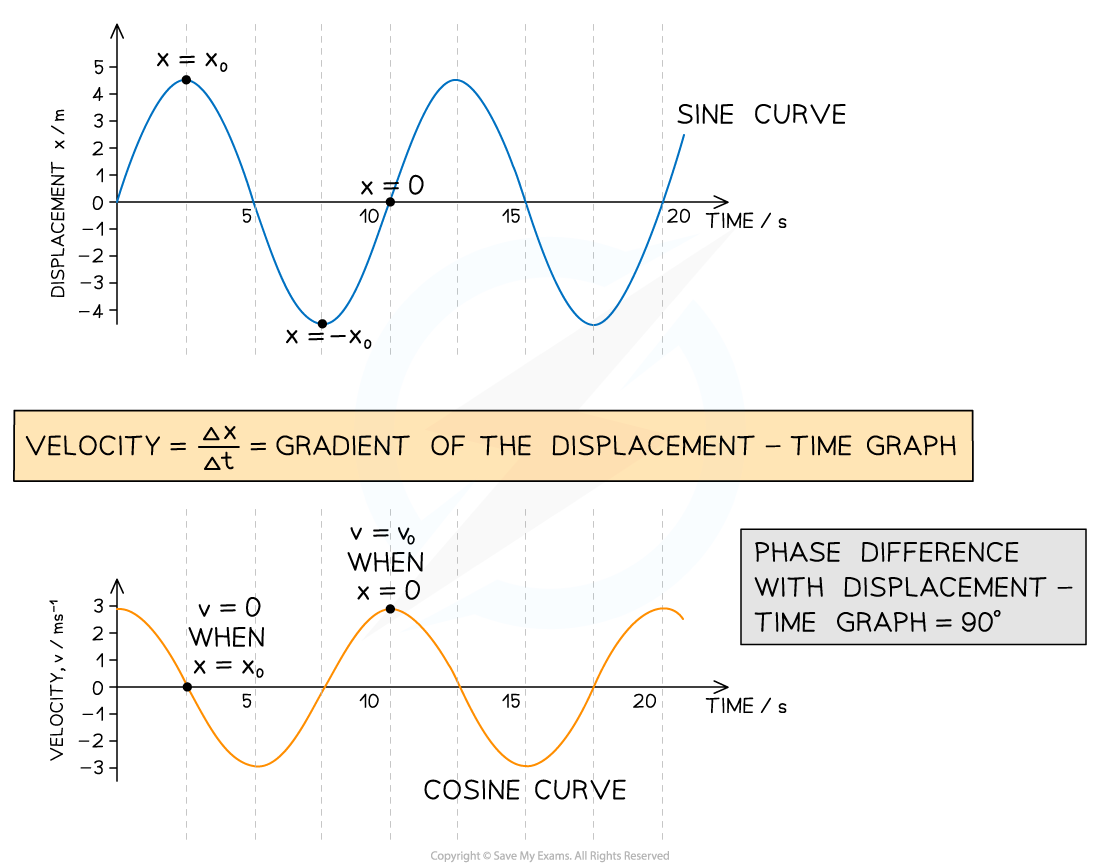
Displacement-time & velocity-time graphs for an object oscillating with SHM. The object starts oscillating from the equilibrium position (x = 0 and t = 0)
Acceleration
- The?acceleration-time graph?is obtained by taking the?gradients?of tangents to all points on the?velocity-time?graph
- The graph is a?negative sine?curve if:
- The object starts to oscillate from the equilibrium position when?x = 0?at?t = 0
- The graph is a?negative cosine?curve if:
- The object starts to oscillate from the position of maximum displacement when?x = x0?at?t = 0
- The maxima and minima on the graph are the values of?maximum acceleration?(a0) of the oscillating object at the positions of maximum displacement (x = x0)
- Once again, the difference in sign indicates a difference in the direction of the acceleration vector
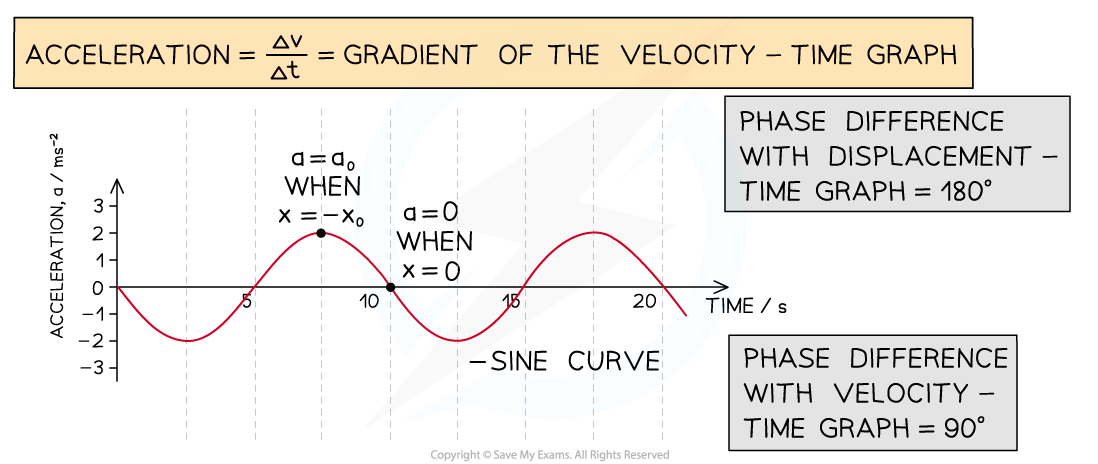
An acceleration-time graph for an object oscillating with SHM. The object starts oscillating from the equilibrium position (x = 0 and t = 0)
- Note that all graphs must have the?same?period
- The only two?differences between the graphs?are:
- The shift in time - i.e. there is a?phase difference?of 90° between successive graphs
- The amplitude of the wave form - i.e. the different amplitudes of the three graphs are the values of maximum displacement?x0, maximum velocity?v0?and maximum acceleration?a0?of the oscillating object
Worked Example
Below is the displacement-time graph for an object oscillating with SHM.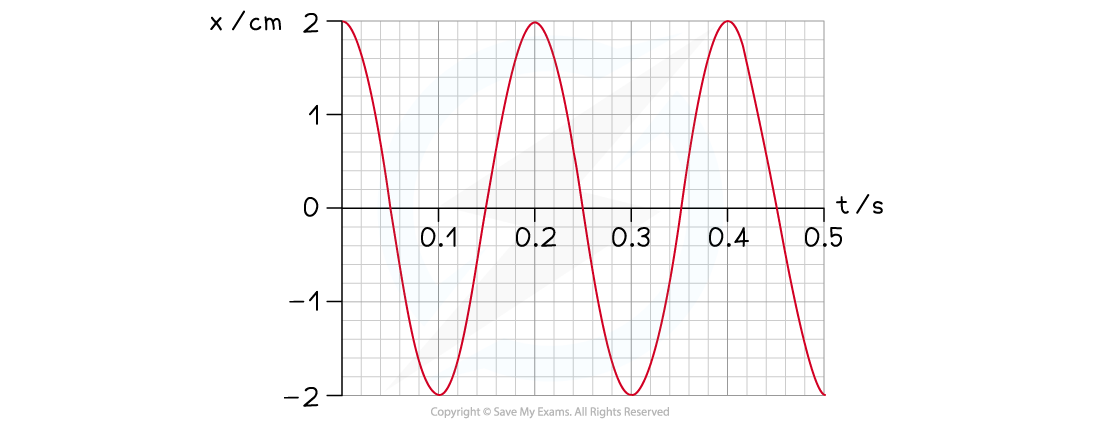 (i) Determine the period of the oscillations
(ii) Calculate the frequency of the oscillations
(iii) Mark a point on the graph where the velocity is zero, label this with "v?= 0"
(iv) Mark a point on the graph where the velocity is maximum and positive, label this with "v0"
(v) Mark a point on the graph where the acceleration is maximum and positive, label this with "a0"
(vi) Determine the value of the maximum velocity?v0
(i) Identify the period?T?of the oscillating object on the graph?
-
- Mark the time between any two identical points on the graph (e.g. two peaks)
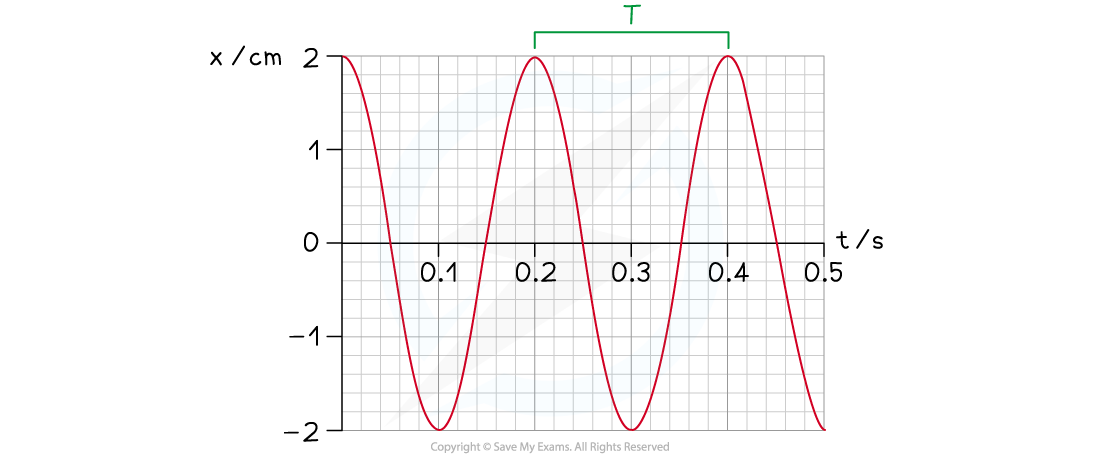
T?= 0.20 s
(ii) Calculate the frequency?f
Step 1: Write down the relationship between frequency and period

Step 2: Substitute the value of the period you have determined in part (i)

f?= 5 Hz
(iii) Identify any position of zero velocity on the displacement-time graph and label this "v?= 0"
-
- The velocity of an object oscillating with SHM is zero at the positions of maximum displacement?x = x0
- Hence, the velocity is zero at any minima or maxima on the displacement-time graph (e.g. at?t = 0.10 s)
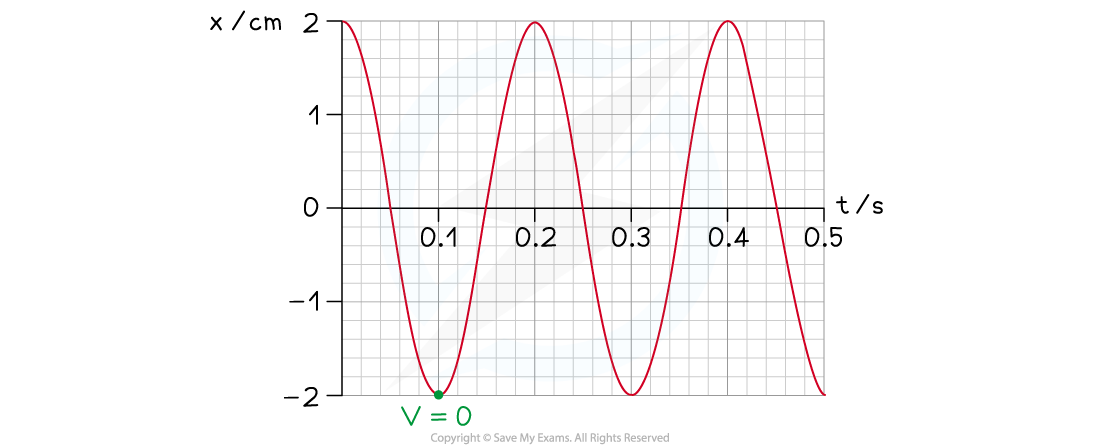 (iv) Identify any position of maximum positive velocity on the displacement-time graph and label this "v0"
-
- An object oscillating with SHM has its maximum velocity at the equilibrium position (x?= 0)
- Velocity is defined as the rate of change of displacement
- The velocity is the gradient of the tangent to a point of zero displacement
- The gradient must be positive (e.g. at?t = 0.15 s)
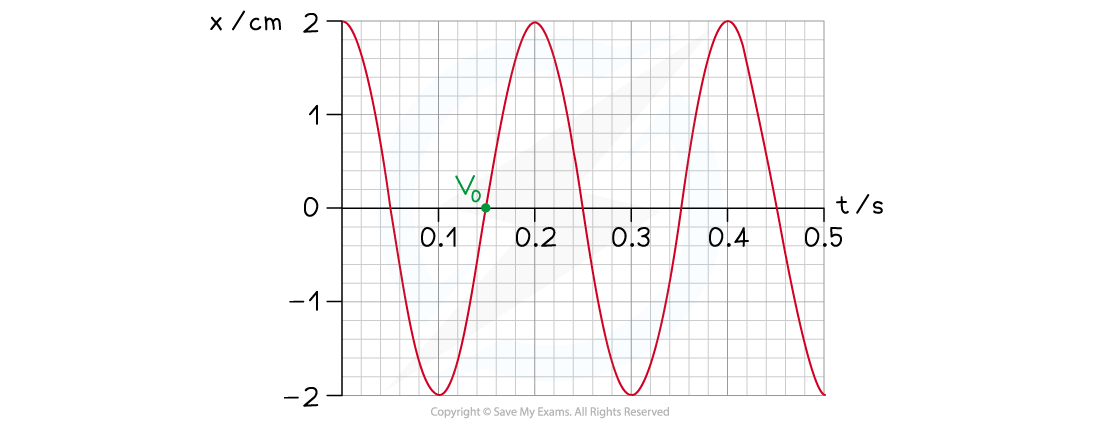
(v) Identify any position of maximum positive acceleration on the displacement-time graph and label this "a0"
-
- An object oscillating with SHM has its maximum acceleration at the positions of maximum displacement (x = x0)
- Acceleration is proportional to negative displacement
- The acceleration is maximum and positive when the displacement is maximum and negative
- The acceleration is maximum and positive at any minima on the displacement-time graph (e.g. at?t = 0.30 s)
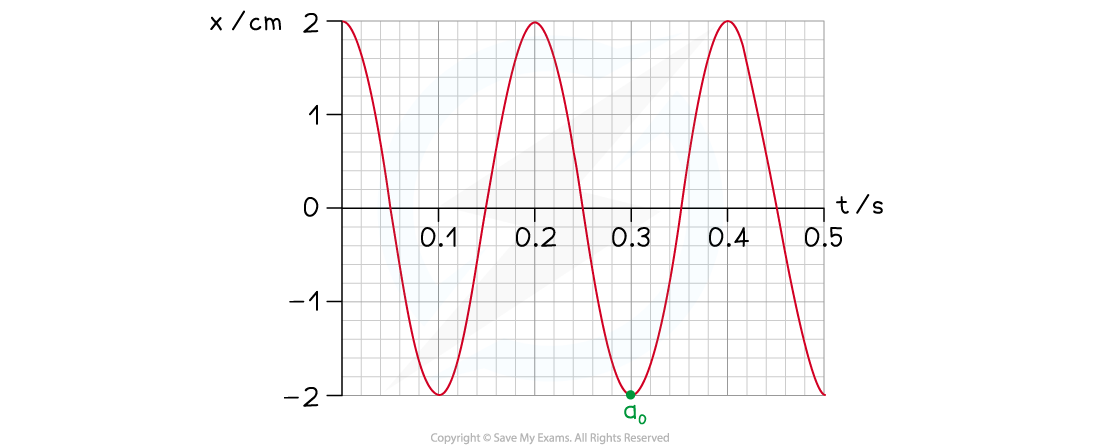 (vi)
(vi)
Step 1: Draw the tangent to the point of maximum positive velocity identified in Step 4 (i.e. at?t?= 0.15 s)?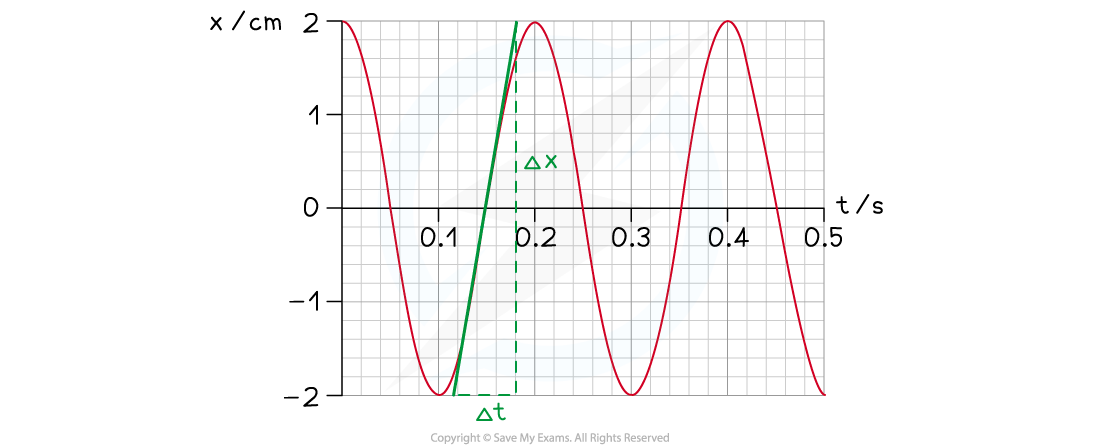
Step 2: Calculate the gradient of the tangent to get the value of the maximum velocity?v0?in centimetres per second (cm s–1)


Gradient = 67 cm s–1
v0?= 67 cm s–1
轉(zhuǎn)載自savemyexams
以上就是關(guān)于【IB DP Physics: HL復(fù)習(xí)筆記4.1.3 SHM Graphs】的解答,如需了解學(xué)校/賽事/課程動(dòng)態(tài),可至翰林教育官網(wǎng)獲取更多信息。
往期文章閱讀推薦:
生物競(jìng)賽金牌教練的實(shí)戰(zhàn)書單!生物學(xué)/生物化學(xué)/病理學(xué)...電子版免費(fèi)領(lǐng)!
哈佛商學(xué)院2026暑期書單曝光!十余位教授私藏書單,本本是“商科天花板”


翰林AMC8視頻課重磅上線!

國(guó)際競(jìng)賽真題資源免費(fèi)領(lǐng)取






