IB DP Biology: SL復(fù)習(xí)筆記2.1.2 Metabolism

Metabolism
- Metabolism?is a catch-all term used to describe?all the chemical reactions?that take place within cells and organisms
- Metabolism can be thought of as?the chemical reactions of life
- The molecules involved are?metabolites
- Many reactions of metabolism take place in?multiple stages
- Each stage is?catalysed?by a separate?enzyme
- A series of interlinked metabolic reactions is called a?metabolic pathway
- Metabolic reactions can be classified broadly as?anabolic?or?catabolic
Anabolism
- Anabolic reactions are involved with the building of large molecules from smaller ones
- Examples include;
- Photosynthesis, where CO2?and water are built up into complex sugars
- Protein synthesis, where amino acids are joined together in sequence
- The buildup of fat stores ahead of animal hibernation
- Anabolic reactions often include?condensation?reactions
- Anabolic reactions are?endergonic?(they require an input of energy to take place)
- Energy-storing products are the end result
Catabolism
- Catabolic reactions are involved with?breaking down large molecules?into smaller ones
- These reactions are often carried out to?release energy?for cellular processes and for the?excretion?of waste
- Examples include:
- Respiration, where CO2?and water are produced from the breakdown of sugars
- Deamination?of proteins to release urea
- The?depletion of fat stores?during animal hibernation
- Catabolic reactions often include?hydrolysis?reactions
- Catabolic reactions are?exergonic?(free energy is released for cellular processes or as excess heat)
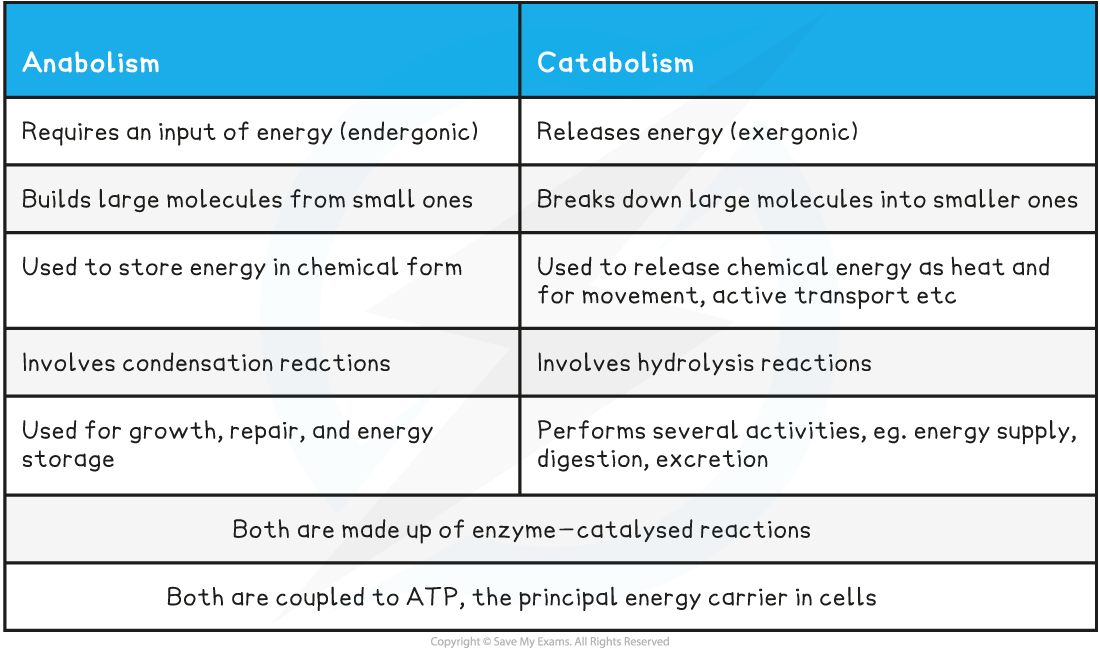
Comparison of Anabolism and Catabolism Table
Exam Tip
You may be familiar with the concept of anabolic steroid drugs used by bodybuilders. This is to build muscle mass and so is a good example to remember when trying to remember the difference between anabolic and catabolic reactions.
轉(zhuǎn)載自savemyexams
以上就是關(guān)于【IB DP Biology: SL復(fù)習(xí)筆記2.1.2 Metabolism】的解答,如需了解學(xué)校/賽事/課程動態(tài),可至翰林教育官網(wǎng)獲取更多信息。
往期文章閱讀推薦:
斯坦福大學(xué)官方推薦書單!名校學(xué)霸們暑假都在讀什么?
MIT官方發(fā)布【2026年夏季推薦閱讀書單】!橫跨科學(xué)/人文/經(jīng)濟(jì)...


翰林AMC8視頻課重磅上線!

國際競賽真題資源免費(fèi)領(lǐng)取






