IB DP Physics: SL復(fù)習(xí)筆記4.4.6 Interference & Path Difference

Double-Slit Interference
- Interference?occurs whenever two or more waves combine to produce a resultant wave with a new resultant?displacement
- The waves combine according to the?principle of superposition
- Constructive interference?happens when the resultant wave has a larger displacement than any of the individual displacements
- Destructive interference?happens when the positive displacement of one wave and the negative displacement of another wave exactly cancel out giving a resultant displacement of zero
Coherence
- Interference is only observable if produced by a?coherent?source
- Waves are said to be coherent if they have:
- A?constant?phase difference
- The?same?frequency
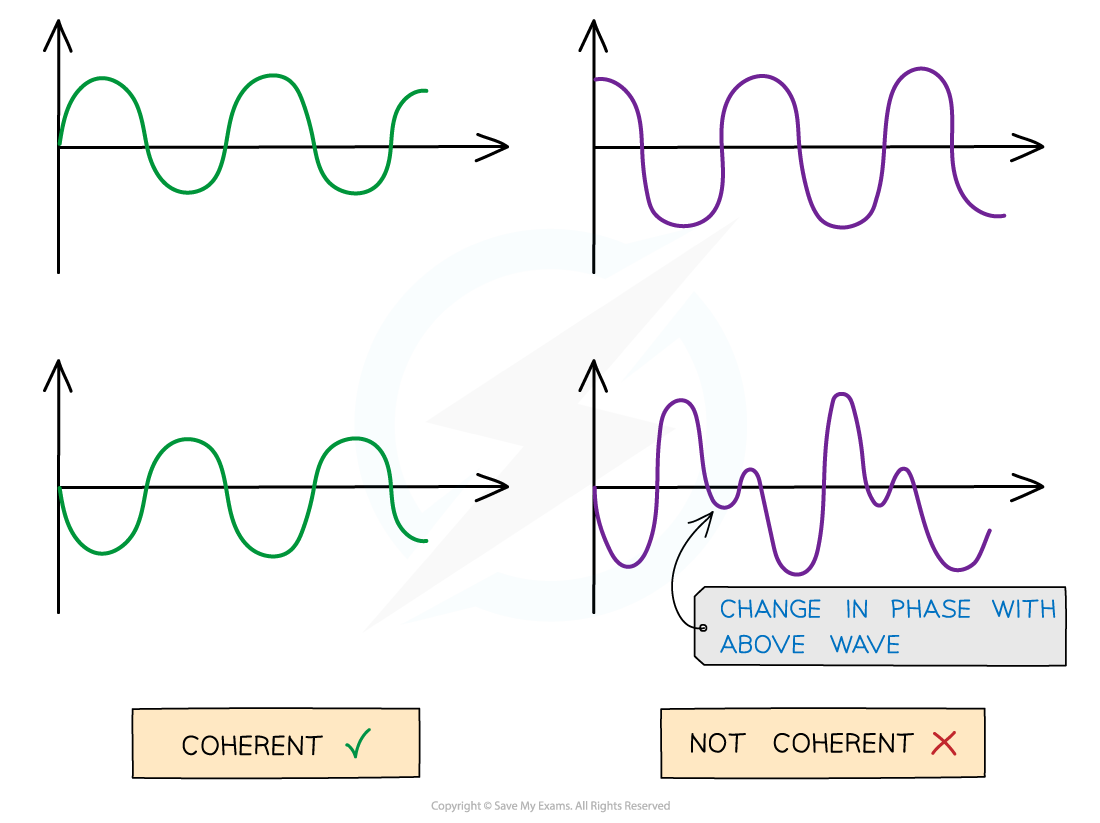
Coherent waves (on the left) and non-coherent waves (on the right). The abrupt change in phase creates an inconsistent phase difference
- A coherent beam of light contains light waves that are?monochromatic?and have a constant phase difference
- Monochromatic light consists of light waves of a?single frequency
- Laser light is an example of a coherent light source
- Filament lamps produce incoherent light waves
Double-Slit Interference of Light
- When a?coherent beam of light?is incident on two narrow slits very close together,?diffraction?occurs at each slit (i.e. the waves spread out)
- As the diffracted waves cross, they?interfere?with each other
- If a screen is placed some distance away from the slits, a pattern of equally spaced bright and dark?fringes?is observed on the screen
- The bright fringes form where the waves interfere constructively (i.e. a crest meets a crest or a trough meets a trough)
- The dark fringes form where the waves interfere destructively (i.e. a crest meets a trough)
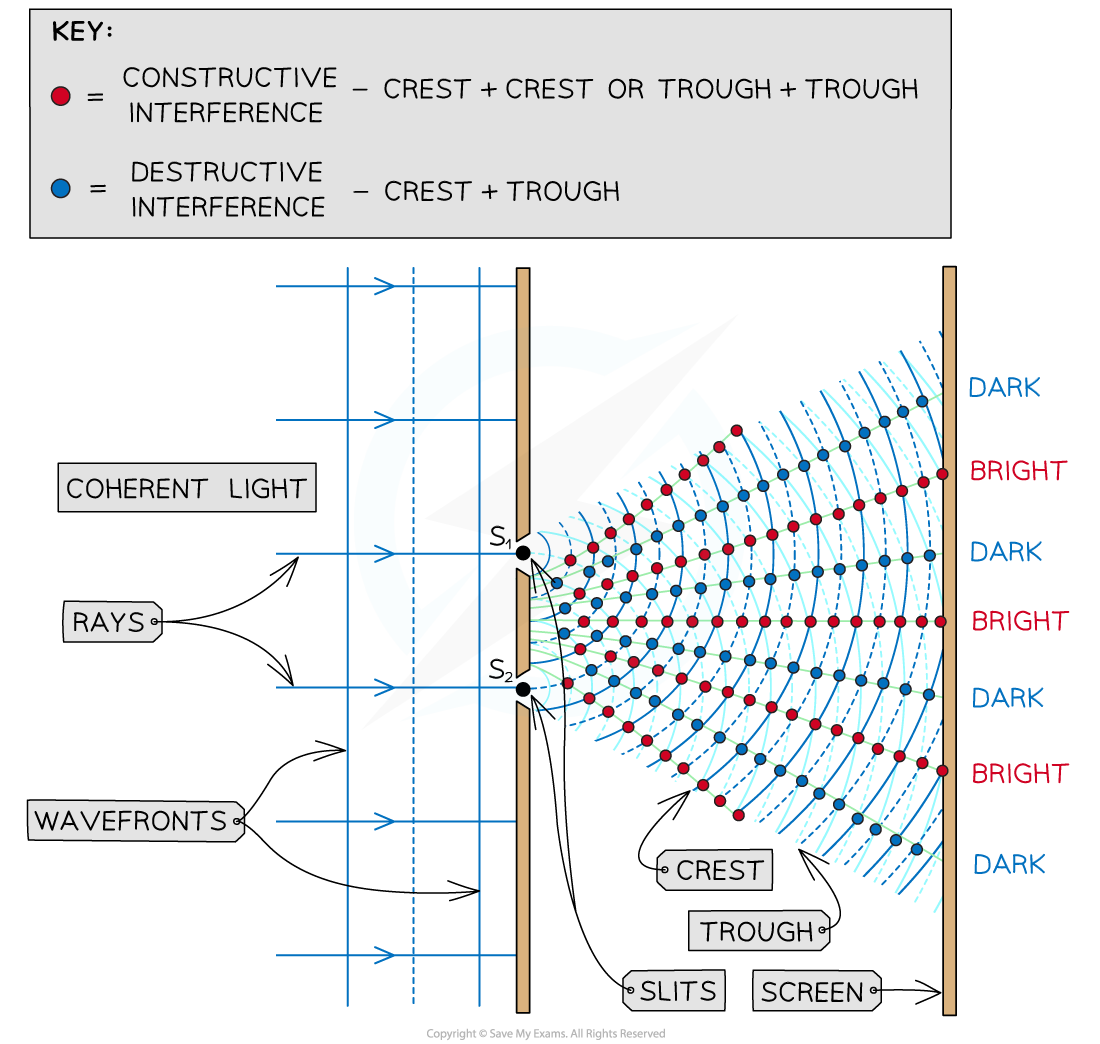
Coherent light waves interfere after passing through two narrow slits. Alternating bright and dark fringes are observed on the screen
Path Difference
- The type of interference occurring at a given point (i.e. constructive or destructive) depends on the?path difference?of the overlapping waves
- Path difference is defined as:
The difference in distance travelled by two waves from their sources to the point where they meet
- Path difference is generally expressed in multiples of?wavelength
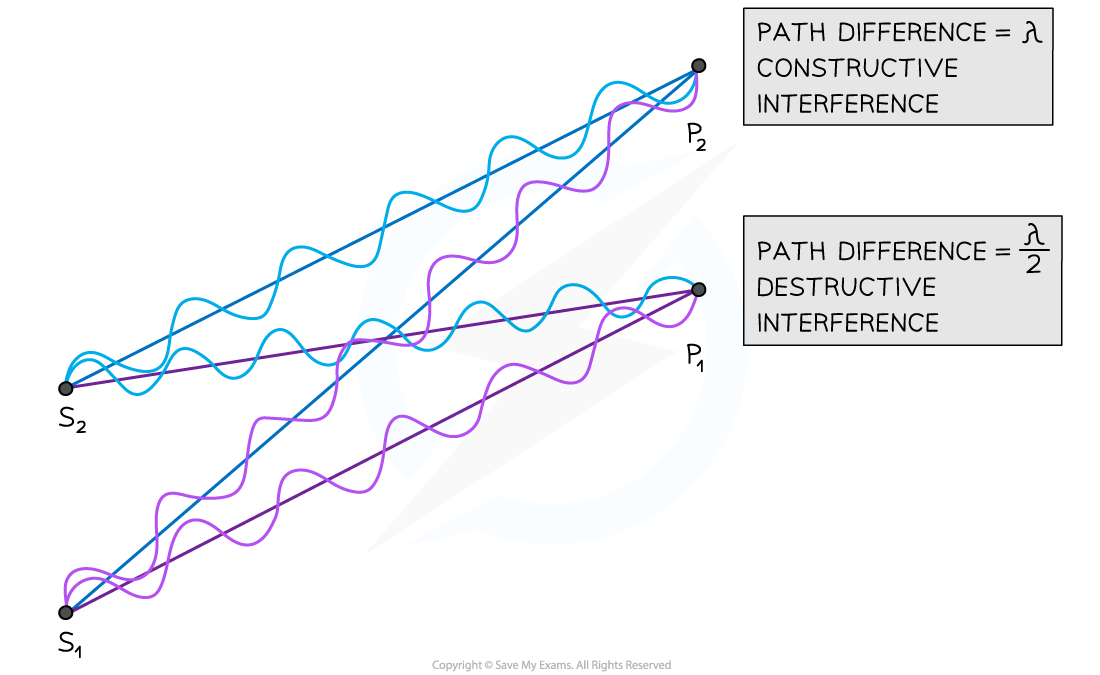
At point P2?the waves have a path difference of a whole number of wavelengths resulting in constructive interference. At point P1?the waves have a path difference of an odd number of half wavelengths resulting in destructive interference
- In the diagram above, the number of wavelengths between:
- S1?? P1?= 6λ
- S2?? P1?= 6.5λ
- S1?? P2?= 7λ
- S2?? P2?= 6λ
- The path difference is:
- (6.5λ – 6λ) =?λ / 2?at point P1
- (7λ – 6λ) =?λ?at point P2
- Hence:
- Destructive interference?occurs?at?point?P1
- Constructive interference?occurs?at?point?P2
Conditions for Constructive and Destructive Interference
- In general, for waves emitted by two coherent sources very close together:
- The condition for?constructive interference?is:
path difference = nλ
-
- The condition for?destructive interference?is:
path difference = (n + ?)λ
-
- Where:
- λ = wavelength of the waves in metres (m)
- n = 0, 1, 2, 3... (any other integer)
- Where:
- The same conditions apply to waves emitted by a single coherent source and diffracted by two narrow slits very close together
Path Difference and Wavefronts
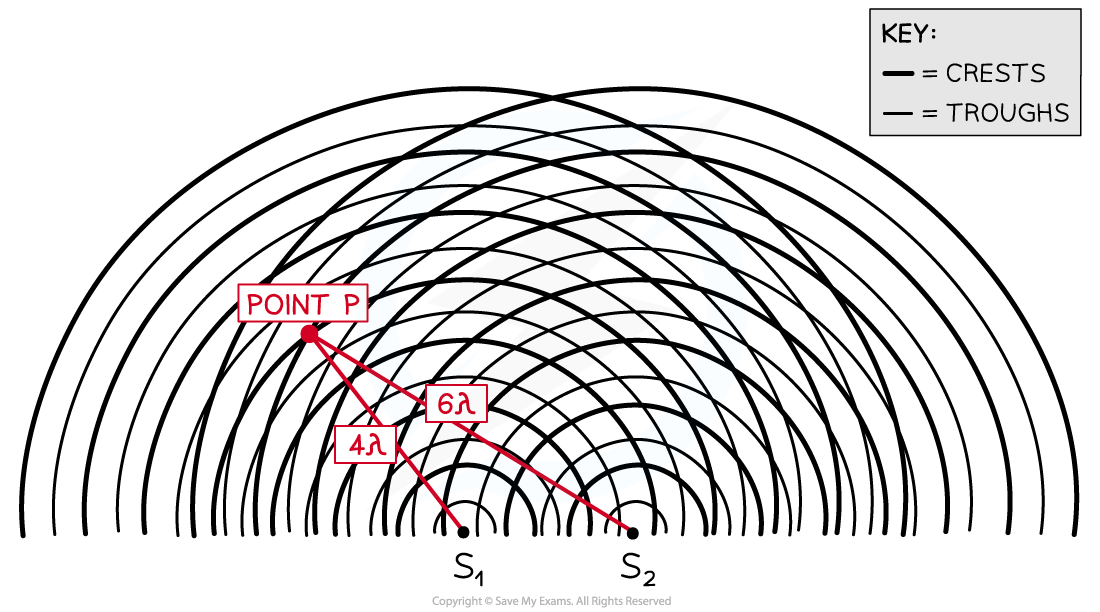
At point P?the waves have a path difference of a whole number of wavelengths resulting in constructive interference
- Another way to represent waves spreading out from two sources is shown in the diagram above
- At point?P, the number of?crests?from:
- Source S1?= 4λ
- Source S2?= 6λ
- The path difference at?P?is (6λ – 4λ) =?2λ
- This is a whole number of wavelengths (n?= 2), hence?constructive interference?occurs?at?point?P
Worked Example
The diagram below is a snapshot of overlapping wavefronts resulting from the interference of coherent waves diffracted by two narrow slits S1?and S2.
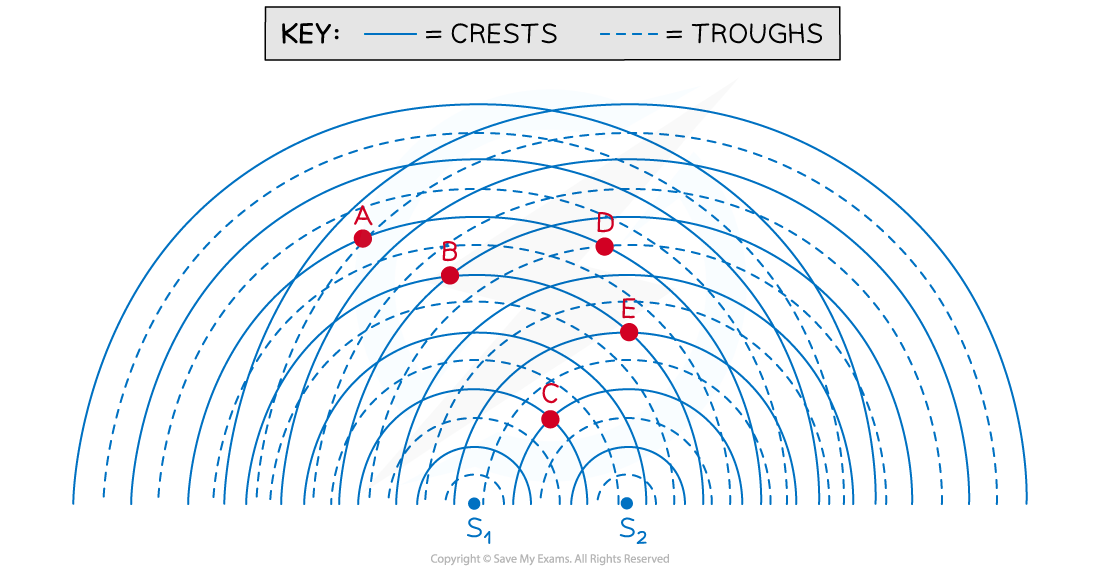
For each of the points shown, determine:
- The path difference from the sources
- The value of?n?in the path difference formula
- Whether they are locations of constructive or destructive interference
Step 1: Count the number of wavelengths between each source and the desired point
-
- E.g. Number of wavelengths between:
- S1?? A = 5λ
- S2?? A?= 6.5λ
- E.g. Number of wavelengths between:
Step 2: Determine the path difference by subtracting the distances of the point from the two sources
-
- E.g. Path difference at A = (6.5λ – 5λ) = 1.5λ
Step 3: Compare the path difference calculated in Step 2 with the condition for constructive or destructive interference and give the value of?n
-
- E.g. Path difference at A = 1.5λ =?(n + ?)λ ? n?= 1
Step 4: Decide whether the point is a location of constructive or destructive interference
-
- E.g. A is a location of destructive interference
- Point?A:
- Path difference = (6.5λ – 5λ) = 1.5λ
- n?= 1
- Destructive interference
- Point?B:
- Path difference = (5λ – 4λ) = λ
- n?= 1
- Constructive interference
- Point?C:
- Path difference = (2λ – 2λ) = 0
- n?= 0
- Constructive interference
- Point?D:
- Path difference = (5λ – 4.5λ) = 0.5λ
- n?= 0
- Destructive interference
- Point?E:
- Path difference = (4λ – 3λ) = λ
- n?= 1
- Constructive interference
Exam Tip
You are not required to memorise the conditions for constructive and destructive interference, as these are given in the data booklet.You must be able to determine the path difference of waves from two sources (or two narrow slits) at a given point. You can then compare this with the given conditions for constructive and destructive interference, in order to decide which type of interference occurs at the point you are considering.
轉(zhuǎn)載自savemyexams
以上就是關(guān)于【IB DP Physics: SL復(fù)習(xí)筆記4.4.6 Interference & Path Difference】的解答,如需了解學(xué)校/賽事/課程動態(tài),可至翰林教育官網(wǎng)獲取更多信息。
往期文章閱讀推薦:
斯坦福大學(xué)官方推薦書單!名校學(xué)霸們暑假都在讀什么?
MIT官方發(fā)布【2026年夏季推薦閱讀書單】!橫跨科學(xué)/人文/經(jīng)濟(jì)...


翰林AMC8視頻課重磅上線!

國際競賽真題資源免費(fèi)領(lǐng)取






