IB DP Physics: SL復習筆記4.4.7 Double-Slit Equation

Double-Slit Equation
Interference Patterns
- Interference patterns depend on:
- The?coherent?light incident on the slits
- The?distance between the slits and the screen?where the interference pattern is observed
- The?separation between the slits
- In particular:
- Successive bright fringes are further apart from each other if the wavelength?λ?of the incident light is longer
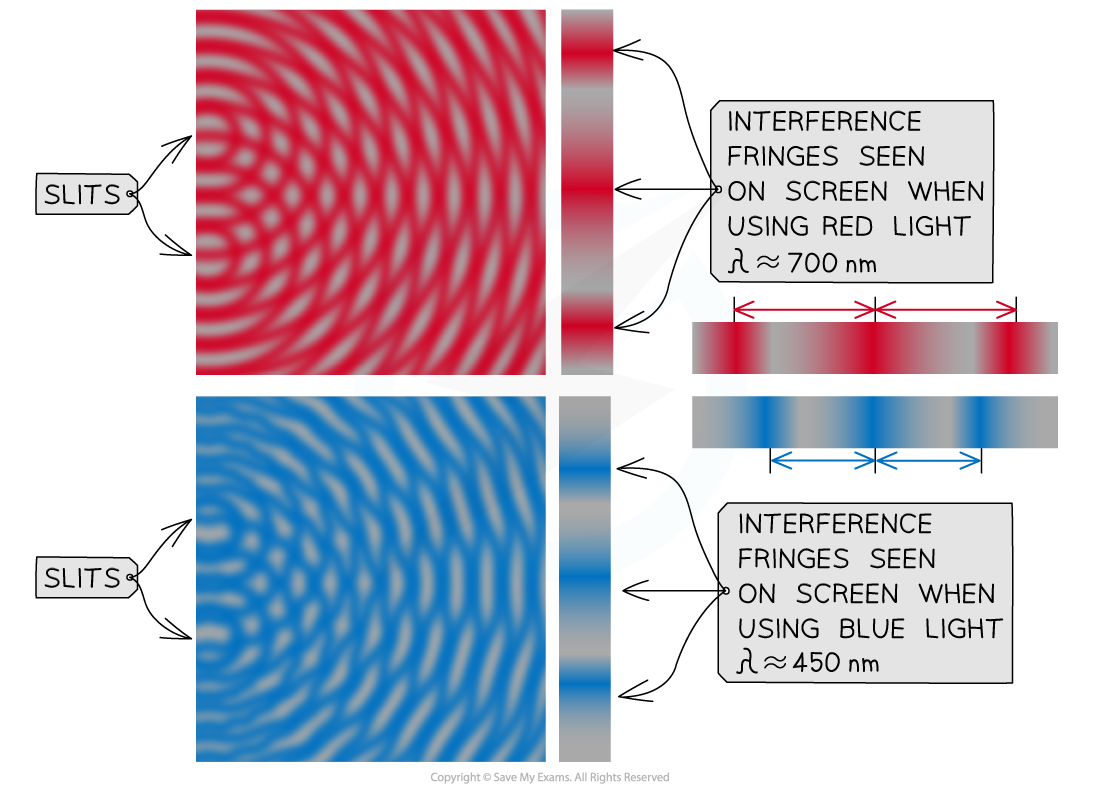
Difference in the interference pattern of red and blue light. Red light has a longer wavelength than blue light, so the fringes are more spaced out
-
- Similarly, bright fringes are more spaced out if the screen is placed further away from the slits
- If the separation between the slits is increased, instead successive bright fringes are closer to each other
Explaining the Interference Pattern
- Two slits are separated by a length?d, and a screen is placed a distance?D?away
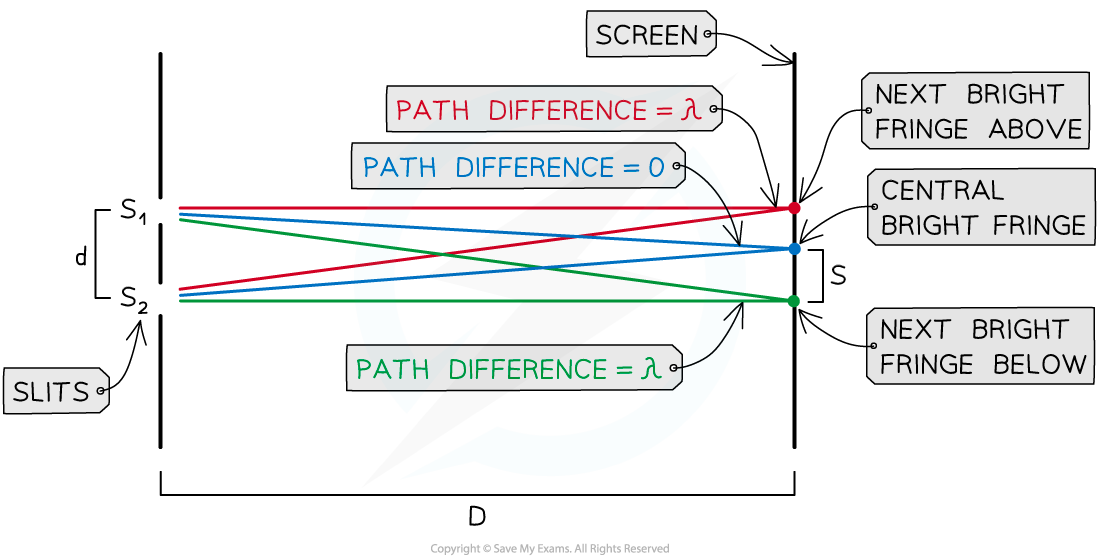
Light rays of wavelength λ incident on two slits a distance s apart interferes and form bright fringes on a screen placed a distance D away from the slits
- When light rays of wavelength?λ?are incident on the two slits:
- A?central bright fringe?where the two waves have travelled the?same?distance to the screen and their path difference is?zero
- Another?bright fringe?is formed either side of the central one where the path difference between the waves is??exactly one wavelength
- This is constructive interference
- Dark fringes?(an absence of light) are formed where the path difference between the waves is some number of wavelengths?plus half a wavelength
- This is destructive interference
- Further bright fringes will be located at each position on the screen where the path difference is exactly equal to?n?number of wavelengths?nλ
- For example: 2λ, 3λ, 4λ...
 Double-Slit Equation
- The separation?s of successive fringes is given by:

- Where:
- s?= separation between successive fringes on the screen (m)
- λ?= wavelength of the waves incident on the slits (m)
- D?= distance between the screen and the slits (m)
- d?= separation between the slits (m)
- Note that?s?is the separation between two successive bright fringes or two successive dark ones
- The above equation shows that the separation between the fringes will increase if:
- The wavelength of the incident light increases
- The distance between the screen and the slits increases
- The separation between the slits decreases
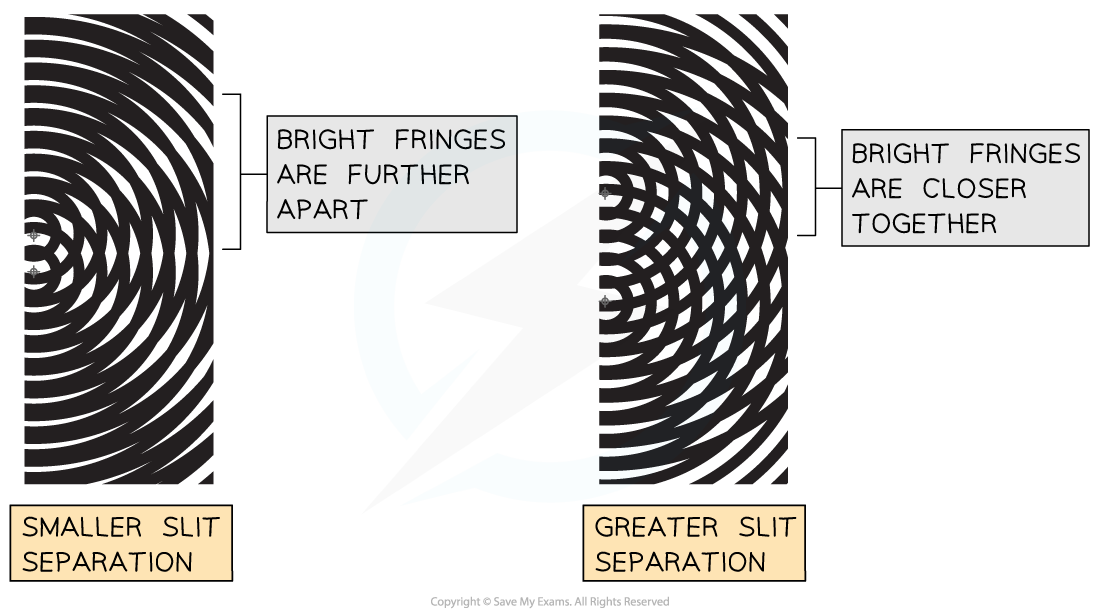
Dependence of the interference pattern on the separation between the slits. The further apart the slits, the closer together the bright fringes
Worked Example
In a double-slit experiment, two slits are placed a distance of 0.40 mm apart and a screen is located 0.50 m away from the slits.
Coherent electromagnetic waves incident on the slits produce an interference pattern on the screen. The separation between dark fringes is 0.50 cm.
Determine the wavelength and state the type of electromagnetic waves used in the experiment.
Step 1: Write down the known quantities
-
- d?= 0.40 mm = 4.0 x 10⁻⁴?m
- D?= 0.50 m
- s?= 0.50 cm = 5.0 x 10⁻³?m
Note that you must convert all lengths into metres (m)
Step 2: Write down the double-slit equation

Step 3: Rearrange the above equation to calculate the wavelength?λ

Step 4: Substitute the numbers into the above equation

λ = 4.0 × 10⁻⁶?m = 4.0 μm
This corresponds to the infrared area of the electromagnetic spectrum
Exam Tip
Remember that the separation between dark fringes is exactly the same as the separation between bright fringes. Whether a question gives you or asks about the separation between dark fringes instead of bright ones it makes no difference.
Some tricky questions might give you the separation between a bright and a dark fringe. This is equal to half the value of?s!
轉載自savemyexams
以上就是關于【IB DP Physics: SL復習筆記4.4.7 Double-Slit Equation】的解答,如需了解學校/賽事/課程動態,可至翰林教育官網獲取更多信息。
往期文章閱讀推薦:
MIT官方發布【2026年夏季推薦閱讀書單】!橫跨科學/人文/經濟...


翰林AMC8視頻課重磅上線!

國際競賽真題資源免費領取






